
What You Are Looking At Is Not Primitive. It Is A Civilisation.
What You Are Looking At Is Not Primitive. It Is A Civilisation.
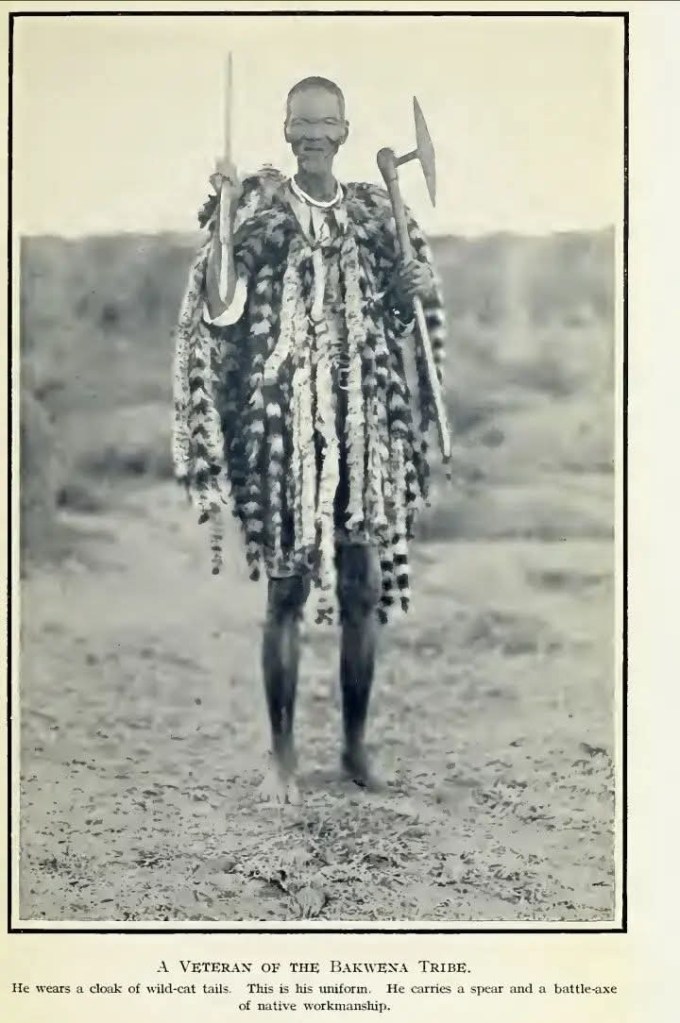
This photograph was taken in the late nineteenth century. The caption printed beneath it reads — in the measured condescension of the colonial era — “A Veteran of the Bakwena Tribe. He wears a cloak of wild-cat tails. This is his uniform. He carries a spear and a battle-axe of native workmanship.”
Read that caption again.
“Native workmanship.”
Two words that contain within them the entire intellectual project of colonialism — the systematic reduction of African material sophistication to the category of the primitive, the accidental, the unworthy of serious examination. The word “native” was not a neutral geographical descriptor in the vocabulary of the nineteenth century colonial enterprise. It was a classification. It placed the subject of the sentence below the threshold of civilisational recognition. It said, in effect — these things were made, but not by people who understood what they were making in any sense that deserves our respect.
This post exists to dismantle that caption word by word. Because every object visible in this photograph is not evidence of primitiveness. It is evidence of a civilisation.
Let us begin with the cloak.
The garment this veteran wears is constructed from the tails of wild-cat — a material that in the traditional Batswana cultural and military framework carried a specific and non-negotiable meaning. The historical record of Batswana pre-colonial material culture is unambiguous on this point: belts and garments made from animal tails were not available to all men. They were the exclusive preserve of warriors. A man wearing such a garment had earned the right to wear it — through initiation, through military service, through demonstrated courage and commitment to the morafe. The cloak was not decoration. It was a rank insignia. It was, in the most precise sense of the term, a military uniform — communicating to every person who saw it exactly what this man had done, what he had proven, and what station he occupied within the social and military hierarchy of his people.
The colonial caption accidentally confirms this — “This is his uniform” — while failing entirely to understand what a uniform means. A uniform is not a random garment. A uniform is the material expression of an institution. It says — I belong to an organised body, I have met its requirements, I carry its authority. This man’s cloak said exactly that. It said it in the language of Batswana material culture, which had been developing and refining its system of military and social communication for well over a thousand years before this photograph was taken.
Now the spear.
The assegai this veteran holds in his right hand is not a crude stick with a sharpened stone attached. It is the product of an iron-working tradition that the archaeological record places in Southern Africa from approximately 400 CE — the same period that Batswana ancestors first settled this region. Iron metallurgy in the Batswana world was not an incidental activity. It was a specialist industry. Smelters and smiths occupied a specific and recognised place within the social structure of Batswana communities. The production of iron — from the mining of ore, through the construction and operation of smelting furnaces, through the bloom cleaning, smithing and forging of the finished product — was an extraordinarily labour-intensive, technically demanding process that required specialised knowledge passed from master to apprentice across generations. The capital city of the Bahurutshe, Kaditshwene — founded in the late 1400s and documented as one of the largest cities in pre-colonial Southern Africa — was founded specifically on the site of iron and copper ore deposits. The city was built around the industry. Tens of thousands of people lived there. The iron and copper produced there entered trade networks that reached the Indian Ocean coast via the Limpopo River. The spear in this photograph is the end product of that entire system. It is not native workmanship in the dismissive sense the colonial caption intended. It is the output of a sophisticated industrial tradition that sustained the military and economic life of an entire civilisation.
The battle-axe over his left shoulder carries the same weight of meaning.
Larger iron objects — hoes, spearheads, axes — appear in the Southern African archaeological record from approximately the end of the first millennium CE. The production of a battle-axe required not merely the ability to smelt iron but the skill to work it — to shape, temper and finish a weapon that would hold its edge under combat conditions, that would be balanced correctly for use in the hand of a fighter, that would be durable enough to serve its owner across years of service. These were not objects produced by accident or by unskilled hands. They were the products of craft specialists who had dedicated their working lives to mastering a technical discipline of genuine complexity.
And the man carrying these objects was not carrying them for the first time on the day this photograph was taken.
He is described as a veteran. He has served. He has been through the bogwera — the male initiation ceremony of the Batswana, marked by circumcision, through which boys became men and men became warriors. Upon completing initiation and being presented at the kgotla — the public assembly of the morafe — young men were formally incorporated into their mophato. The mephato system, the age-regiment structure of Batswana military and civic organisation, was one of the most sophisticated pre-colonial military organisational frameworks in Southern Africa. First documented among the Kgafela Kgatla and the Makabe Tlokwa of the Pilanesberg area around 1750 CE, the mephato committed men for life to military and civic duties under the command of senior members of the political hierarchy. They were not standing armies in the modern sense. They were something more durable — lifelong civic-military cohorts whose membership was based on birth order, lineage and historical timing, and whose service encompassed the full spectrum of community obligation from territorial defence to ceremonial duty to public works.
When a man graduated from bogwera and was presented to his mephato, he was given weapons. Not symbolically. Actually. A dagger. A spear. The instruments of his new status as a warrior and citizen of the morafe.
The man in this photograph has been through all of that. He has lived inside an institutional system of military organisation, craft specialisation, ceremonial protocol and social hierarchy that colonial observers in the late nineteenth century lacked both the framework and the humility to recognise for what it was. So they wrote “native workmanship” and moved on.
We will not move on.
Look at this photograph again — not through the eyes of the colonial caption but through the eyes of what the evidence actually tells us.
You are looking at a Motswana warrior of the Bakwena morafe. He stands on the soil of his ancestors with the weapons of his people in his hands and the cloak of his military service on his shoulders. Behind him stretches the Southern African highveld that his people have occupied, governed, defended and civilised for over fourteen centuries.
His posture is upright. His expression is composed. He is not performing for the camera. He is simply standing in the full, untroubled authority of a man who knows exactly who he is and what he has earned.
The colonial caption called what he wears and carries “native workmanship.”
We call it what it actually is.
The material evidence of a civilisation.
Ancient. Sophisticated. Documented. Ours.
 Hi welcome to my website