KINGDOM OF KERMA
KINGDOM OF KERMA
The Kingdom of Kerma was an ancient civilization that existed between 2500 BC and 1500 BC, with its capital at the city of Kerma. It was located in the heart of Sudanese Nubia (ideginously known as Ta-Nehesy). Its inhabitants were renowned for being talented warriors and archers. The major occupations of the kingdom included trade, tending livestock, hunting, and fishing. The Kingdom of Kerma existed in three distinct phases – Ancient / Early Kerma (around 2500 BC – 2050 BC), Middle Kerma (around 2050 BC – 1750 BC) and Classic Kerma (around 1750 BC – 1500 BC).
Kerma is known among archaeologists for the unique architecture of its metropolis, which reflects an exceptionally high degree of urban organization. The city had its own expanded harbour quarter facing the Nile, thick fortification walls and bastions, royal residence and cemeteries, religious buildings, storehouses, and bakeries. Moreover, the archaeology of the city indicated that the political structure of the kingdom was more complex than the monocratic political system of ancient Egypt. The archaeology of the cemeteries indicates that magnificent and pompous burials weren’t just reserved for the ruling class, but was made available to all elites, merchants, and anyone with the finances to bear its costs.
Among the monumental works believed to have been built during this time is called the Deffufa. The word ‘deffufa’ is either derived from the Nubian term for a mud-brick building or from the Arabic word ‘daffa’, meaning ‘mass’ or ‘pile’. There are three known deffufas, i.e. the western deffufa, the eastern deffufa, and a third lesser-known deffufa. The Kingdom of Kerma had a very advantageous position when it came to trade in Central Africa. They were situated at the heart of the trade route from western to eastern Africa, and also were the primary controllers of the trade route from central Africa to the Mediterranean. This meant that they were able to exact heavy taxes and tolls from all trade across these routes. This advantageous position in trade is a direct cause for the wealth of the Kerma.
Classic Kerma was the golden age of the kingdom. It was during this period that its rulers successfully took control of Egyptian fortresses and gold mines in the Second cataract. The kingdom kept on attacking and capturing Egyptian territories until around 1500 BC Thutmose I attacked Kerma itself and annexed the kingdom into the Egyptian Empire. The Nubian name for Kerma is Doki which means Red Hill. The city of Kerma itself has been inhabited for 9,500 years. Kerma was ruled by a mixture of a lineage-based elite and priests. The cultural ties between Kerma and Kemet is similar to two regional states within one people.
The Kingdom of Kerma, was one of the earliest urban centers in the Nile region. This region had been inhabited from as far back as 5,000 BC, mainly by small fishing villages and trade centers. There is archaeological evidence of a unified culture and kingdom emerging from a conglomeration of these small villages and the proto-Kerma (pre-dynastic) A-Group Culture of 3,800-3,100 BC. This culture and its kingdom was known as the Naqada kingdom. Around the turn of the proto-dynastic period, Naqada, in its bid to conquer and unify the whole Nile valley, seems to have conquered Nubia. This created a unified kingdom surrounding the area of Nubia. After the fall of the Naqada kingdom in 2700 BC, the Kerma culture took over the area of Nubia, with Kermites spreading out from the city of Kerma. Eventually this culture was the dominant one in the area, and led to the creation of the The Kingdom of Kerma around 2500 BC with the entirety of the area of Nubia under their control.
In the Kingdom of Kerma’s most prosperous phase, from about 1700–1500 BCE, it absorbed the Sudanese kingdom of Sai and became a sizable, populous empire rivaling Kemet. This Kingdom covered wide swathes of the great Nile river, covering all of Kush and Kemet, barring the areas around the city of Waset, where the Kemetic Kings still held power. The Kermite Empire was divided into provinces run by a pesto (governor). The pesto had subordinates who served specialized functions. Nubian queens were co-rulers with pharaohs. In some cases, they ruled alone.
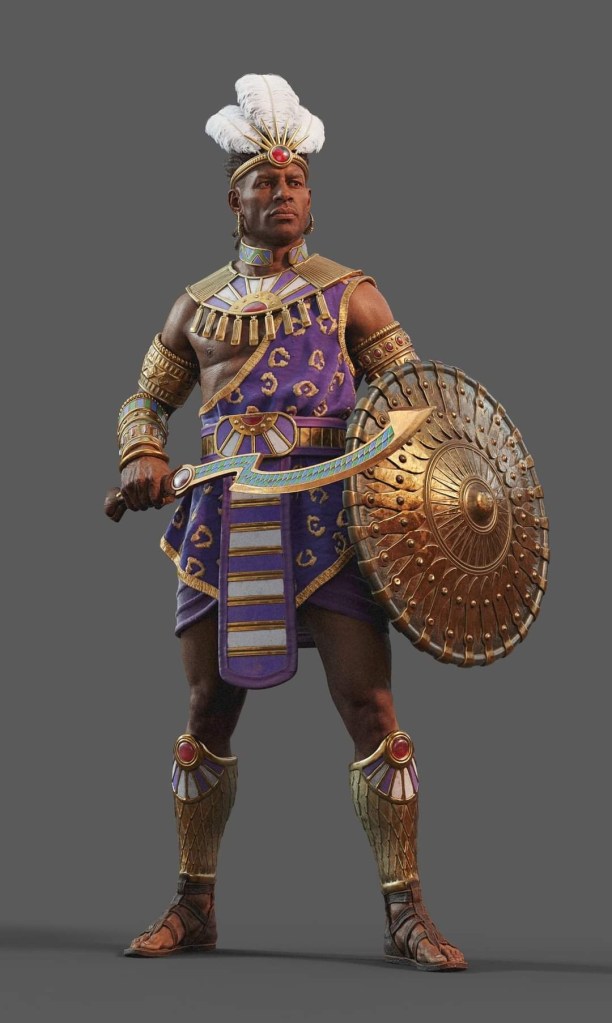
Nubia was known as the land of the bow. Kermite soldiers were expert archers, often lending their services out to train and educate other kingdoms’ armies as well. Their bows were about six feet in length, usually made with palm fiber stretched across different kinds of wood. The arrows were short, fletched with eagle and goose feather, given steel tips. Often the archers also carried a dedicated quiver with poison tipped arrows. The other Kermite weapons were the spear, pike and the Khopesh sword. While the Kermites were expert archers and bow makers, their melee weapons may have been imported. The Kermite military is also credited with the first use of elephants in active combat in warfare, as earlier elephants were only used for transport. They also trained war elephants for export to Egypt.
Source: https://thinkafrica.net/the-kingdom-of-kerma-2500-1500-bc/
During the New Kingdom (c. 1550-1070 BC), The Kingdom of Kush located further south succeeded Kerma and would emerge as the dominate force within Ta-Nehesy. The Kushites would consolidate their power around the fourth cataract over the centuries compete with Kemet over influence and dominance within the Nile Valley. The fall of Kerma would usher in a golden age for both Kemet and Kush when the Kushite Kings of Napata established the 25th Kushite Dynasty that lasted for about one hundred years beginning in the middle of the 8th century BCE.
To be continued…
“King of Upper Kemet…Beautiful is the Ka-Soul of Ra who appears in Waset”
Purchase Merch to Support our Efforts:
https://www.knowthyselfinstitute.com/shop
“I have not spoken angrily or arrogantly. I have not cursed anyone in thought, word or deeds.” ~35th & 36th Principals of Matt
 Hi welcome to my website
Thanks for the information!
LikeLiked by 1 person
You are welcome
LikeLike