CULTURAL CONTINUITY: ANCIENT AFRICAN HAIR STYLING
CULTURAL CONTINUITY: ANCIENT AFRICAN HAIR STYLING
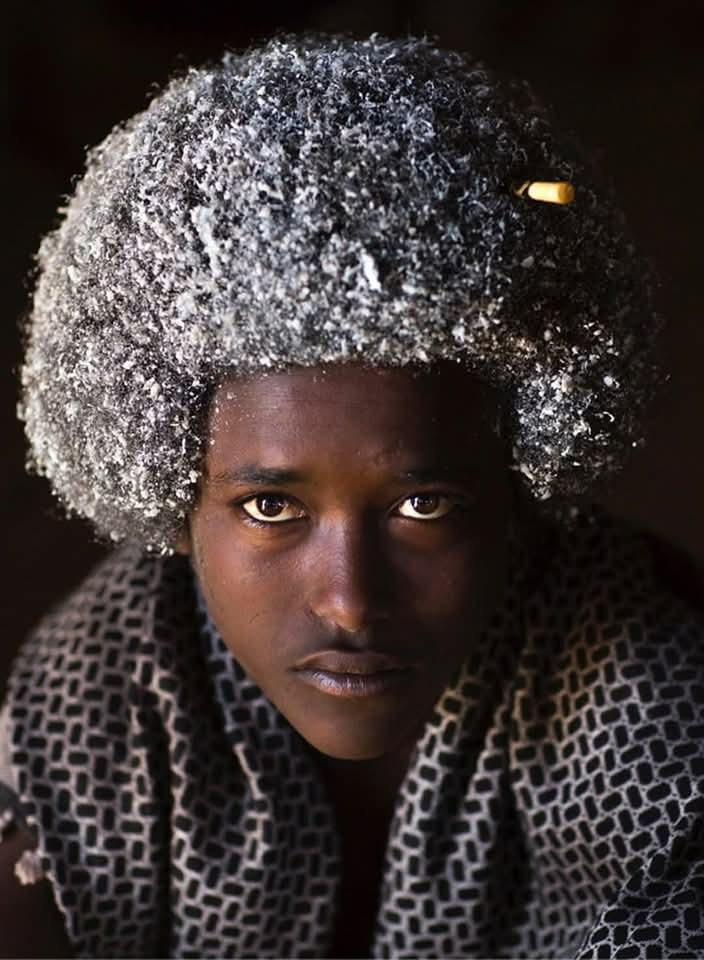
In Ancient Kemet hair was an embodiment of their identity and many of their crowns drew inspiration from ancient African hairstyles. Hairstyles carried religious and social significance and portrayed information about gender, age, and social status. The Kemetyu (ancient Egyptians) wore elaborate braids, locs and short twists. In this image of Yuya, father of the powerful Queen Tiye of the 18th Dynasty, he is depicted with his hair covered in a thick coat of animal fat which was a common hair product in Kemet, a cultural practiced continued by populations still to this day in Ethiopia.
These images show the process of how Africans used hair products to achieve hairstyles such as the Nubian Lappet or twisted loc style which is it is referred to as today. The Kemetyu (ancient Egyptians) and Nehesi (Nubians) had a variety of hair textures from curly to coarse that could keep its shape when certain oils and animal fats were added. They would slather butter onto their hair and scalp, protecting it from the sun which then could be twisted into locs, combed out into long flowing waves, or used to enhance curl definition. The most elaborate style was the Lappet hairstyle that consisted of layers of locs over lapping each other.
In a 2009 study British archeologist Geoffrey Tassie acknowledges the importance of Kemetic hair in the portrayal of social and class status stating, “hairstyles were a means of displaying status. An institutionalized cannon for hairstyles was established coinciding with the creations of administrative institutions. These codified hairstyles continued to serve as the norms for identifying members of the administration or signs of authority.” The study of ritualistic and hierarchal hairstyles in ancient Africa is called ethno-trichology.
Source: https://discovery.ucl.ac.uk/id/eprint/18730/
Prominent during the New Kingdom this hairstyle can be seen being worn by Nubian Dignitaries on the temple walls of King Tutankhamun’s tomb (TT80). Although the layered Lappet style would fade from history, similar hairstyles are still practiced by Ethiopians and and people of African decent. Beeswax and cow fat are still used today 5,000 years later to achieve these elaborate designs specifically in Ethiopia.
Wigs were sometime worn however it was rare due to their high cost. The idea of wigs has been used by racist Egyptologist to explain away the obvious African textured hair and hairstyles seen widely throughout ancient Kemetic artwork.
- • •
In 2023, Professor Christopher Ehret reported that the physical anthropological findings from the “major burial sites of those founding locales of ancient Egypt in the fourth millennium BCE, notably El-Badari as well as Naqada, show no demographic indebtedness to the Levant”. Ehret specified that these studies revealed cranial and dental affinities with “closest parallels” to other longtime populations in the surrounding areas of Northeastern Africa “such as Nubia and the northern Horn of Africa”.
Ehret, Christopher (20 June 2023). Ancient Africa: A Global History, to 300 CE. Princeton: Princeton University Press. pp. 83–85.
***Click Photo for detailed description
The relationship between Kemetic Crowns and ancient African hairstyles. WATCH NOW! https://www.youtube.com/watch?v=teifWMAe2Qg&t=244s
Follow our YouTube Channel:
https://www.youtube.com/@knowthyselfinstitute
Visit our Virtual Museum:
https://www.knowthyselfinstitute.com/museum
“I have not spoken angrily or arrogantly. I have not cursed anyone in thought, word or deeds.” ~35th & 36th Principals of Ma’at


Very nice
LikeLiked by 1 person
Thanks
LikeLiked by 1 person