It was 1971, just a year after the guns of the Nigerian Civil War had fallen silent.
It was 1971, just a year after the guns of the Nigerian Civil War had fallen silent. Aba was still wearing its wounds—streets buzzing with traders trying to start afresh with twenty pounds in their pockets, men and women walking with the weight of loss in their eyes, and an air of survival hanging over every conversation. For the Igbo people, hope was fragile, almost broken.
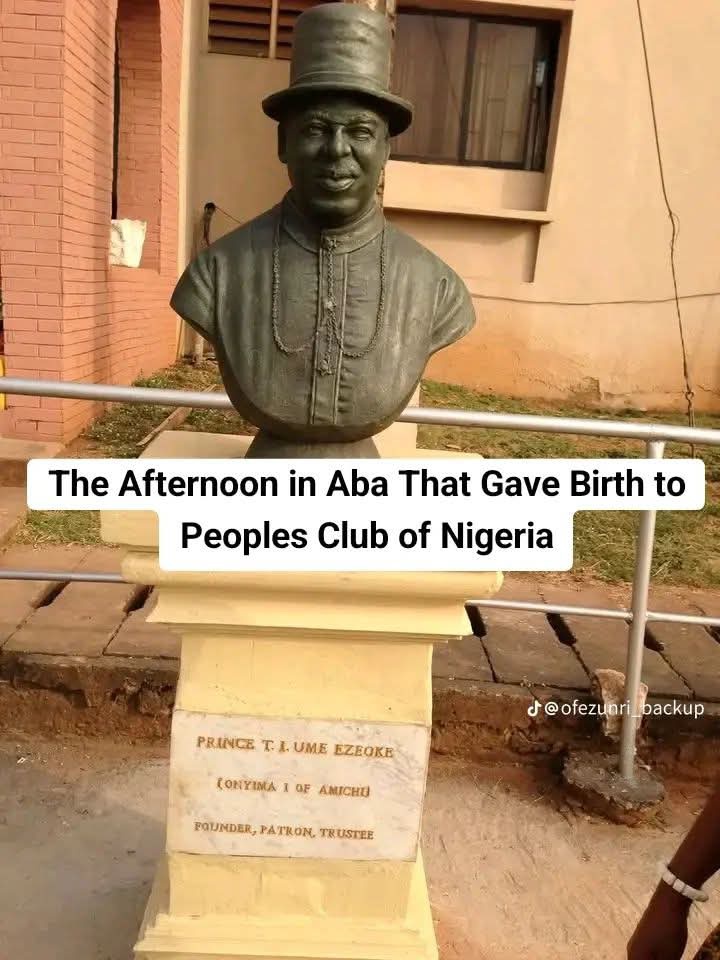
Somewhere in that restless city, a few men sat together, sharing drinks and memories. Among them was Chief Titus Ike Ume-Ezeoke, the Onyima of Amichi. The war had stripped him and his friends of the businesses they once built with sweat and brilliance. Their mansions and trading empires had been reduced to shadows, and all the Federal Government offered them to rebuild was a mere twenty pounds.
Yet, in that moment of despair, something remarkable happened. As Chief Titus reclined with his close friend, Chief Umeohamadike Obieze, the Azukaenyi of Unubi, and others in their circle, talk shifted from what they had lost to what they could still create. That afternoon in Aba, Peoples Club of Nigeria was born—not just as a social club, but as a brotherhood, a lifeline for men who needed to laugh again, rebuild again, and heal together from the brutal scars of war.
Chief Titus was not an ordinary man. He carried the weight of royal blood—son of His Royal Highness, Igwe Peter Umeorimili Ezeoke, the Paramount Obi of Amichi. His brothers were giants of their time: Sir Geoffrey Ume-Ezeoke, the respected Accountant-General of old Anambra State, and Chief Edwin Ume-Ezeoke, who would go on to become Speaker of Nigeria’s House of Representatives under President Shagari in 1979. But none of that shielded him from the pain of the war. Like every Igbo man, he had to start from scratch.
Before the war, Igbo traders had built vibrant fraternities, the most notable being the Okaa Society of Nigeria—a gathering of ambitious young businessmen who thrived on friendship and shared success. But the Okaa Society perished with the war; many of its members never returned. The Peoples Club, in many ways, was the resurrection of that spirit. It quickly became the meeting point for a generation determined to rise again.
Through its members, wealth was rebuilt, dignity was restored, and Igbo resilience once more shone across Nigeria and beyond. From that circle of broken men in Aba grew a movement that would define social and economic life for decades.
By March 1983, after guiding the club with vision and steady hands, Chief Titus Ike Ume-Ezeoke stepped down as Founder and Patron. He handed the leadership baton to Dr. Chukwuma Obioha, Akajiugo of Arondizuogu, who became the second National President. But Chief Titus’s legacy lived on. He had done more than create a club—he had given his people a way to heal, a place to belong, and a symbol of their unbreakable spirit. Peoples Club was, and still is, proof that even in the ashes of war, fellowship can plant seeds of hope—and from hope, a people can rise again.


Thank you for your education of the population of the world.
I never knew the depth that tragedy truly hits other people and you made it easy to comprehend.
LikeLiked by 1 person
Wow
LikeLiked by 1 person