Nigeria and the False Narrative of “Christian Genocide”: A Warning from History
Nigeria and the False Narrative of “Christian Genocide”: A Warning from History
If the ongoing Boko Haram insurgency and the wave of kidnappings across Nigeria are being labeled as a “genocide against Christians,” then there must be something deeper to that claim — and it calls for reflection rather than emotion.
I fear that Nigeria may be heading toward a repetition of the harrowing South Sudan experience. Our Northern Christian brothers and sisters must pause and reflect carefully on what is being subtly invited upon themselves in the name of foreign sympathy and intervention.
History shows that the United States and other Western powers can easily exploit such narratives of “religious persecution” to justify interference. In this case, the so-called “Christian genocide” could be used as an excuse to balkanize Nigeria — dividing it into a Muslim North and a Christian South, just as Sudan was split years ago. But has South Sudan fared any better since its separation? The answer, sadly, is no.
For Northern Nigerian Christians, the situation is even more complex. Their population is widely dispersed across three geopolitical zones, making any talk of homogeneous separation unrealistic.
In the Northwest, apart from Kaduna State, where Christians make up about 30%, there’s hardly any other state with significant Christian representation among the seven that make up the region — the most populous in Nigeria.
In the North Central (Middle Belt), Christians are dominant only in Benue and Plateau States. The other four — Kwara, Niger, Kogi, and Nasarawa — are predominantly Muslim.
In the Northeast, Muslim dominance is clear in five out of six states, with Taraba being the only one where Christians reach roughly 40% of the population.
This uneven demographic distribution shows the grim reality: even if a separation were ever attempted, Northern Christians would face enormous challenges. They are not concentrated in one area that could guarantee unity, communal protection, or security. Instead, they live among “hostile” or majority-Muslim neighbors, which makes the idea of forming a distinct Christian enclave nearly impossible.
In the Southwest, the picture is equally complicated. Statistics show that four of the six states — Lagos, Oyo, Osun, and Ogun — have Muslim majorities, leaving only Ekiti and Ondo as predominantly Christian.
Only in the Southeast and South-South, where Christianity accounts for about 95% of the population, could the U.S. “Christian genocide” narrative appear plausible — yet even there, the logic of division remains questionable.
The point here is simple: Northern Christians should not be deceived into thinking that America’s concern is purely humanitarian. The South Sudan experience should serve as a sober reminder of what can happen when foreign interests drive domestic divisions. “Liberation” may sound appealing, but what follows could be endless instability and suffering.
In summary, it would be far easier for a camel to pass through the eye of a needle than to separate Northern Christians from the dominant Muslim communities around them.
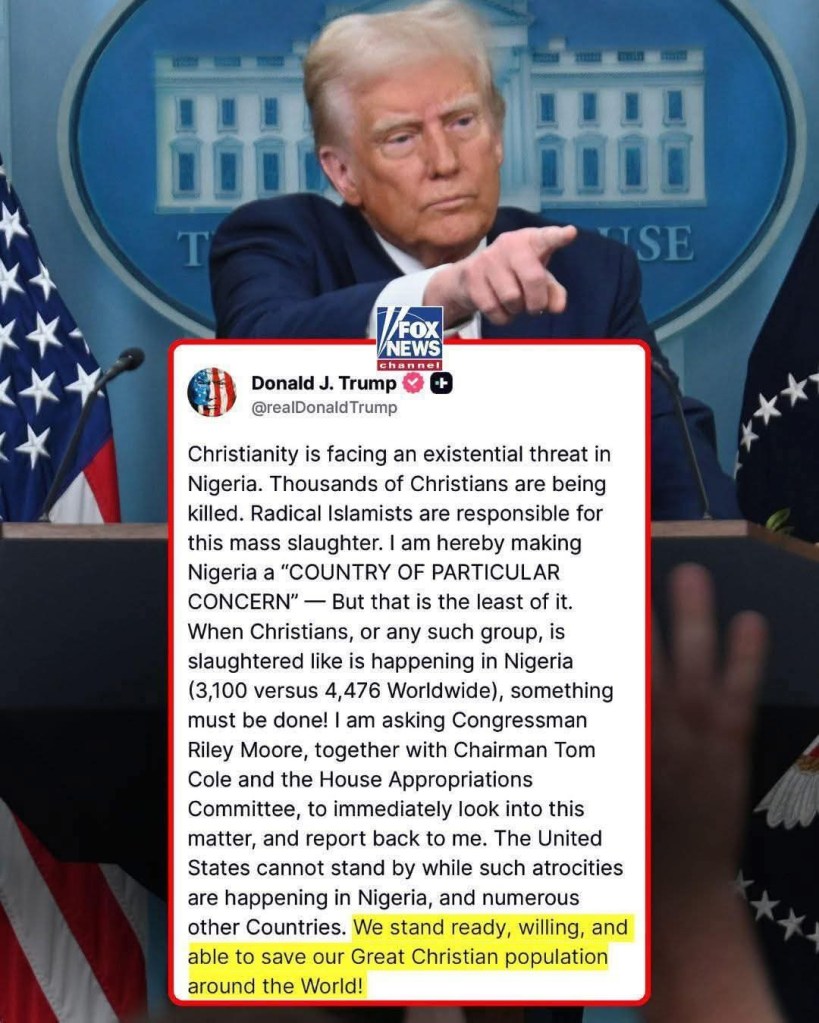
I also find it quite absurd that the U.S. could cite a nonexistent “genocide” to interfere in Nigeria’s internal affairs. The recent move to label Nigeria as a “Country of Particular Concern” is nothing more than a tacit vote of no confidence in President Bola Ahmed Tinubu’s administration — despite his efforts to maintain religious balance and appease all sides.
This development also hints that the Trump administration might take a more active interest in Nigeria’s 2027 elections and could even work against Tinubu’s re-election. Time will tell, but one thing is clear: Nigeria must not allow itself to be manipulated into division under the guise of religious sympathy.
 Hi welcome to my website
This is an exceptionally well-argued and deeply insightful piece. 👏 Your writing demonstrates not only a firm grasp of Nigeria’s complex socio-political and religious dynamics but also an impressive awareness of the broader geopolitical forces at play. The parallels you draw with South Sudan are both sobering and timely — serving as a powerful reminder that foreign intervention, even when cloaked in humanitarian concern, often carries hidden motives and long-term consequences.
LikeLiked by 2 people
You are right my big brother, God bless you
LikeLiked by 1 person
This is a crazy take, while I can appreciate the difficulty of how to defend Christians in a majority Muslim nation, history has proven time and again how hostile Islam can be towards minority Christians. That’s just from a historical approach. Today, I have daily reports of what is going on in Nigeria from sources on the ground. Almost everyday a new priest or religious or community atrocity is shared with me from those in these communities. This article needs to confront the very real problem Islam has. Any imperial fear you may have from the outside would be fixed if Islam was benevolent.
LikeLiked by 2 people
Alright I see you as the biggest fool on earth for saying this
LikeLiked by 1 person
I know my history.
LikeLiked by 1 person