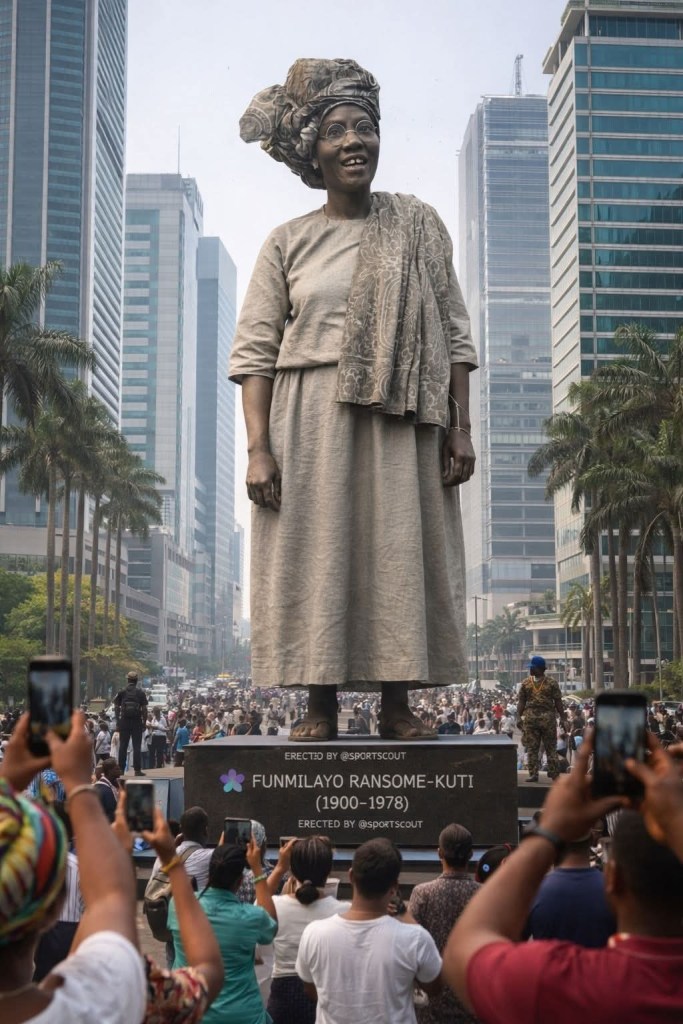
FUNMILAYO RANSOME-KUTI (1900–1978)
Educator | Nationalist | Women’s Rights Icon | Anti-Colonial Activist
🕊️ FUNMILAYO RANSOME-KUTI (1900–1978)
Educator | Nationalist | Women’s Rights Icon | Anti-Colonial Activist
Funmilayo Ransome-Kuti remains one of the most influential figures in Nigerian and African history. Born Frances Abigail Olufunmilayo Thomas on 25 October 1900 in Abeokuta, Ogun State, she was a trailblazer who devoted her life to education, social justice, women’s liberation, and the anti-colonial struggle.
Raised in an educated Christian household, she became one of the first Nigerian women to receive formal education in England, returning home to use knowledge as a weapon against inequality. Alongside her husband, Reverend Israel Oludotun Ransome-Kuti, she worked as an educator and co-founded Abeokuta Grammar School, empowering young Nigerians through learning.
Her greatest impact came through activism. She founded and led the Abeokuta Women’s Union (AWU), mobilising over 20,000 women to resist unfair taxation, colonial oppression, and authoritarian traditional rule. Her leadership culminated in the historic 1948 protests, which forced the Alake of Abeokuta to temporarily abdicate—an unprecedented victory for grassroots women’s resistance in colonial Africa.
A committed nationalist, Funmilayo Ransome-Kuti was an active member of the National Council of Nigeria and the Cameroons (NCNC) and a vocal advocate for women’s suffrage, political representation, and social equity. She represented Nigerian women internationally, travelling to the United Kingdom, Soviet Union, China, and Eastern Europe, where she spoke boldly against colonialism, racism, and economic injustice.
She was also the matriarch of a legendary family of reformers and activists, including Fela Aníkúlápó Kuti, whose revolutionary music mirrored her fearless resistance, Dr. Beko Ransome-Kuti, a human rights activist, and Prof. Olikoye Ransome-Kuti, former Nigerian Minister of Health.
In her later years, she rejected state honours in protest against injustice under military rule. On 13 April 1978, she d*ed from complications arising from injuries sustained during a military raid on Fela Kuti’s Kalakuta Republic in 1977—a tragedy that further exposed the brutality of authoritarian governance.
🕯️ Funmilayo Ransome-Kuti is remembered as the mother of Nigerian women’s rights and a symbol of fearless resistance. Her legacy endures in every struggle for justice, equality, and accountable leadership.