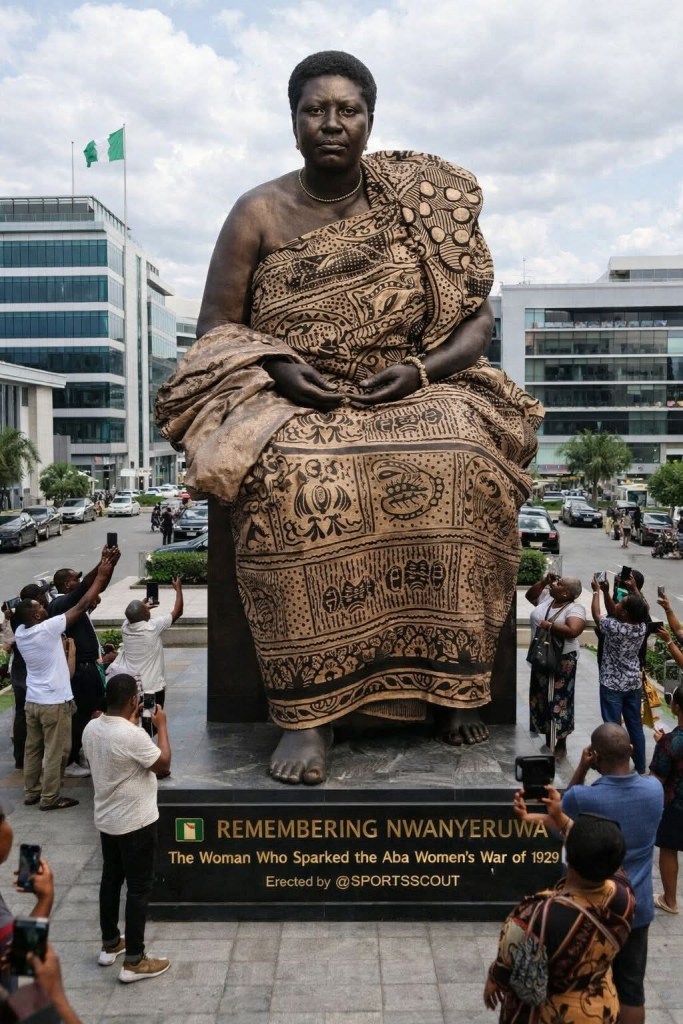
The Woman Who Sparked the Aba Women’s War of 1929
🇳🇬 REMEMBERING NWANYERUWA
The Woman Who Sparked the Aba Women’s War of 1929
Nwanyeruwa was an Igbo woman and market trader from Oloko, in present-day Abia State, Nigeria, whose courageous resistance to colonial injustice ignited one of the most significant anti-colonial movements in African history — the Aba Women’s War of 1929, also known as the Igbo Women’s War (Ogu Umunwanyi).
Early Life
Details of Nwanyeruwa’s birth date and early childhood are not documented, a reflection of how colonial records largely ignored the personal histories of African women. By 1929, however, she was a widow and respected trader, well-connected within the powerful women’s market networks of southeastern Nigeria.
The Historic Confrontation (18 November 1929)
On 18 November 1929, a colonial agent acting under a British-appointed warrant chief attempted to count Nwanyeruwa’s household and livestock. In Igbo society, such counting signaled imminent taxation.
At the time, women were not traditionally taxed, and the region was already suffering severe economic hardship.
Nwanyeruwa refused to comply and openly challenged the authority of the colonial system. This confrontation, which reportedly involved physical intimidation against her, became the spark that ignited mass resistance.
Mobilization and Leadership
Rather than remaining silent, Nwanyeruwa alerted other women in Oloko and nearby communities. Through traditional communication networks, women across eastern Nigeria mobilized rapidly. Within days, thousands of women gathered to protest:
Proposed taxation of women
Abuse of power by warrant chiefs
Exclusion of women from governance
The women used non-violent indigenous protest methods, including singing, dancing, public ridicule, and “sitting on” officials to force accountability.
The Aba Women’s War
The movement spread across large parts of eastern Nigeria, involving over 10,000 women from different ethnic groups. Although largely peaceful, colonial repression led to violent confrontations, resulting in the deaths of dozens of women.
Impact on Governance
The uprising forced the British colonial administration to introduce major reforms:
Plans to tax women were abandoned
The unchecked power of warrant chiefs was reduced
Women were appointed to Native Courts, marking a significant step toward political inclusion
Legacy
Nwanyeruwa never held formal government office, but her actions directly influenced colonial policy changes and women’s political participation in Nigeria. She is remembered as:
A symbol of women’s resistance and courage
A pioneer of female-led mass political action in Africa
A foundational figure in Nigeria’s anti-colonial and women’s rights history
D*ath
Like her birth, the exact date of Nwanyeruwa’s d*ath is not recorded. Her legacy, however, lives on as a turning point in Nigerian and African history.
🕊️ Historical Significance
Nwanyeruwa’s courage proved that African women were not passive subjects of colonial rule but organized, strategic, and powerful agents of change. Her stand in 1929 reshaped governance, inspired future movements, and secured her place in history.
 Hi welcome to my website