
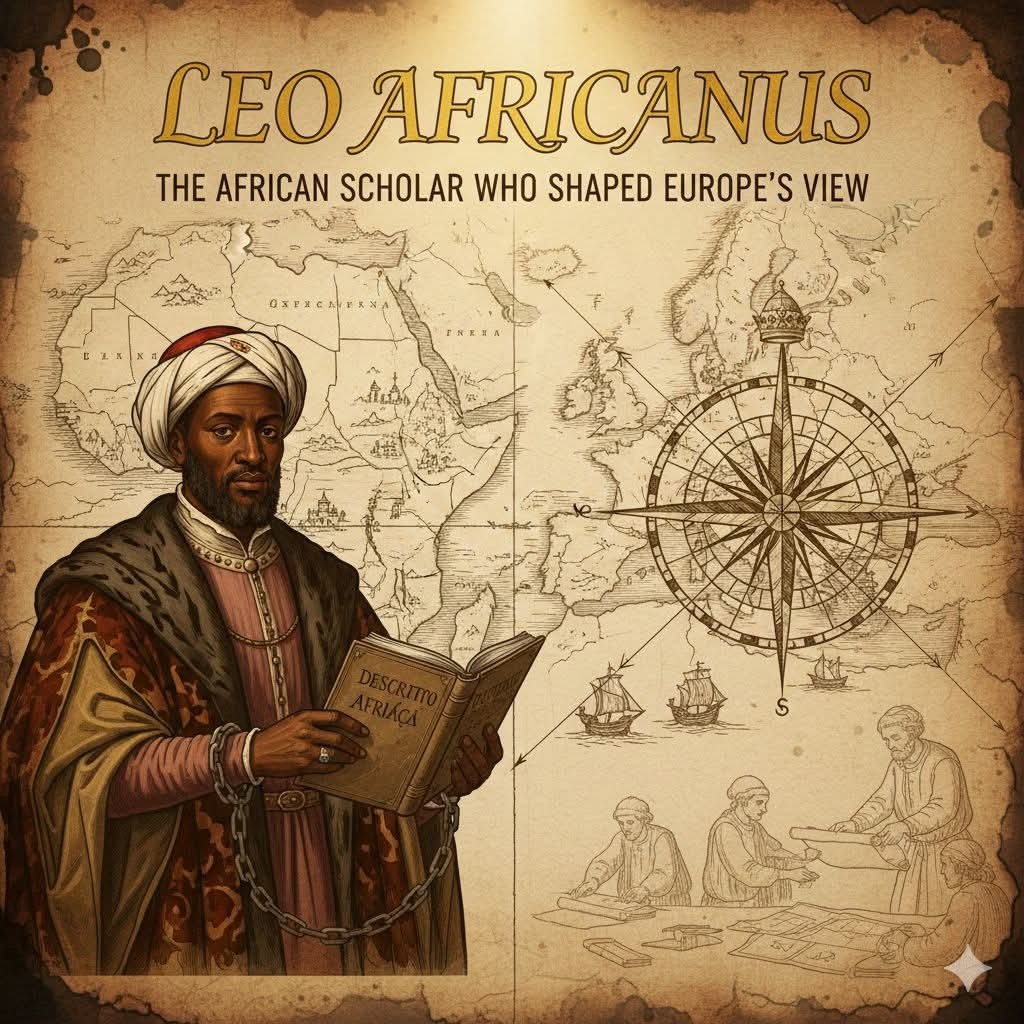
An African scholar shaped how Europe understood Africa for centuries. His name was Leo Africanus.
An African scholar shaped how Europe understood Africa for centuries. His name was Leo Africanus.
Born around 1494 in Granada to a Muslim family that later settled in Fez, Leo Africanus was educated in law, languages, and diplomacy. His birth name was al-Hasan ibn Muhammad al-Wazzan, and as a young man he traveled widely across North Africa, West Africa, and the Middle East on diplomatic missions.
In 1518, while returning from one such journey, he was captured by pirates in the Mediterranean and taken to Rome. Instead of being imprisoned or executed, he was presented to Pope Leo X, baptized, and given the name Leo Africanus.
What followed was extraordinary.
In Rome, Leo Africanus wrote “Description of Africa,” a detailed account of African cities, kingdoms, cultures, trade routes, and intellectual life. At a time when most Europeans had little direct knowledge of Africa, his book became the most authoritative source on the continent for hundreds of years.
European mapmakers, scholars, and rulers relied on his work. Universities taught from it. Empires planned with it.
For generations, Europe learned about Africa from an African voice—even if that voice was often stripped of its context.
After years in Europe, Leo Africanus eventually returned to the Muslim world, though the details of his later life remain unclear. What is certain is his impact: one man, crossing cultures under coercion, ended up defining how an entire continent was understood beyond its borders.
 Hi welcome to my website
I’m curious to learn more about Leo Africanus and how his story shaped history.
LikeLiked by 2 people
Alright
LikeLike