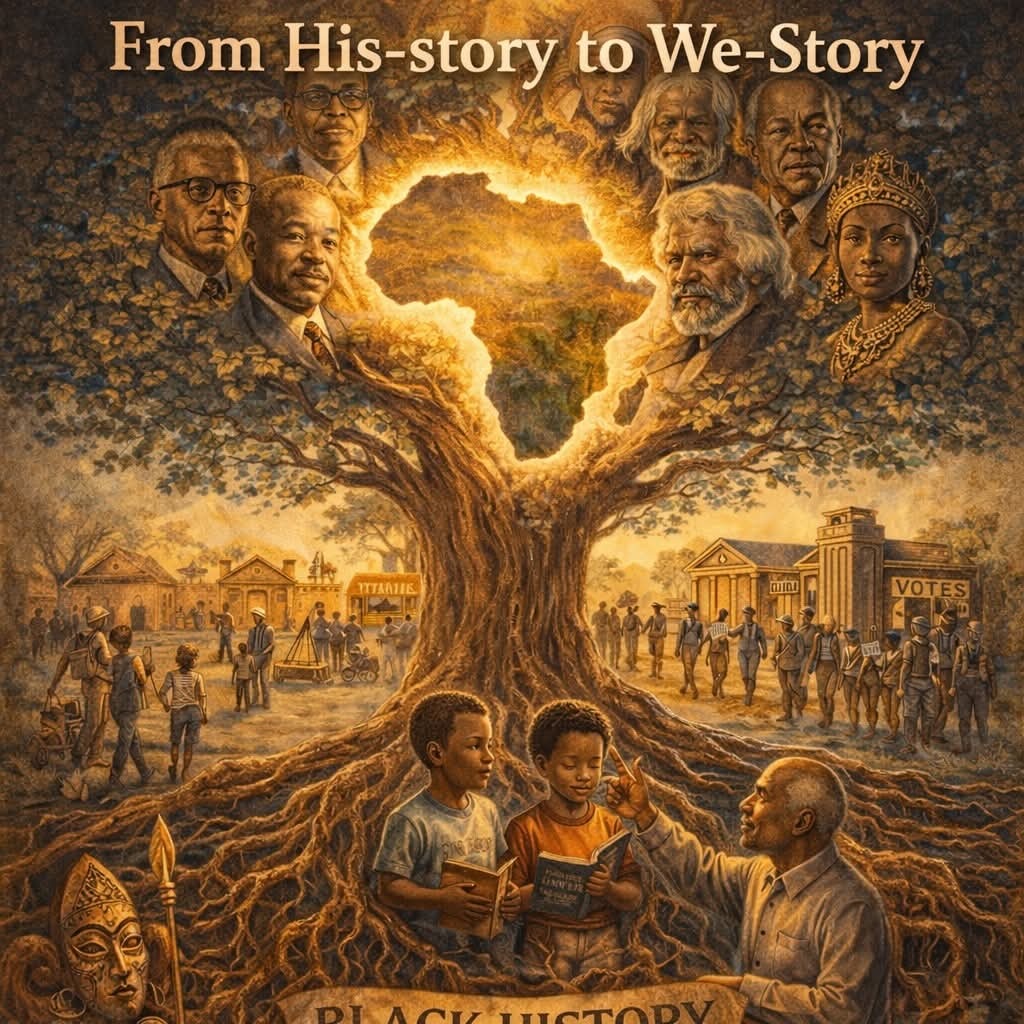
BLACK HISTORY: THE LIFELINE OF A PEOPLE — MEMORY, MOVEMENT & MISSION:
🖤 BLACK HISTORY: THE LIFELINE OF A PEOPLE — MEMORY, MOVEMENT & MISSION: Has Black History Served Its Purpose?
It’s been a hundred years. It started out as Black History Week. Do you have a sense that it has served a purpose? Or has it been a detriment?
Any people who don’t know their history is doomed to death. Any people who don’t know their history is doomed to death — economic death, political death, cultural death, intellectual death. Because history is the experience of your ancestors struggling against the adversaries that is trying to keep you from becoming who you are trying to become.
If you don’t have a blueprint of that struggle, how do you know where to begin or where to go? History tells you what to emulate and what to throw away. History tells you what is significant and what is precious and what is holy and what is special and what is not. But you have to have it to make those discerning.
And so our history is like the biblical cord back to our ancestry. And if that gets cut, you’re in trouble. The biblical cord is what nourishes you. It’s your nutrients.
Woodson and the Deliberate Awareness Movement
So it isn’t that Carter G. Woodson created anything other than the awareness — the deliberate awareness.
If you go back to the 1740s, when the brothers in Massachusetts founded the African Free Lodge, which becomes the Prince Hall Free Masonic Lodge, they named it the African Free Lodge. They still knew who they were.
When the Black people in Savannah, Georgia founded the African Baptist Church in 1749 — when there wasn’t even a white Baptist church in Savannah yet — they still knew who they were.
So we didn’t lose our history, but our ability to carry out the intergenerational transmission of our historical knowledge — especially using institutions — had been wiped away and taken away from us, impairing greatly our ability to transmit our body of knowledge and experiences.
And Woodson said it had to be restored.
The Scholar Who Was Also a Street Activist
So, so but this man was an extraordinary brother. He was a community activist. He was not just a sit-down scholar. He was out there picketing. He was dealing with Black communities around the country in crisis and looking at them and studying them.
Because we talk about Black Wall Street in Tulsa, but we don’t talk about the other 80, 90, or 100 Black Wall Streets all across America — from Mound Bayou to Rosewood to Wilmington and so forth — because we get into that kind of singular focus. But we built those kinds of communities all over the country.
And Woodson was an inspiration along with Booker T. Washington, along with W.E.B. Du Bois, along with Ida B. Wells, along with Mary McLeod Bethune, and Mary Church Terrell.
These were youngsters — like we were young when we were out there trying to kick it at 18, 19. Well, they were that age when we are now making reference to a period of time when these young people were the 18, 19, 20, 25-year-olds fighting for Black freedom.
The Institutional Roots: Niagara Movement to NAACP
The NAACP was born out of a Black organization called the Niagara Movement — which had Booker T. Washington in it, Ida B. Wells in it, W.E.B. Du Bois in it, Mary McLeod Bethune in it, Carter G. Woodson in it. All these young Black men and women were trying to figure a way out of this thing.
The Niagara Movement was born out of an earlier movement started in Rochester by Black women and morphed into what became known as the Afro-American League. This is before Malcolm X. The Afro-American League becomes the Niagara Movement, and that becomes the NAACP.
And for the first four years of the founding of the NAACP, it wasn’t even called the NAACP — it was still called the Niagara Movement. Four years later they renamed it to attract white legal assistance and funding.
Thurgood Marshall & Legal Warfare
One of the young brothers who came into this movement was Thurgood Marshall — a brilliant revolutionary strategist long before the Supreme Court.
When you study Thurgood Marshall before the Court, you see a legal strategist who understood that Plessy v. Ferguson had to be overturned if Black independence and equality were to be protected under the 14th Amendment.
Marshall pushed the legal strategy through the NAACP that culminated in Brown v. Board of Education. Even if one debates Brown’s educational outcomes, what it did constitutionally was overturn “separate but equal” as legal doctrine — declaring it unconstitutional.
Did Black History Fall Short? When asked whether Black History Month fell short, the reflection was this: At one time it felt like it did — but that was a naive expectation.
We were trying to influence millions of people whose socialization we did not control — through institutions we did not control — schools, churches, universities, media.
Yet doors were forced open. Black Studies entered colleges. Curricula expanded. Generations carried this knowledge into corporations, agencies, and government. This wasn’t just name-changing. This was idea-changing.
Book Bans & Fear of Historical Consciousness
Today we see books being banned, histories erased, curricula attacked. But we are not burning those books. They are. And that reaction is revealing. It is awakening people who once took Black history for granted. When the enemy tries to stop the train of self-knowledge, it confirms how powerful it is.
Africa: The Psychological Transformation
Personal testimony underscores this truth. Taking young people to Africa — even for two weeks — transforms them. When they see civilizations their ancestors built… when they understand that dreaming is legitimate… their character shifts, their speech shifts, their aspirations expand. History reshapes psychology.
The Global Spread of Black Historical Consciousness
The Black history movement did not stop in America. It spilled into the Caribbean, Europe, and Africa. After the Berlin Conference of 1885 carved Africa among European powers — with the exception of Ethiopia, Liberia, and Sierra Leone — diasporic Africans helped found liberated spaces like Sierra Leone’s Freetown, built by repatriated Africans and Jamaican Maroons returning home. This is global Black institutional history often erased.
Final Reflection
Black History Week — later Black History Month — was never meant to confine celebration. It was meant to spotlight urgency.
A strategic emphasis — not a limitation.
Because Black history is not seasonal.
It is structural.
It is identity infrastructure.
It is the cord that feeds a people their memory, mission, and movement.
 Hi welcome to my website
Powerful message ❤️📚 history, memory and mission truly matter!
LikeLiked by 1 person