THE NIGHT THAT CHANGED NIGERIA 🇳🇬 FOREVER: Inside the 1966 Coup That Ended Civilian Rule
⚔️🔥 THE NIGHT THAT CHANGED NIGERIA 🇳🇬 FOREVER: Inside the 1966 Coup That Ended Civilian Rule 🔥⚔️
Nigeria’s journey after independence in 1960 was filled with hope—but beneath the surface, tension, division, and political instability were building. That tension exploded in the early hours of January 15, 1966, when young military officers staged Nigeria’s first successful coup, forever altering the nation’s destiny.
🪖 THE COUP THAT SHOOK A NATION
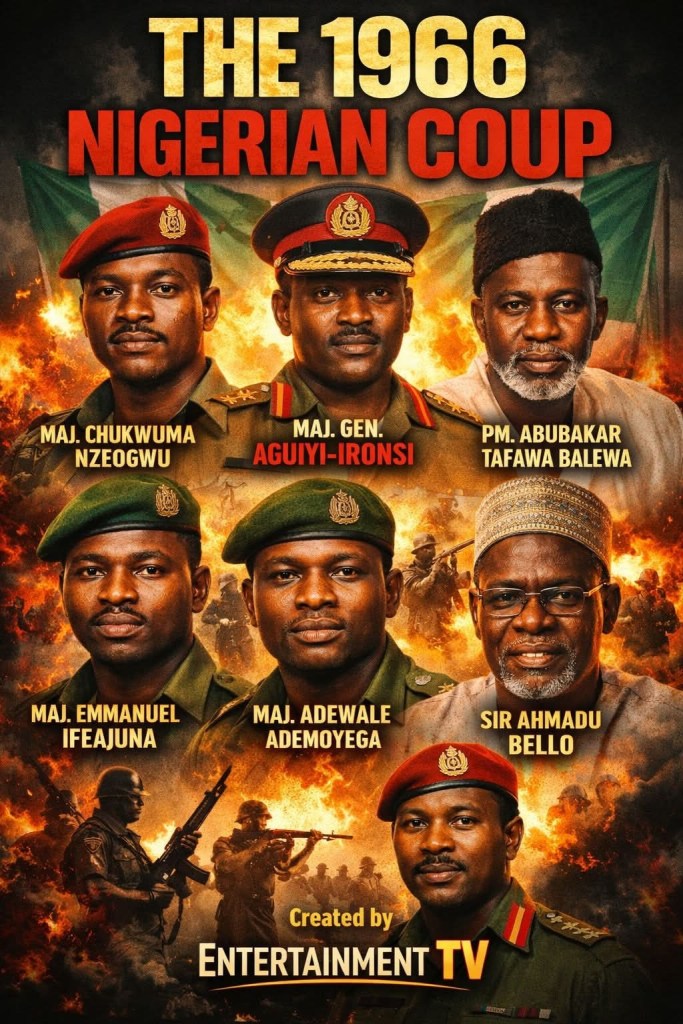
The operation was led by Major Chukwuma Kaduna Nzeogwu, a charismatic and disciplined officer born on February 26, 1937, in Kaduna. He was only 28 years old when he led one of the most consequential events in Nigerian history.
🎯 The Mission
The coup plotters claimed they wanted to:
End corruption
Stop political chaos
Remove what they saw as “bad leadership”
Other key officers involved included:
Major Emmanuel Ifeajuna (first Nigerian Olympic gold medalist, later executed in 1967)
Major Adewale Ademoyega (survived and later documented the coup)
Captain Ganiyu Adeleke
Major Chris Anuforo
💥 TARGETS AND ASSASSINATIONS
The coup was violent and selective. Several top leaders were @ss@ssinated:
Abubakar Tafawa Balewa
Born: 1912
D!ed: January 1966 (killed during the coup)
Ahmadu Bello
Born: June 12, 1910
D!ed: January 15, 1966
Samuel Ladoke Akintola
Born: July 6, 1910
D!ed: January 15, 1966
Festus Okotie-Eboh
Born: 1912
D!ed: January 1966
Many senior military officers were also
k!lled.
⚠️ However, some prominent leaders—especially from the Eastern region—were not harmed, which later fueled ethnic suspicion and controversy.
🏛️ THE FALL OF CIVILIAN GOVERNMENT
Nigeria’s First Republic collapsed overnight.
The President at the time, Nnamdi Azikiwe (1904–1996), was abroad during the coup.
With the civilian leadership eliminated or weakened, the military stepped in.
👑 THE MAN WHO TOOK POWER
Although Nzeogwu initiated the coup, he did not become leader.
Power was handed to:
Major General Johnson Aguiyi-Ironsi
Born: March 3, 1924
Became Head of State: January 1966
D!ed: July 29, 1966 (assassinated in a counter-coup)
⚖️ HOW IRONSI RULED NIGERIA
Ironsi established Nigeria’s first military government.
Key Actions:
Suspended the constitution
Banned political parties
Centralized power under military control
🔥 The Most Controversial Move:
Ironsi introduced Decree No. 34, which:
Abolished Nigeria’s federal system
Replaced it with a unitary system
👉 This decision angered many, especially in Northern Nigeria, who feared domination.
🌪️ THE BACKLASH AND COUNTER-COUP
Tensions exploded again just months later.
On July 29, 1966, Northern soldiers launched a counter-coup.
What happened:
Johnson Aguiyi-Ironsi was captured and
k!lled
His host, Adekunle Fajuyi (1926–1966), was also k!lled for refusing to betray him
👑 THE NEXT LEADER
After the counter-coup, power shifted to:
General Yakubu Gowon
Born: October 19, 1934
Became Head of State: 1966
Led Nigeria during the Civil War (1967–1970)
⚰️ WHAT HAPPENED TO THE COUP LEADERS?
Chukwuma Kaduna Nzeogwu
Initially arrested
Later fought for Biafra
Died: July 29, 1967 in Nsukka during the Civil War
Emmanuel Ifeajuna
Executed by Biafran authorities in 1967 for alleged betrayal
Adewale Ademoyega
Survived the war
D!ed: February 2018
🧭 WHY THIS COUP MATTERS
This single event:
Ended Nigeria’s First Republic
Introduced military rule
Triggered ethnic tensions
Led directly to the Nigerian Civil War (1967–1970)
It remains one of the most debated events in Nigerian history—seen by some as a revolutionary attempt to fix the country, and by others as the beginning of long-term instability.
🧠 FINAL THOUGHT
The 1966 coup was not just a takeover—it was a turning point that reshaped Nigeria’s political structure, military influence, and national unity.
It reminds us that leadership, unity, and justice are fragile—and must be protected at all costs.
📚 NOTE (FOR EDUCATIONAL PURPOSES ONLY)
This content is strictly for educational and historical awareness purposes. Readers are encouraged to carry out further research to better understand Nigeria’s history, the events of 1966, and how they shaped the nation we know today.
NigerianHistory #1966Coup