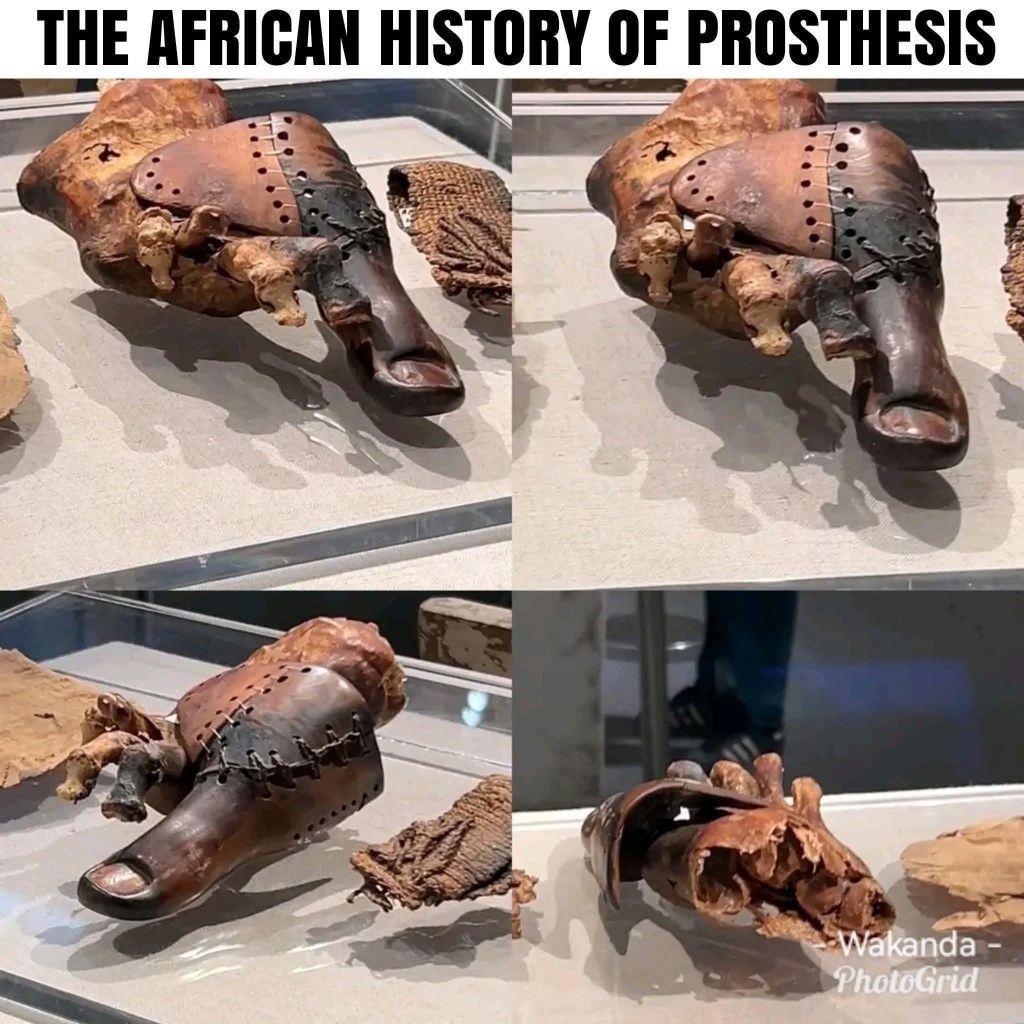
THE AFRICAN HISTORY OF PROSTHESIS
THE AFRICAN HISTORY OF PROSTHESIS
Africa’s history of prosthetics illustrates a rich legacy of innovation, fusing practical and cultural considerations. In ancient Kemet (Egypt) prostheses were used to complete the bodies of mummified individuals (Finch, 1990; Nerlich et al., 2000). The case of an ancient Egyptian wooden toe prosthesis highlights both the medical knowledge of the time and the cultural significance of bodily integrity in the afterlife (Nerlich et al., 2000; Bedigrew, 2014). The Berbers exhibited pragmatic understanding of prosthetics, creating wooden and metal limb prostheses that fit the wearer’s needs, showcasing the growing understanding of design principles (Dasen, 2016).
Meanwhile, the Yoruba people of Nigeria had their healers create wooden prosthetics bearing traditional carvings. These prosthetics were not just functional but symbolised the wearer’s heritage, belief system and status (Adelola et al., 2014). Ghana’s Akan people also demonstrated creativity, using materials such as bamboo and metal to fashion prosthetics that combined functionality with beauty, often incorporating personal or cultural narratives into their designs (Agyei-Mensah & de-Graft Aikins, 2010). Although there is little evidence of traditional prosthetics among the Dogon people of Mali, ethnoarchaeological studies suggest the possibility of using carved wooden prosthetics for mobility in the past, reflecting early recognition of the need to cope with physical disabilities (Lane, 2011).
In Eastern Africa, prosthetics were made from locally available wood and leather, sometimes adorned with decorative carvings that signified the person’s status or accomplishments (Maina et al., 2022). Likewise, the Maasai people crafted prosthetics from accessible materials such as leather and animal bones for their warriors, demonstrating their ingenuity in dealing with injuries (Edgerton, 1992). Zimbabwean historical records indicate that the Shona people were known to have produced wooden arms and legs for the disabled (Bhebe & Ranger, 1995). The Zulu people used leather and wood to construct temporary prosthetics for warriors, underscoring the importance of these prosthetics in preserving a warrior’s dignity and self-esteem (Ngubane, 1977).
References
Adelola, O. A., Dawodu, S. T., & Akinwande, J. A. (2014). Orthopaedic traditional medicine in Southwestern Nigeria. Journal of Orthopaedic Surgery and Research, 9(1), 1–8. https://doi.org/10.1186/s13018-014-0092-3
Dasen, V. (2016). Healing images: Gems and medicine. Oxford Journal of Archaeology, 35(2), 177–191. https://doi.org/10.1111/ojoa.12083
Finch, C. S. (1990). The African background to medical science: Essays on African history, science and civilizations. Karnak House.
Lane, P. (2011). The potential for a post-colonial archaeology in sub-Saharan Africa: Indigenous and usable pasts. World Archaeology, 43(1), 7–25. https://doi.org/10.1080/00438243.2011.544890
Nerlich, A. G., Zink, A., Szeimies, U., & Hagedorn, H. G. (2000). The big toe of an ancient Egyptian. The Lancet, 356(9248), 2176–2179. https://doi.org/10.1016/S0140-6736(00)03507-8
Ngubane, H. (1977). Mind and body in Zulu medicine: An ethnography of health and illness in Nyuswa-Zulu thought and practice. Academic Press.
 Hi welcome to my website