
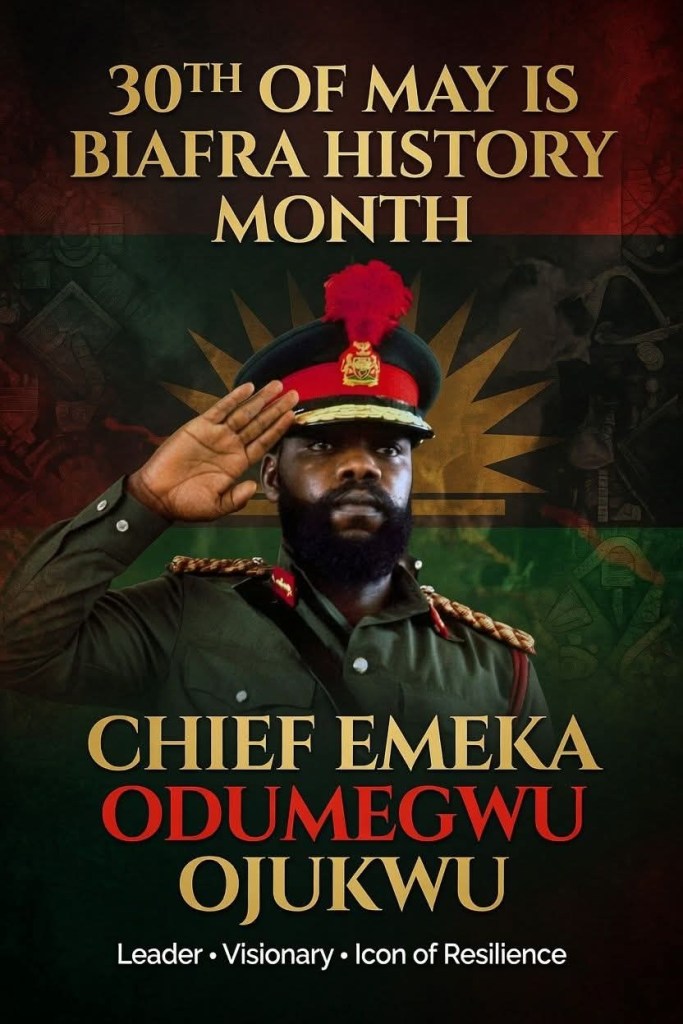
The General of the People: The Life and Legacy of Chukwuemeka Odumegwu-Ojukwu.
(30th edition – May 2026)
The General of the People: The Life and Legacy of Chukwuemeka Odumegwu-Ojukwu.
Chukwuemeka Odumegwu-Ojukwu remains one of the most polarizing and charismatic figures in African history. Often referred to simply as “Ojukwu” or “The Ikemba,” he was the face of the secessionist movement that led to the Nigerian Civil War (1967–1970). His life was a complex tapestry of aristocratic privilege, military discipline, and revolutionary fervor.
Early Life and Education
Born on November 4, 1933, in Zungeru, Northern Nigeria, Ojukwu was the son of Sir Louis Odumegwu Ojukwu, who was arguably the wealthiest man in Nigeria at the time. Despite his silver-spoon upbringing, Ojukwu was known for his rebellious streak and intellectual depth.
Oxford Education: He earned a master’s degree in history from Lincoln College, Oxford.
The Civil Service: Upon returning to Nigeria, he initially joined the colonial civil service rather than his father’s business empire.
The Military Path: In a move that shocked his family, he enlisted as a recruit in the Nigerian Army, eventually rising to become one of the first indigenous officers to hold high command.
The Path to Biafra
The 1960s were a turbulent decade for the young Nigerian republic. Following the January 1966 coup and the subsequent July counter-coup, the country descended into ethnic violence.
Ojukwu, then the Military Governor of the Eastern Region, found himself at the center of a humanitarian and political crisis. Thousands of Igbos were being killed in “pogroms” in the North, and millions were fleeing back to the East.
“I have been compelled to take this step, to save the lives and properties of the people of this Region.” Ojukwu, on the declaration of Biafra.
When negotiations with the Federal Military Government (led by Yakubu Gowon) broke down most notably at the Aburi Accord** in Ghana—Ojukwu declared the Eastern Region an independent state:
The Republic of Biafra, on May 30, 1967.
The Nigerian Civil War (1967–1970)
Ojukwu served as the Head of State and General of the People’s Army during the three-year conflict. The war was characterized by:
The Blockade: The Federal government implemented a “starvation as a weapon of war” policy, leading to a massive famine in Biafra.
The Ahiara Declaration: Ojukwu’s manifesto which outlined the principles of the Biafran revolution, emphasizing self-reliance and African dignity.
International Attention: While Biafra received limited diplomatic recognition (Tanzania, Gabon, Ivory Coast, Zambia, and Haiti), Ojukwu’s oratory skills helped bring the Biafran plight to the world stage, sparking the first major televised global humanitarian movement.
In January 1970, with the Biafran defenses collapsing and his people on the brink of total starvation, Ojukwu fled into exile in Côte d’Ivoire to avoid a surrender he felt would lead to the wholesale massacre of his leadership.
Exile, Return, and Final Years
Ojukwu spent 13 years in exile before being granted a presidential pardon by Shehu Shagari in 1982. His return to Nigeria was triumphant; he was greeted by crowds of millions in the Southeast.
He re-entered the political arena, eventually founding the All Progressives Grand Alliance (APGA), a party that remains a significant force in Nigerian politics today. Despite his transition to a civilian politician, he never lost his title of “Ezeigbo Gburugburu” (King of the Igbos Everywhere).
Historical Significance
To his critics, Ojukwu was an ambitious man whose refusal to compromise led to the deaths of over a million people. To his supporters, he was a visionary hero who stood up against genocide and fought for the right of his people to exist.
He died on November 26, 2011, in the United Kingdom. His funeral in Nigeria was one of the largest in the nation’s history, attended by both allies and former battlefield enemie a testament to his undeniable impact on the soul of the nation.
 Hi welcome to my website