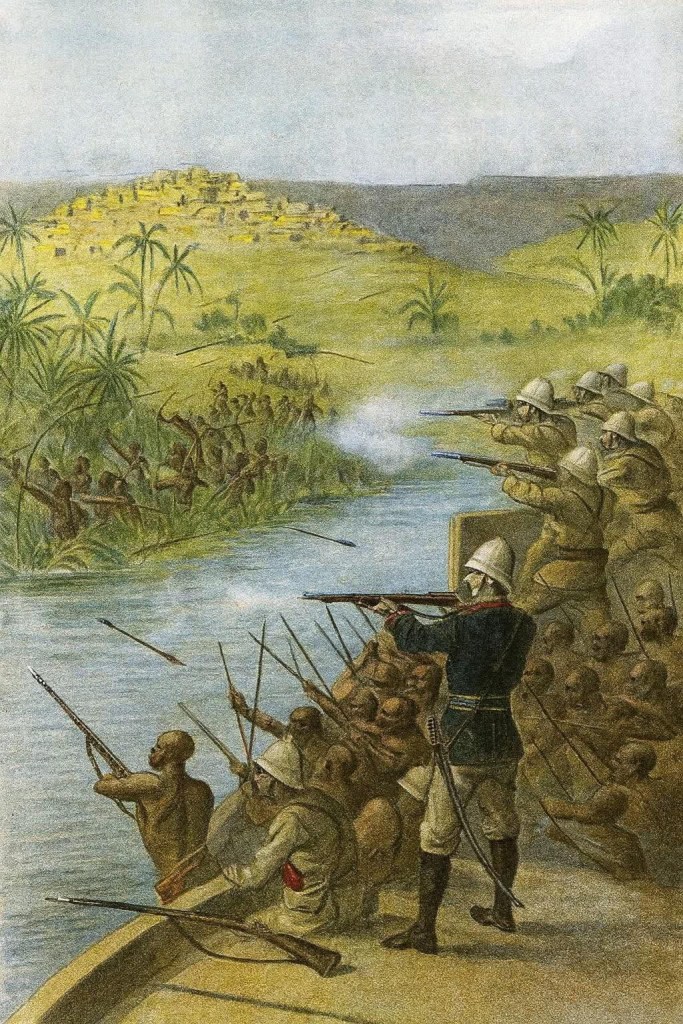
Invasion of Benin Kingdom 1897,a full scale Military action.
Invasion of Benin Kingdom 1897,a full scale Military action.
The invasion of the Benin Kingdom in 1897 was the climax of escalating tensions between the powerful Edo state and British imperial forces seeking to impose colonial control over the region. In January 1897, a British delegation led by James Robert Phillips, the Acting Consul-General of the Niger Coast Protectorate, set out for Benin City despite clear warnings from Benin chiefs that the visit would violate sacred rituals being observed by Oba Ovonramwen Nogbaisi, the reigning monarch. As Phillips and his party approached Benin, they were ambushed near Ugbine village on 4 January 1897, and most of the delegation was killed.
Britain used this incident as justification for a full-scale military retaliation. On 9 February 1897, a heavily armed “punitive expedition” under the command of Admiral Sir Harry Rawson advanced on Benin from multiple directions with naval officers, soldiers, and African auxiliaries. After intense fighting, British forces breached the famous defensive earthworks and entered Benin City on 18 February 1897. Much of the city was set ablaze, and the royal palace was looted. Thousands of priceless artworks—now known globally as the Benin Bronzes—were seized and later sold across Europe to offset the cost of the expedition.
The renowned Benin Walls, an immense system of moats and embankments that had once stretched for hundreds of kilometres and ranked among the largest earthworks in the world, were heavily damaged during the assault. After the fall of the city, large sections of the walls were deliberately dismantled to prevent any future military resistance and to force open the kingdom to colonial administration and trade. Oba Ovonramwen fled but later surrendered in August 1897 and was exiled to Calabar, where he remained until his death in 1914.
The 1897 invasion marked the definitive end of Benin’s independence as a sovereign kingdom and its incorporation into British colonial rule. It also stands as one of the most devastating episodes of cultural destruction and military conquest in West African history, with the wrecking of the Benin Walls symbolizing the collapse of a sophisticated pre-colonial civilization that had endured for centuries.