THEY DIDN’T JUST WANT FREEDOM…
THEY DIDN’T JUST WANT FREEDOM…
They were ready to die for it.
In the aftermath of World War II, the people of Madagascar dared to dream of independence. Exhausted by decades of French colonial rule, forced labor, land seizures, and the scars of wartime exploitation, a new generation of nationalists emerged.
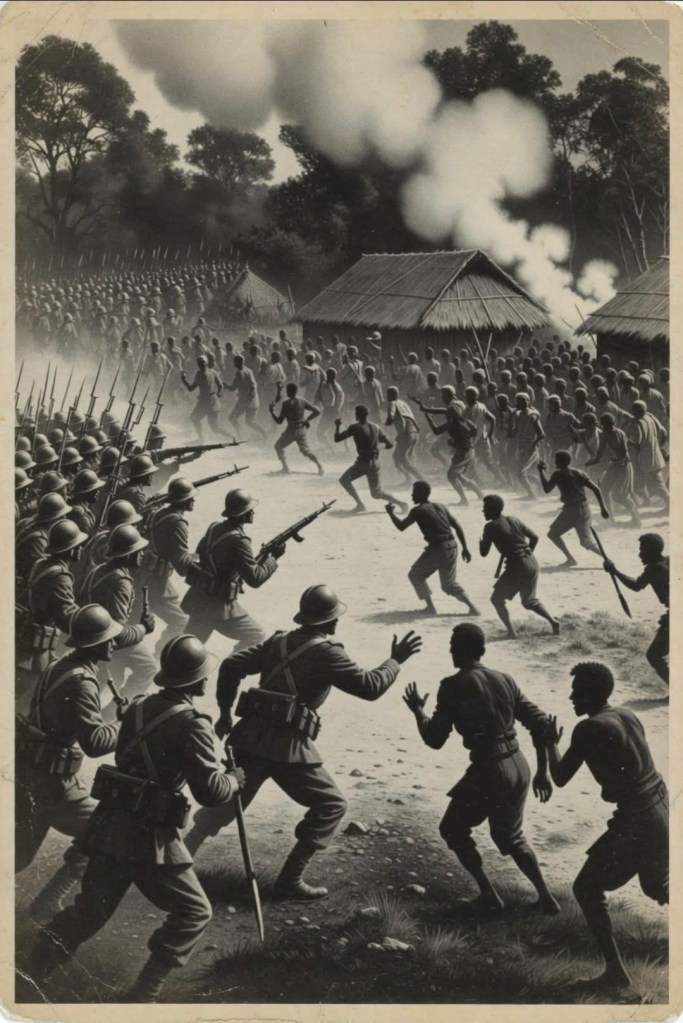
On March 29, 1947, the spark ignited. Coordinated attacks erupted across the eastern regions of the island, from Moramanga to Manakara. Armed mostly with spears, machetes, and a few captured rifles, Malagasy fighters, many of them were veterans who had fought for France in Europe, struck French military posts, plantations, and administrative centers. For a brief, electrifying moment, rebels controlled large parts of the countryside. Hope spread like wildfire through villages and forests.
This was the Malagasy Uprising (or Madagascar Rebellion of 1947–1949), one of the bloodiest and most brutally suppressed anti-colonial revolts in African history. The French response was swift, merciless, and calculated to terrorize. Reinforcements poured in, eventually reaching 18,000 troops, including Senegalese tirailleurs and Foreign Legion units. What began as a military operation quickly turned into a campaign of collective punishment designed to break the will of an entire people.
Villages suspected of supporting the rebels were burned to the ground. Entire communities were massacred. Suspects were rounded up, tortured, and executed on the spot. One of the most infamous atrocities occurred at Moramanga on May 6, 1947: French forces, fearing an attack, opened machine-gun fire on train wagons filled with Malagasy prisoners, many of them members or sympathizers of the MDRM (Mouvement démocratique de la rénovation malgache), the main nationalist political party. Between 120 and 160 people were slaughtered in the wagons.
French forces also used death flights throwing live prisoners out of airplanes, along with systematic rape, starvation tactics, and the destruction of food supplies. The goal was not merely to defeat fighters, but to make the very idea of resistance unthinkable. The human cost was staggering. The MDRM leaders Joseph Raseta, Joseph Ravoahangy, and Jacques Rabemananjara were arrested, despite limited direct involvement in the armed revolt. They faced treason trials; some were sentenced to death (later commuted).
Casualty figures remain bitterly disputed to this day. Official French numbers were revised downward to around 11,000. Independent estimates and contemporary French reports ranged from 30,000 to over 100,000 Malagasy dead, the vast majority civilians killed in the repression, or who perished from famine, disease, and displacement in the forests. In a population of roughly 4 million, this represented an unimaginable loss. The rebellion was largely crushed by late 1948, with scattered resistance continuing into 1949. The most painful truth?
This was not simply a military defeat. It was a deliberate campaign of terror meant to send a clear message across France’s crumbling empire: “Never try this again.”
Yet the uprising planted seeds that would not die. The courage displayed in 1947 became a foundational memory in Madagascar’s long march toward independence, finally achieved in 1960.
Today, the Malagasy Uprising remains one of the least-known chapters of the global anti-colonial struggle. Rarely taught outside Madagascar. Seldom featured in Western documentaries. Often reduced to footnotes.
But these were real people, farmers, teachers, veterans, mothers, and youth who risked everything for tanindrazana(the land of their ancestors) and dignity.
💭 What does it take for ordinary people to rise against overwhelming power?
💔 Why are some colonial atrocities remembered while others are buried?
🔥 How does suppressed memory shape a nation’s future?
If this story moved you:
❤️ Like to honor their sacrifice
💬 Comment your thoughts, What should the world know about 1947?
🔁 Share so this history is no longer erased
Because remembering is resistance. When we forget the courage of the Malagasy people in 1947, we forget what freedom has always cost.
 Hi welcome to my website
This is a powerful and deeply moving piece of historical storytelling. You give voice to a tragedy and act of resistance that far too many people around the world know little about. The way you combine historical detail with emotional humanity makes the Malagasy Uprising feel immediate, personal, and unforgettable.
LikeLiked by 1 person
Thank you very much big brother I really appreciate your support
LikeLike