INDIGENOUS AFRICAN COUNTRIES NAMES
INDIGENOUS AFRICAN COUNTRIES NAMES
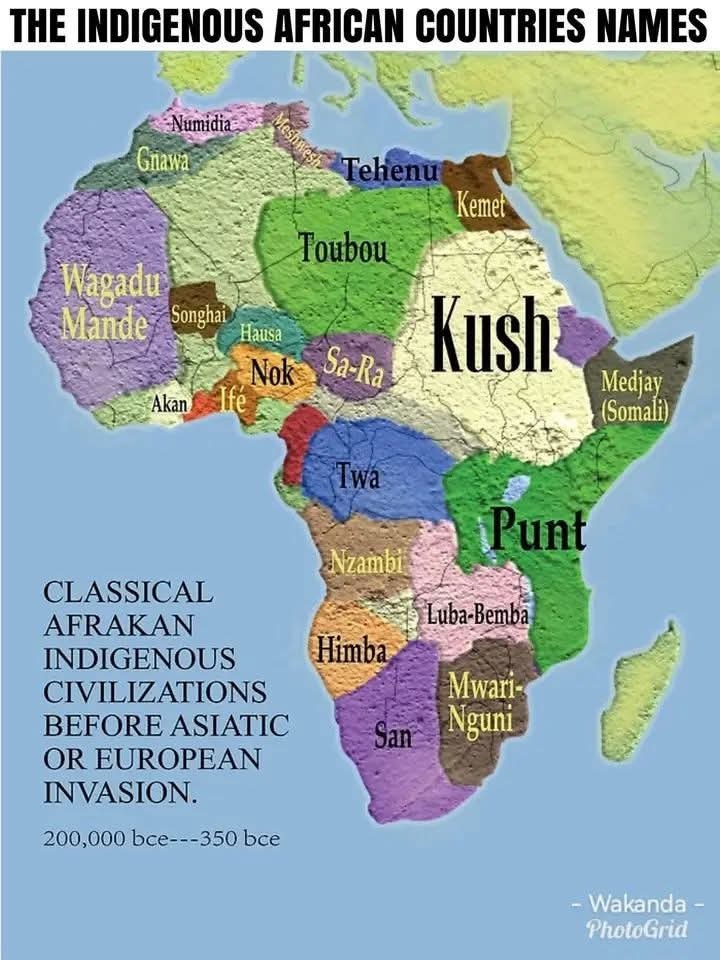
Africa’s rich history of indigenous civilizations was reflected in their territories’ names, which were rooted in local language and culture, providing an accurate historical record that was often obscured by the renaming of these lands during later colonization and conquest.
Before Arab invasions in the 7th century, North Africa contained powerful kingdoms with indigenous names. Ancient Egypt was known locally as Kemet, meaning “the Land of the blacks”. (Obenga, 1992). To its south, Ta-Seti and later Nubia referred to the region that Arab and European powers later called Sudan. The Berber populations used the term Numidia to describe territories in modern-day Algeria, while Mauretania referred to areas in present-day Morocco and western Algeria before the Roman and later Arab reclassifications (Davidson, 1994).
West African empires were known by indigenous names that reflected their political and cultural origins, not the later labels applied by outsiders. For example, the Empire of Ghana was originally called Wagadou (Levtzion & Hopkins, 2000), and the Mali Empire was known as Manden Kurufaba, or “the federation of Manden” (Niane, 1984). The Songhai Empire derived its name from its founding ethnic group. These names emphasize a continuity that was often obscured when Arabs and Europeans renamed them for trade convenience. Similarly, Central African political entities had unique names connected to their systems of governance. The Kongo Kingdom was named for the Bakongo people and its capital, M’banza Kongo (Thornton, 1998). Neighboring empires like Luba and Lunda were also named for their core ethnic and linguistic identities (Vansina, 1966). These indigenous titles stand in direct contrast to subsequent colonial classifications imposed upon the region, such as “Belgian Congo” or “French Equatorial Africa,” highlighting a pre-colonial reality defined by autonomous African states.
In East Africa, the powerful city-states along the Swahili Coast bore indigenous names long before Arab and European incursions. Kilwa Kisiwani, Mombasa, and Zanzibar were thriving centers of trade that developed independently before external domination (Pouwels, 2002). Inland, the Ethiopian state referred to itself as Aksum before the rise of the later Solomonic dynasty (Phillipson, 2012). Great Lakes kingdoms such as Buganda, Bunyoro, and Rwanda had established monarchies whose names survive to this day, resisting complete erasure by colonial renaming. In Southern Africa, indigenous states included the Mapungubwe Kingdom (11th–13th century) and later Great Zimbabwe, whose names reflected the Shona people’s political heritage (Pwiti, 1996). The term Zimbabwe itself derives from the Shona phrase dzimba-dza-mabwe, meaning “houses of stone.” Other groups, such as the Khoisan, also had territorial identifiers erased by colonial naming, as Europeans imposed “Cape Colony,” “Natal,” and later “South Africa.”
References
Phillipson, D. W. (2012). Foundations of an African Civilisation: Aksum and the Northern Horn, 1000 BC–AD 1300. James Currey.
Pouwels, R. L. (2002). Horn and Crescent: Cultural Change and Traditional Islam on the East African Coast, 800–1900. Cambridge University Press.
Levtzion, N., & Hopkins, J. F. P. (2000). Corpus of Early Arabic Sources for West African History. Markus Wiener Publishers.
Thornton, J. K. (1998). Africa and Africans in the Making of the Atlantic World, 1400–1800. Cambridge University Press.
Obenga, T. (1992). Ancient Egypt and Black Africa: A Student’s Handbook for the Study of Ancient Egypt in Philosophy, Linguistics, and Culture. Karnak House.