
They didn’t just kill him. They turned his suffering into a public warning.
They didn’t just kill him. They turned his suffering into a public warning.
And according to historical accounts, he remained alive for three days.
Three days.
Not on a battlefield.
Not after a fair trial.
Not for committing a crime proven in court.
But because he was an enslaved African living under a system that believed terror was more powerful than mercy.
- Dutch Suriname.
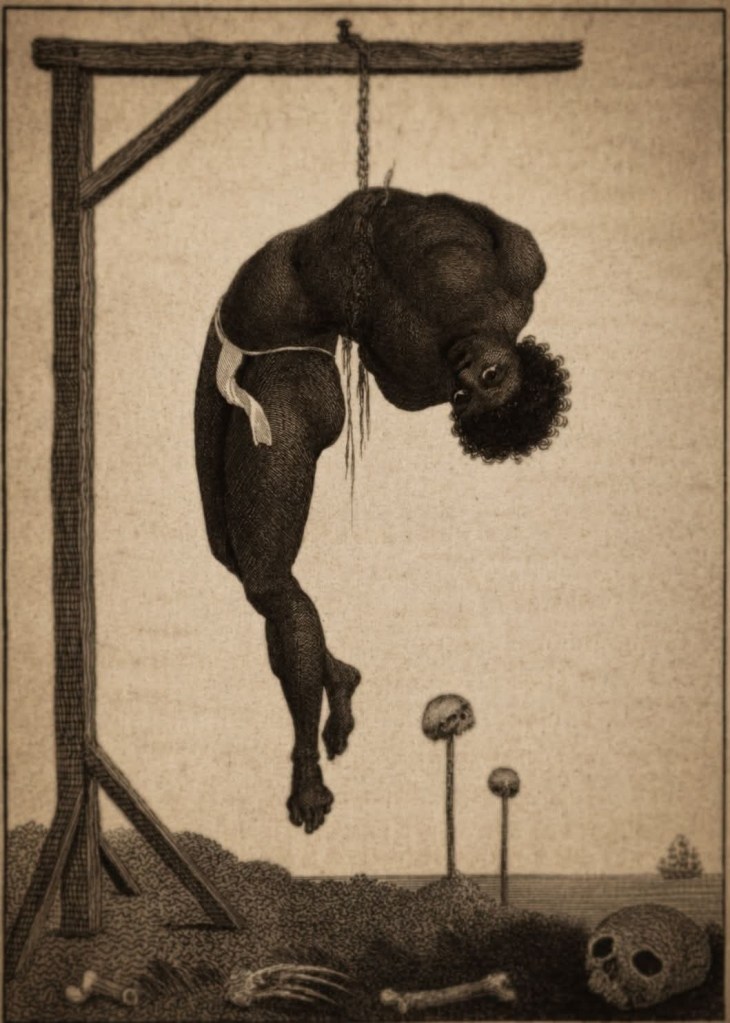
A man whose name has largely been lost to history was condemned to one of the most brutal punishments ever recorded during the era of slavery.
A hook was driven through an incision near his ribs.
Then he was hoisted into the air.
Alive.
Below him stood the skulls of other enslaved Africans who had already been executed.
Their remains were displayed as a message.
A warning.
A spectacle.
A declaration of what could happen to anyone who dared resist.
This wasn’t punishment.
It was psychological warfare.
The goal was not simply to kill one man.
The goal was to make thousands of others watch.
To make them fear freedom.
To make them fear rebellion.
To make them believe there was no escape.
And perhaps the most disturbing part is that this wasn’t an isolated act.
Across the Atlantic slave system, public torture, mutilation, executions, and displays of human suffering were often used to maintain control over enslaved populations.
When many people think of slavery today, they imagine forced labor.
Long hours in the fields.
Chains.
Whips.
But slavery was also something darker.
It was a system built on calculated terror.
A system that tried to break the human spirit before it could even imagine resistance.
The man in this image has no famous monument.
No widely known biography.
No descendants telling his story on television.
For generations, his suffering existed mostly as a footnote buried in old records and forgotten archives.
Yet his story forces us to confront a painful truth.
History is not only made by kings, presidents, generals, and empires.
Sometimes history survives in the lives of people whose names were deliberately erased.
People who endured unimaginable cruelty so others would be too afraid to fight back.
And that raises a haunting question.
The world remembers the names of many rulers who ordered these acts.
But not the name of the man who endured them.
What does that say about the way history chooses who deserves to be remembered?
 Hi welcome to my website