LOOKING AT AFRICAN ART WITH AFRICAN EYES: MATTERS ARISING FROM TODAY’S POST
LOOKING AT AFRICAN ART WITH AFRICAN EYES: MATTERS ARISING FROM TODAY’S POST
One of the most unintelligent comments I encountered regarding the question of whether this image could be used to depict an angel was the claim that it is “ugly.”
According to some people, an angel must always conform to their personal idea of physical beauty. Therefore, because this figure does not resemble the images they are accustomed to seeing, they dismiss it as ugly and unworthy of representing a heavenly being.
But such a reaction reveals a profound ignorance of African art and its purpose.
Do we really think that the artist who carved this figure had no sense of beauty?
The same African artistic traditions produced some of the most admired sculptures, masks, carvings, and human figures in the world. These artists were not careless people. They were intelligent observers of life, culture, spirituality, and nature.
Traditional African art was often not intended to be a realistic photograph of a person. Nor was it always concerned with physical attractiveness. Its purpose was deeper.
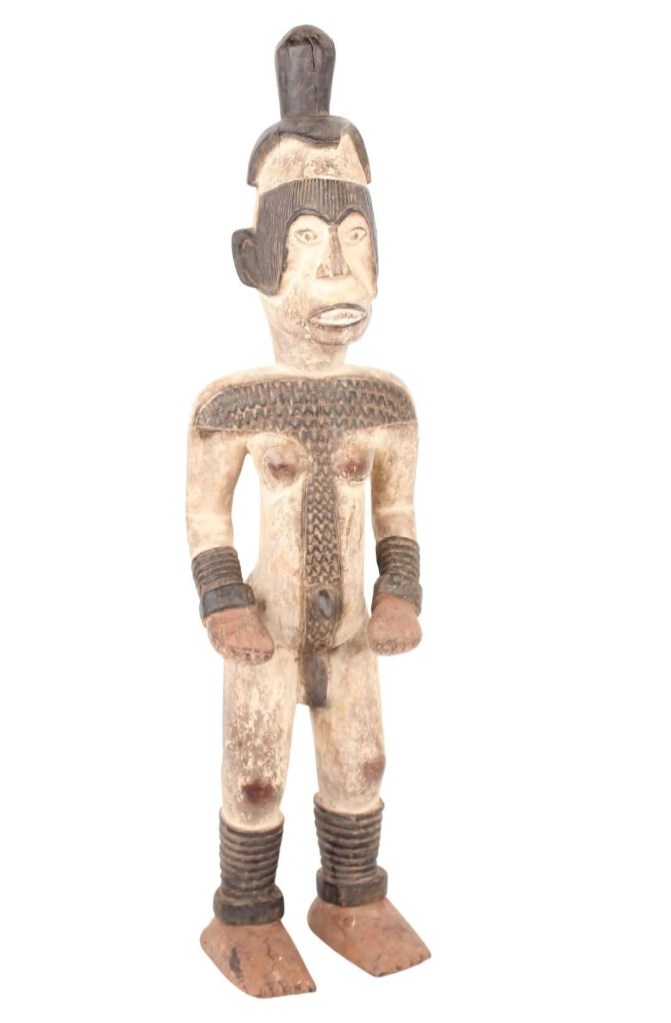
Look carefully at this figure.
Why is the head shaped in this way?
Why are the eyes, mouth, and ears emphasized?
Why are there bands around the wrists and ankles?
Why is the body decorated with patterns?
Why is the hairstyle or headpiece presented in this particular form? Why are some parts of the body exposed while others are highlighted?
None of these details is accidental.
In African artistic traditions, every feature can carry meaning. The artist is communicating ideas about identity, status, spirituality, power, protection, fertility, wisdom, ancestry, or the relationship between the visible and invisible worlds.
The task of the viewer is not simply to ask, “Is this beautiful?”
The real question is: “What is the artist trying to communicate?”
Only when we gather together the meanings hidden in the posture, symbols, proportions, adornments, and patterns can we begin to understand the message being conveyed.
Ironically, many people who praise ancient Greek, Roman, Asian, or European religious art often refuse to make the same effort when confronted with African art. They dismiss what they do not understand.
An artwork like this should first be studied before it is judged.
The tragedy is that many Africans have learned to appreciate the symbols of other civilizations while remaining blind to the language and genius of their own.
Sàd!