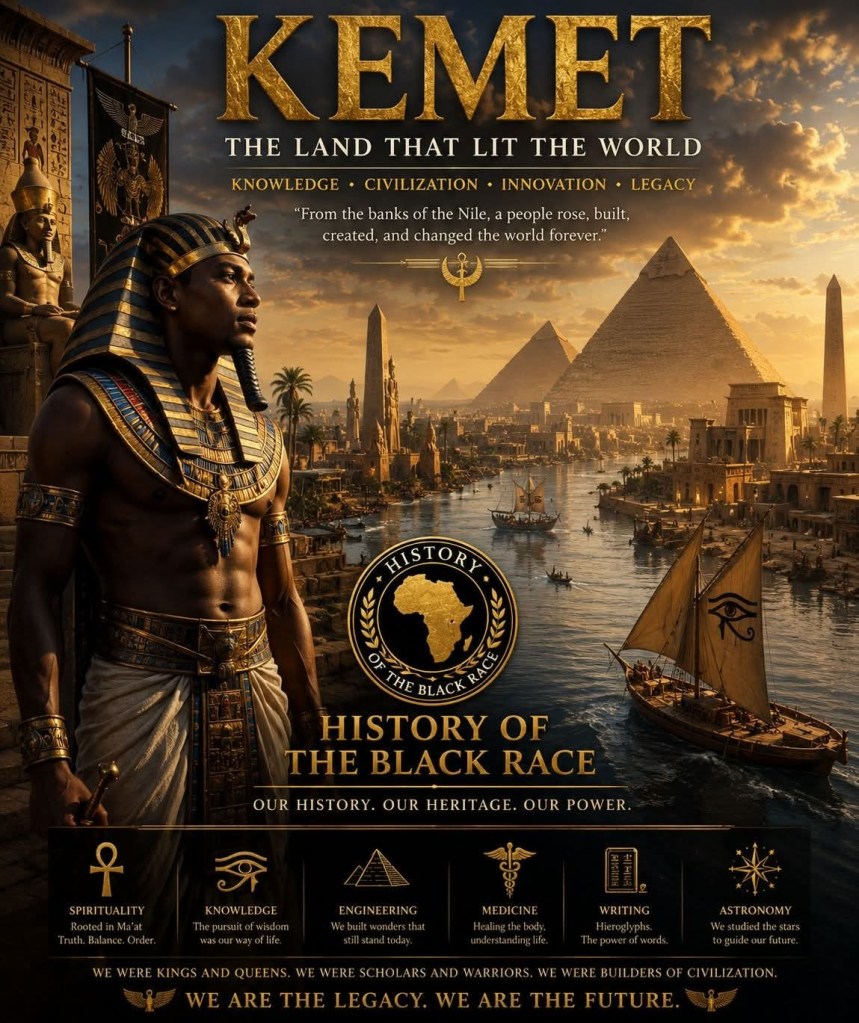
KEMET: THE LAND THAT LIT THE WORLD
KEMET: THE LAND THAT LIT THE WORLD
There was a time when the banks of the Nile gave rise to one of the greatest civilizations humanity has ever known. Long before many of the world’s famous empires emerged, Kemet—the ancient name for Egypt, meaning “The Black Land” because of the rich, fertile soil deposited by the Nile—stood as a beacon of knowledge, innovation, and civilization.
Kemet was more than a kingdom. It was a center of learning, architecture, science, medicine, engineering, mathematics, astronomy, agriculture, and government. Its people built magnificent temples, towering pyramids, and thriving cities that continue to inspire awe thousands of years later. Scholars traveled from distant lands to learn from its wisdom, while its craftsmen and engineers created works that still challenge modern understanding.
The people of Kemet believed that a nation should be built on Ma’at—truth, justice, balance, harmony, and righteousness. These principles shaped their laws, leadership, and daily lives. Their civilization flourished because they valued knowledge, discipline, unity, and hard work.
But like many great civilizations, Kemet faced centuries of challenges. Internal political struggles weakened the kingdom, making it vulnerable to foreign powers. Over time, it came under the control of the Assyrians, followed by the Persian (Achaemenid) Empire. In 332 BCE, it was conquered by Alexander the Great of Macedonia. After his death, Egypt was ruled by the Ptolemaic Dynasty, a Greek ruling family. Finally, in 30 BCE, after the death of Cleopatra VII, Egypt became a province of the Roman Empire.
It is important to understand that Kemet was not colonized by modern European colonial powers in the ancient period. Instead, it experienced successive conquests by neighboring and Mediterranean empires over many centuries. These conquests gradually ended the independence of ancient Egyptian civilization, though its culture and influence endured.
The story of Kemet is not simply about conquest or decline—it is about endurance. Its monuments still stand. Its ideas still influence the world. Its achievements remain among humanity’s greatest accomplishments.
Today, Kemet reminds us that Africa has always been a cradle of civilization, innovation, and human achievement. The lesson is not to live only in the glory of the past, but to draw inspiration from it. Our ancestors proved that greatness is possible through wisdom, unity, discipline, and vision.
Let history awaken confidence rather than division. Let it inspire young Africans to pursue knowledge, preserve their heritage, and build a future worthy of those who came before.
History of the Black Race
“A people who know the greatness of their past are better prepared to build the greatness of their future.
History of the black race