Who Really Discovered Africa?
Who Really Discovered Africa?
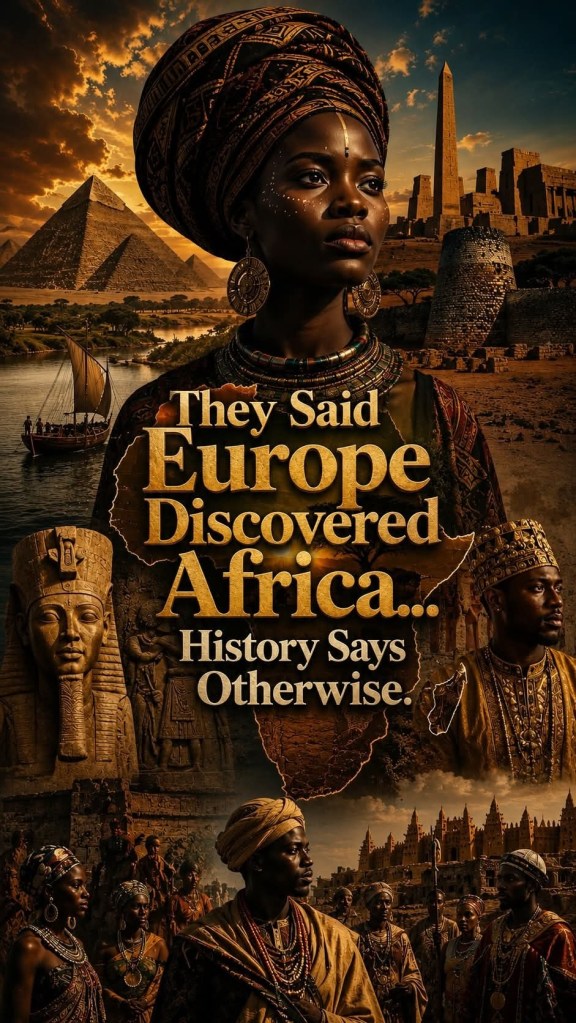
When people ask, “Who discovered Africa?” the question itself deserves to be questioned.
How do you discover a continent where people were already living?
How do you discover a land that had cities, kingdoms, universities, trade routes, engineers, astronomers, artists, and millions of inhabitants?
The truth is that Africa was never “discovered.” It was already known—first and foremost by Africans themselves.
Long before European ships appeared on African shores, Africa was home to powerful civilizations. The pyramids of ancient Egypt had stood for thousands of years. The Kingdom of Kush rivaled its neighbors in military strength and culture. Aksum connected Africa to international trade across the Red Sea. The Mali Empire became one of the wealthiest empires in history through commerce, scholarship, and governance. Great Zimbabwe built massive stone cities without mortar, astonishing later visitors.
These were not isolated societies. They traded gold, salt, ivory, textiles, iron, and knowledge across the Sahara, the Indian Ocean, and the Mediterranean. African merchants met Arab, Persian, Indian, and Asian traders centuries before most Europeans sailed beyond their own coastlines.
So where did the idea that Europe “discovered” Africa come from?
It came from the Age of Exploration—but from a European point of view.
When Portuguese explorers reached parts of West and Southern Africa in the 15th century, they were not arriving on empty shores. They were entering lands that had rulers, laws, languages, markets, armies, and diplomatic traditions. They discovered routes that were new to Europe—not a continent that had been unknown to humanity.
History often reflects the perspective of those who recorded it.
For centuries, European textbooks described exploration as if the world only became important when Europeans arrived. But Africa had already been shaping world history. African gold fueled international economies. African knowledge influenced mathematics, medicine, agriculture, and architecture. African civilizations maintained complex political systems while many parts of Europe were still emerging from the early Middle Ages.
Even the earliest humans originated in Africa. The oldest known fossils of Homo sapiens have been found on the continent, making Africa the birthplace of our species. In a profound sense, humanity did not discover Africa. Humanity began there.
This is why many historians reject the phrase “the discovery of Africa.” A more accurate description is that Europeans explored, mapped, and established direct sea routes to regions of Africa that were previously unfamiliar to Europe.
Words matter because they shape the way we think.
To say Africa was discovered suggests it had no history until outsiders arrived. The historical evidence tells a different story. Africa had history, civilization, innovation, and influence long before European exploration.
Perhaps the better question is not, “Who discovered Africa?”
Perhaps the real question is:
Why were generations taught that a continent filled with civilizations had to be discovered at all?