HISTORY BEHIND JUSTICE CHARLES DADI ONYEAMA you should know.
HISTORY BEHIND JUSTICE CHARLES DADI ONYEAMA you should know.
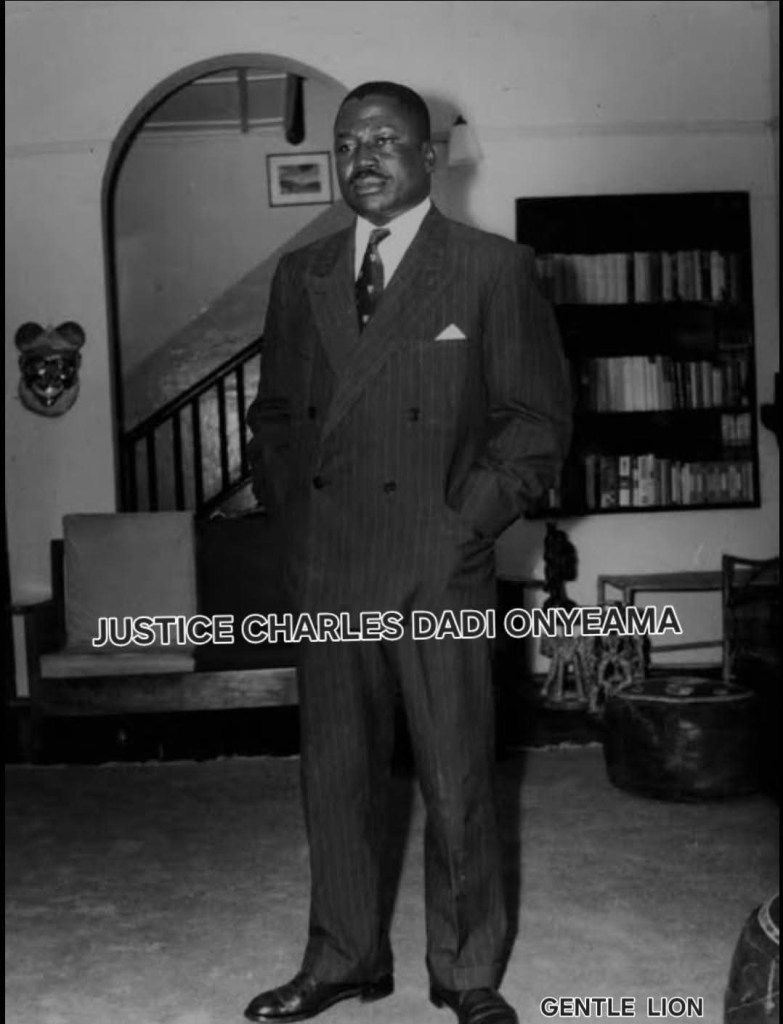
Justice Charles Dadi Umeha Onyeama (April 26, 1916 – September 5, 1999) stands as one of the most towering and intellectually formidable legal minds in African history. As a trailblazing jurist, he etched his name into history by becoming the very first Nigerian judge to sit on the International Court of Justice (ICJ) at The Hague.
His journey traces a remarkable path from the heart of the Agbaja region to the highest legal echelons in the world.
1. Lineage background: Son of an “African God”
Charles Dadi Onyeama was born in Enugu. He was royal by birth, the son of the legendary and powerful Chief Onyeama n’Eke, an extraordinarily influential and autocratic ruler who dominated the Agbaja region of Igboland during the colonial era.
Growing up in the shadow of his father’s massive historical legacy, Charles was set on a path of premium education early on. His academic journey took him across top institutions:
Primary Education: Government School in Bonny.
Secondary Education: Government College, Umuahia, and the prestigious King’s College, Lagos.
Universities: He crossed borders to attend Achimota College in Ghana, before moving to the United Kingdom to study at University College London (UCL) and Brasenose College, Oxford between 1940 and 1941.
He was subsequently called to the English Bar at Lincoln’s Inn.
2.Climb Through the Nigerian Judiciary
Upon returning to Nigeria, Onyeama initially balanced administrative and political roles before fully committing to the bench.
He served as an Assistant District Officer in Lagos (1944) and was a member of the colonial Legislative Council from 1944 to 1946.
He also served in the Eastern House of Assembly and contributed to the early committees drafting Nigeria’s pre-independence constitutions.
His true calling, however, was the judiciary:
In 1952, he was appointed a Chief Magistrate.
By 1957, he became a High Court Judge, serving in Western Nigeria and later Lagos.
In 1964, he reached the pinnacle of the nation’s judiciary when he was appointed a Justice of the Supreme Court of Nigeria. He sat on the apex court during a volatile era in Nigeria’s history, serving alongside other legendary judicial pioneers like Sir Adetokunbo Ademola, Sir Lionel Brett, and Justice Chike Idigbe.
3.The Historic Leap to the World Court (ICJ)
In 1966, the International Court of Justice faced immense geopolitical pressure. Following a highly controversial and deeply unpopular ICJ judgment regarding South West Africa (now Namibia), African nations fiercely demanded proper judicial representation on the global stage.
The seat dedicated to the British Commonwealth became vacant. In November 1966, backed by a wave of continental support, Justice Onyeama was elected to the International Court of Justice.
He served a full nine-year term from 1967 to 1976, breaking boundaries as the first Nigerian to do so. His presence on the global bench helped restore continental faith in international law. After completing his term, he was succeeded by another iconic Nigerian jurist, Dr. Taslim Olawale Elias.
While at the ICJ, his international repute was so high that he was appointed as one of the elite international judges for the 1971 Beagle Channel Arbitration, which successfully resolved a tense territorial dispute between Argentina and Chile.
4.Later Years and Continued Global Service
Returning to Nigeria in 1976, Justice Onyeama did not simply retire. The federal government consistently called upon his flawless integrity to head major national boards:
He served as Chairman of the Board of the University of Ife (now OAU) Teaching Hospital Complex.
He chaired the National Orthopaedic Hospital Management Board.
In 1980, the United Nations Secretary-General appointed him as a Special Representative to examine human rights violations in designated global regions.
From 1982 to 1990, he continued his international judicial legacy by serving as a judge at the World Bank Administrative Tribunal.
For his immense service to humanity and jurisprudence, he was honored by the Nigerian government with the national award of Commander of the Federal Republic (CFR) in 1981 and received an honorary Doctor of Laws (LL.D) from the University of Nigeria, Nsukka (UNN).
5. A Lasting Family Legacy
Justice Onyeama passed away on September 5, 1999, but his family lineage continues to deeply influence Nigerian and international spheres.
Geoffrey Onyeama: His son, who served with distinction as Nigeria’s Minister of Foreign Affairs (2015–2023) after a long career at the World Intellectual Property Organization (WIPO).
Dillibe Onyeama: His late son, a famed author and journalist who made history as the first Black boy to graduate from Eton College in the UK, later writing the groundbreaking book A Black Boy at Eton (originally Nigger at Eton), and authoring the definitive biography of his father, titled Dadi: The Man, The Legend.
Justice Charles Dadi Onyeama is remembered not just as a brilliant judge, but as a fearless, unbending, and principled pioneer who took the brilliance of the Nigerian legal mind and proved its exceptional worth to the entire world.
Follow this page to know more.
Gentle Lion