Dodan Barracks in the 1970s: Power, Protest and a Defining Symbol of Military Rule
Dodan Barracks in the 1970s: Power, Protest and a Defining Symbol of Military Rule
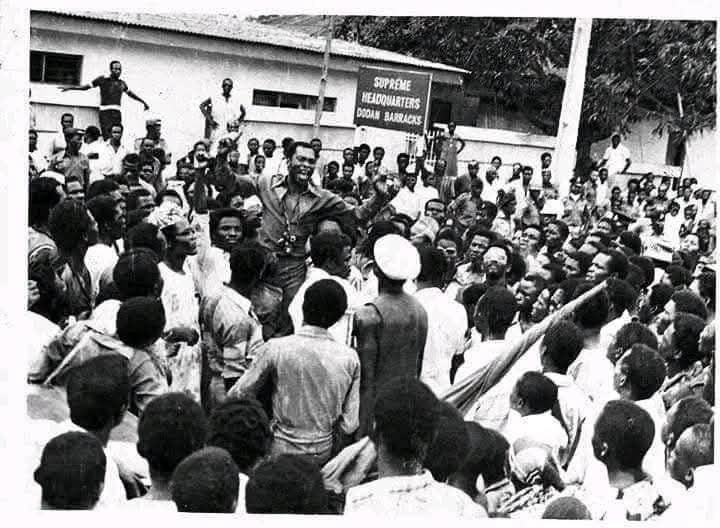
This historic photograph shows a large crowd gathered outside Dodan Barracks in Ikoyi, Lagos, during the 1970s, a period when Nigeria was under military rule. At the time, Dodan Barracks served as the seat of the Federal Military Government and the official residence of Nigeria’s Head of State, making it one of the country’s most heavily guarded and politically significant locations.
Public demonstrations near the barracks were rare and often viewed as acts of extraordinary courage, given the strict security measures surrounding the military headquarters.
The image also evokes memories of the confrontation between Fela Anikulapo Kuti and the military authorities. In February 1977, soldiers launched a violent raid on Kalakuta Republic, Fela’s communal residence and recording studio, after years of tension between the Afrobeat icon and the military government.
During the assault, Kalakuta Republic was set ablaze, hundreds of residents were beaten, and Fela’s elderly mother, Chief Funmilayo Ransome-Kuti, was allegedly thrown from an upstairs window. She sustained severe injuries and died several months later from complications arising from the attack.
The tragedy profoundly affected Fela. In response, he composed some of his most powerful protest songs, including “Coffin for Head of State” and “Unknown Soldier,” condemning the military and demanding accountability for the attack and his mother’s death. Through his music, Fela immortalised one of the darkest episodes of Nigeria’s military era and continued his outspoken criticism of authoritarian rule.
The name Dodan Barracks itself has an important historical origin. It was named after Dodan, a town in the Arakan region of present-day Myanmar (formerly Burma).
During the Second World War, Nigerian soldiers serving in the Royal West African Frontier Force (RWAFF) fought alongside Allied forces in the Burma Campaign. The barracks was named in honour of their bravery and contribution during that
campaign.
Following Nigeria’s return to democratic rule and the relocation of the Federal Capital to Abuja, Dodan Barracks ceased to function as the nation’s seat of government.
Nevertheless, it remains an important historical landmark, symbolising both Nigeria’s military past and the struggles for democracy, civil rights, and freedom of expression that defined much of the country’s post-independence history.