
Mary Slessor with Missionaries and Colonial Officials in Nigeria
Mary Slessor with Missionaries and Colonial Officials in Nigeria
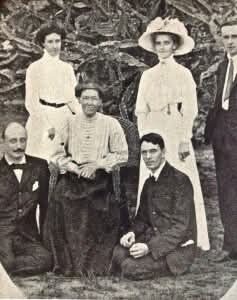
This historic photograph shows Mary Slessor seated at the centre during a formal gathering with fellow missionaries of the Calabar Mission and British colonial officials in southeastern Nigeria.
Unlike the simple local clothing she usually wore while living among the Efik and Ibibio communities, Slessor appears here in more formal European-style dress, reflecting the official nature of the occasion.
A Missionary Who Became Part of the Community
Born in Aberdeen, Scotland, in 1848, Mary Slessor arrived in what is now Cross River State in 1876 under the United Presbyterian Church of Scotland. Rather than remaining within missionary compounds, she immersed herself in local communities, learned local languages, and travelled extensively into areas that many Europeans had not entered.
She became widely respected for her humanitarian work, particularly her efforts to protect children and improve the welfare of women.
Campaign Against Twin Infanticide
Mary Slessor is best remembered for opposing the practice of killing twins, which existed among some communities because twins were believed to bring misfortune. She rescued and adopted many children who would otherwise have been abandoned or killed.
Modern historians note, however, that customs varied between communities, and accounts written during the colonial period sometimes oversimplified or generalised local beliefs. Even so, there is broad historical agreement that Slessor devoted much of her life to caring for vulnerable children and advocating against practices she believed endangered them.
Beyond Missionary Work
Slessor also served as a Vice-Consul in parts of the Protectorate of Southern Nigeria, where she mediated disputes and worked alongside local leaders and colonial administrators. Her influence extended beyond religious work into education, healthcare, and local governance.
She remained in Nigeria until her death on 13 January 1915 in Use Ikot Oku, near Calabar. She was given a state funeral by the British colonial administration in recognition of her service.
Today, Mary Slessor remains one of the most well-known missionaries associated with Nigeria, particularly in Cross River and Akwa Ibom States, where schools, churches, roads, and institutions bear her name.
Mary Slessor seated with fellow missionaries and colonial officials during a formal gathering in colonial Nigeria.
Sources: Mary Slessor papers; United Presbyterian Church archives; National Archives (UK); historical records of the Calabar Mission; Wikipedia.
 Hi welcome to my website