THE BANGOURA FAMILY: FROM THE ANCIENT SOSSO WORLD TO MODERN GUINEA
THE BANGOURA FAMILY: FROM THE ANCIENT SOSSO WORLD TO MODERN GUINEA
The history of the Bangoura family cannot be understood without first understanding the deeper history of the western Sahel.
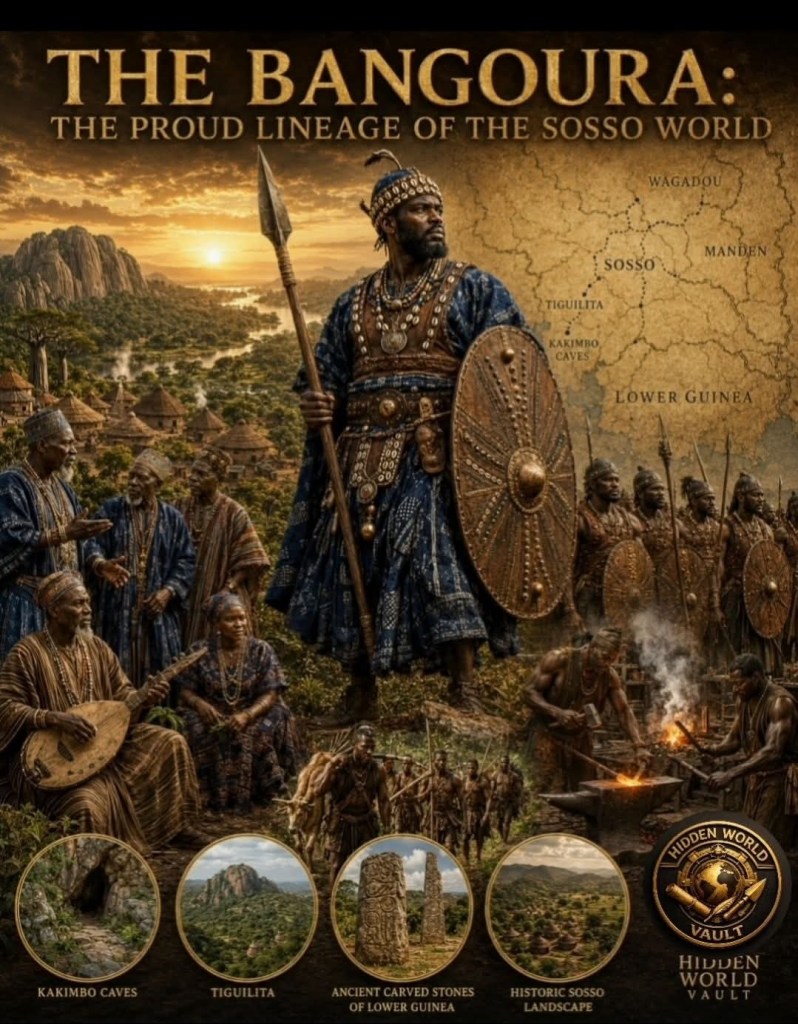
According to the historical framework explored by Hidden World Vault, the story begins before the rise of Wagadou (Ancient Ghana), with the ancient populations remembered in Mandé oral traditions as the Kakolo (Kakoro), one of the earliest peoples associated with the western Sahel.
Over many centuries, these early populations mixed with and were gradually joined by the people who would later become known as the Soninké, founders of the Kingdom of Wagadou. Rather than replacing one another, these communities increasingly formed a shared cultural and political world.
From this long process of interaction eventually emerged several later identities, including the Sosso, from whom the modern Susu largely developed.
Within this historical tradition, the Bangoura are remembered as one of the important lineages of the Sosso world.
- The Meaning of Bangoura
Several oral traditions explain the name by dividing it into:
● Ban — to refuse
● Kora/Koura — enemy or adversary
● Ra — leader or chief
According to this traditional interpretation, Bangoura refers to:
“The leader who refused to submit to his enemy.”
Whether this reflects the true historical etymology remains uncertain, but it remains an important explanation preserved within oral tradition.
- Bangoura in Sosso Tradition
(a) Sosso traditions remember the Bangoura as courageous warriors, protectors of their communities, and respected political leaders.
(b) Some traditions also associate them with Fakoli Koroma (Fakoly), one of the most celebrated military figures of the Sosso period, although different oral traditions disagree about the precise nature of that relationship.
(c) Other Susu traditions remember early Bangoura rulers in Lower Guinea and connect them with ancient sites such as:
● Kakimbo
● Tiguilita
● Ancient carved stones
These traditions reflect the deep historical presence of Bangoura families in coastal Guinea, although the chronology and identities of the earliest rulers remain subjects of ongoing historical research.
- Bangoura Across West Africa
Today the surname appears in several forms:
● Bangoura — Guinea
● Bangura — Sierra Leone
● Bankoura / Bankora — parts of Burkina Faso
These variations are best explained by centuries of migration, local pronunciation, and colonial spelling systems rather than by different origins.
- Bangoura and the Susu
Today the Bangoura surname is strongly associated with the Susu people, particularly in Guinea and Sierra Leone.
However, from the perspective of the historical continuum explored by Hidden World Vault, the Susu identity itself emerged through centuries of interaction among earlier populations, including ancient Kakolo communities, Soninké influences, and the political evolution of the Sosso state.
In this understanding, Bangoura history forms part of that larger story rather than existing in isolation.
- A Note on Historical Interpretation
Many accounts of Bangoura history come from oral traditions, which are invaluable sources of African historical memory. At the same time, some claims, such as exclusive descent from a single ancestor, unique ownership of the Sosso Empire, are not established by the broader historical scholarship and should be presented as traditions rather than universally accepted historical facts.
- The history of the Bangoura family, like that of many great West African lineages, is therefore best understood through a combination of oral tradition, linguistics, archaeology, anthropology, and written historical sources.
The story of the Bangoura is ultimately part of the much older story of the peoples who helped shape the Mandé world, from the ancient Kakolo, through Wagadou and Sosso, to the Susu communities of today.