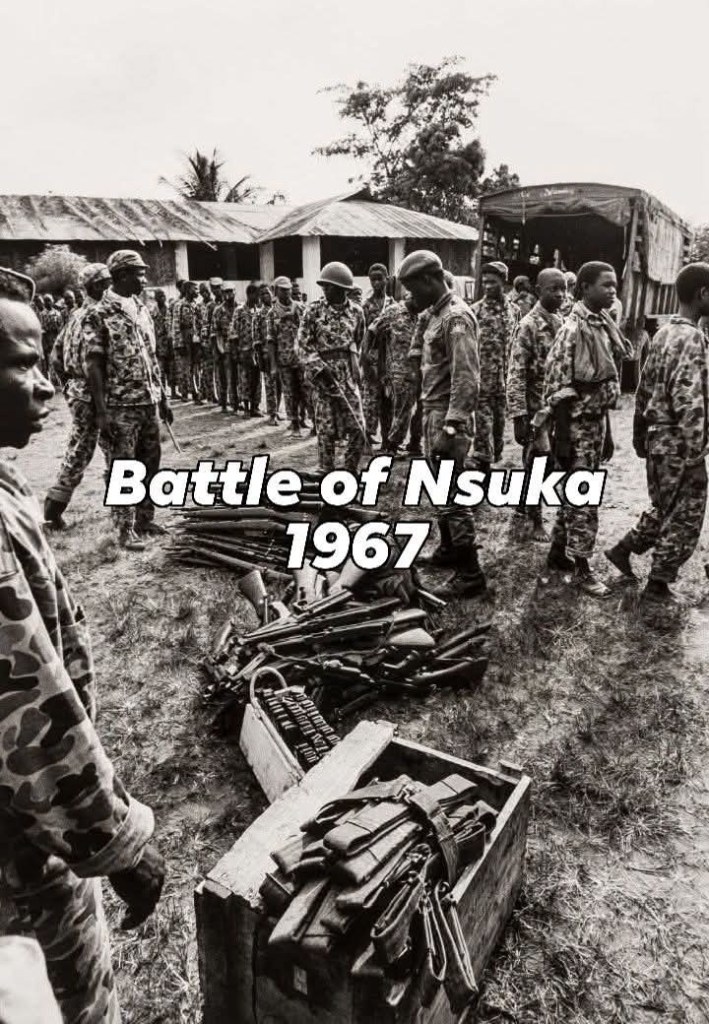
Battle of Nsukka (July 1967)
Battle of Nsukka (July 1967)
The Battle of Nsukka was one of the first major battles of the Nigerian Civil War (Biafran War). It took place in July 1967, shortly after the Republic of Biafra declared independence on 30 May 1967.
The battle was important because Nsukka lay on the northern frontier of Biafra and controlled one of the main roads leading into the Igbo heartland.
Background
After Biafra declared independence, the Nigerian Federal Military Government decided to restore control by force.
The first major offensive was launched from the north by the 1st Division of the Nigerian Army under Muhammadu Buhari? Actually commander was Mohammed Shuwa leading one of the key brigades, under the overall command of Mohammed Shuwa and the division commanded by Mohammed Inuwa Wushishi? Early in the war, operational command was under Hassan Usman Katsina before later changes. (Accounts differ on specific command responsibilities during the opening phase.)
Biafran forces defending Nsukka were lightly equipped and had fewer experienced soldiers than the Federal troops.
Why Nsukka mattered
Nsukka was strategically important because it:
Guarded the northern entrance into Biafra.
Sat on the road linking northern Nigeria with Enugu, the Biafran capital.
Was home to the University of Nigeria, one of Nigeria’s leading universities.
The Battle
In early July 1967, Federal forces advanced south from the north toward Nsukka.
Nigerian troops used superior firepower, including artillery and armored vehicles.
Biafran defenders resisted fiercely but lacked heavy weapons and ammunition.
After several days of fighting, Federal forces captured Nsukka.
Aftermath
The fall of Nsukka had several important consequences:
It gave the Federal Army its first significant territorial success in the war.
Many civilians fled deeper into Biafra to escape the fighting.
The loss exposed the road to Enugu, increasing pressure on the Biafran capital.
Although Biafra later launched its famous Mid-West invasion in August 1967 to shift the war, it never regained lasting control of Nsukka.
Casualties
The exact number of casualties is unknown. Both sides suffered military losses, and many civilians were displaced as the front moved south.
Historical significance
The Battle of Nsukka demonstrated that:
The war would be a large-scale conventional conflict rather than a brief uprising.
The Federal Government intended to recapture Biafra step by step.
Biafra would have to rely on determined resistance and limited resources against a larger, better-equipped army.
HISTORY