THE DAY EGYPT CHANGED FOREVER
THE DAY EGYPT CHANGED FOREVER | The Arab Invasion That Still Shapes Africa
What if I told you that one invasion over 1,300 years ago completely changed Egypt forever?
Not just its rulers…
Not just its religion…
But its language, culture, identity, and even the course of African history.
Yet, this is one of the most debated events in history.
Some call it a liberation.
Others call it a conquest.
Some see it as the birth of a great civilization.
Others see it as the end of an ancient one.
So… what really happened?
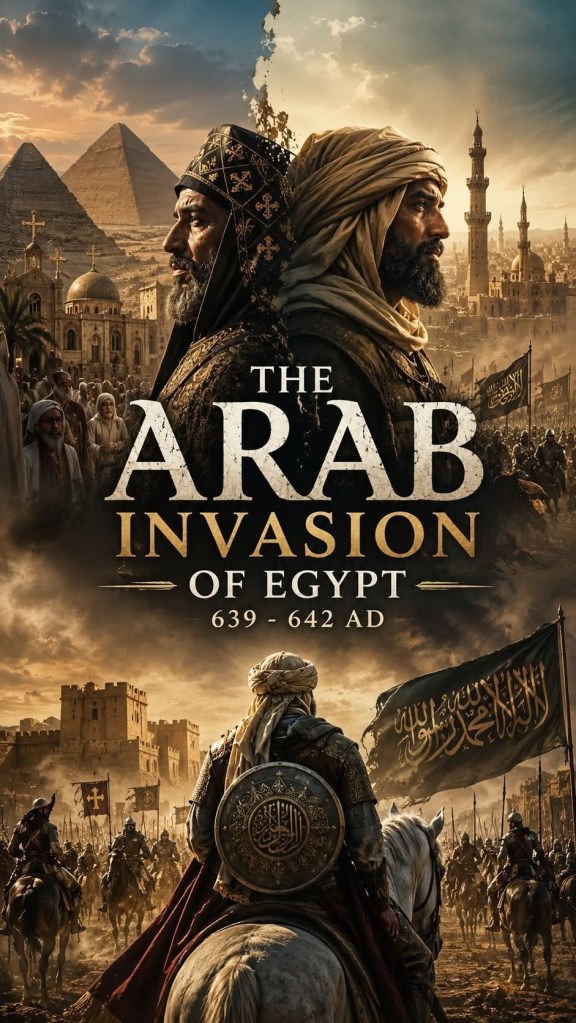
Let’s go back to the year 639 AD.
Long before the Arabs arrived, Egypt was already an ancient civilization thousands of years old. The pyramids had stood for over 3,000 years. The Pharaohs were gone, but their legacy remained.
At that time, Egypt was no longer ruled by Egyptians.
It was controlled by the Byzantine Empire—the eastern half of the Roman Empire.
Most Egyptians were Coptic Christians. They spoke the Coptic language, the last direct descendant of the language of the ancient Egyptians.
But life was not easy.
The Byzantine government imposed heavy taxes, and many Copts believed they were being mistreated because of religious disagreements with the imperial church.
Then something extraordinary happened.
A new religion had emerged in Arabia—Islam.
Within just a few years, Muslim armies defeated the mighty Persian Empire and captured Syria and Palestine.
Now only one great prize remained…
Egypt.
But why Egypt?
Because Egypt wasn’t just another country.
It was one of the richest lands on Earth.
The Nile fed millions.
Its wheat supplied much of the Mediterranean.
Its ports connected Africa, Asia, and Europe.
Whoever controlled Egypt controlled wealth, trade, and power.
The mission was given to a commander named Amr ibn al-As.
With an army that was small compared to the Byzantine forces, he crossed the Sinai Desert and marched into Egypt.
Think about that for a moment.
A relatively small army dared to challenge one of the world’s greatest empires.
The biggest obstacle stood ahead—the massive Fortress of Babylon, near present-day Cairo.
Its walls were enormous.
Its soldiers were experienced.
The Byzantines believed it could not fall.
But after months of siege, the fortress surrendered.
The road to Egypt lay open.
Next came Alexandria.
One of the greatest cities in the world.
A center of commerce, learning, and Christianity.
When Alexandria fell in 642 AD, Byzantine rule in Egypt effectively came to an end.
But here’s where history becomes far more complicated than many people imagine.
Did every Egyptian welcome the Arabs?
No.
Did every Egyptian fight against them?
Also no.
Some Coptic Christians hoped the new rulers would treat them better than the Byzantines.
Others resisted.
Many ordinary people simply wanted peace after years of war and heavy taxation.
History is rarely black and white.
Now here’s another myth that needs correcting.
Many people believe Egypt became Muslim overnight.
It didn’t.
For centuries after the conquest, most Egyptians remained Christians.
Churches stayed open.
The Coptic language continued to be spoken.
Conversions to Islam happened gradually over hundreds of years through a complex mix of religious conviction, social change, economic incentives, and cultural integration.
Another huge transformation followed.
Arabic slowly replaced Coptic as the main language of Egypt.
Today, millions of Egyptians speak Arabic, while Coptic survives mainly in the liturgy of the Coptic Orthodox Church.
Think about how profound that is.
A language that traced its roots back to the ancient Pharaohs was gradually replaced over centuries.
The Arabs also founded a new city called Fustat.
Over time, that city grew into what would eventually become Cairo—one of the greatest cities in Africa and the Islamic world.
From Egypt, Islam spread across North Africa through trade, migration, diplomacy, scholarship, and, in some places, conquest.
Centuries later, powerful African kingdoms such as Mali and Songhai would become renowned centers of Islamic learning.
So was the Arab invasion of Egypt a blessing?
Or was it the loss of one of Africa’s oldest civilizations?
The truth depends on which voices you listen to.
Some celebrate it as the beginning of Egypt’s Islamic identity and its rise as a global center of scholarship.
Others mourn the decline of the Coptic language and the fading of ancient traditions.
Perhaps both perspectives contain elements of truth.
History is rarely a story of pure heroes or pure villains.
It is a story of change, adaptation, conflict, and survival.
And maybe the biggest question isn’t whether the Arab conquest was good or bad.
Maybe the real question is this:
If the Arab conquest had never happened… would Egypt still speak the language of the Pharaohs today? Would Cairo exist as we know it? Would North Africa look the same?
What do you think?
Was the Arab conquest of Egypt a liberation, a conquest, or a turning point that cannot be judged in simple terms?
Share your thoughts in the comments—but remember, let’s debate history with facts, respect, and an open mind.


As an Egyptian….I truly appreciate this thoughtful and balanced perspective.
History is rarely black and white
and discussing it with facts
respect, and an open mind is the best way to understand our past.
LikeLiked by 3 people
Yes you are right
LikeLiked by 1 person