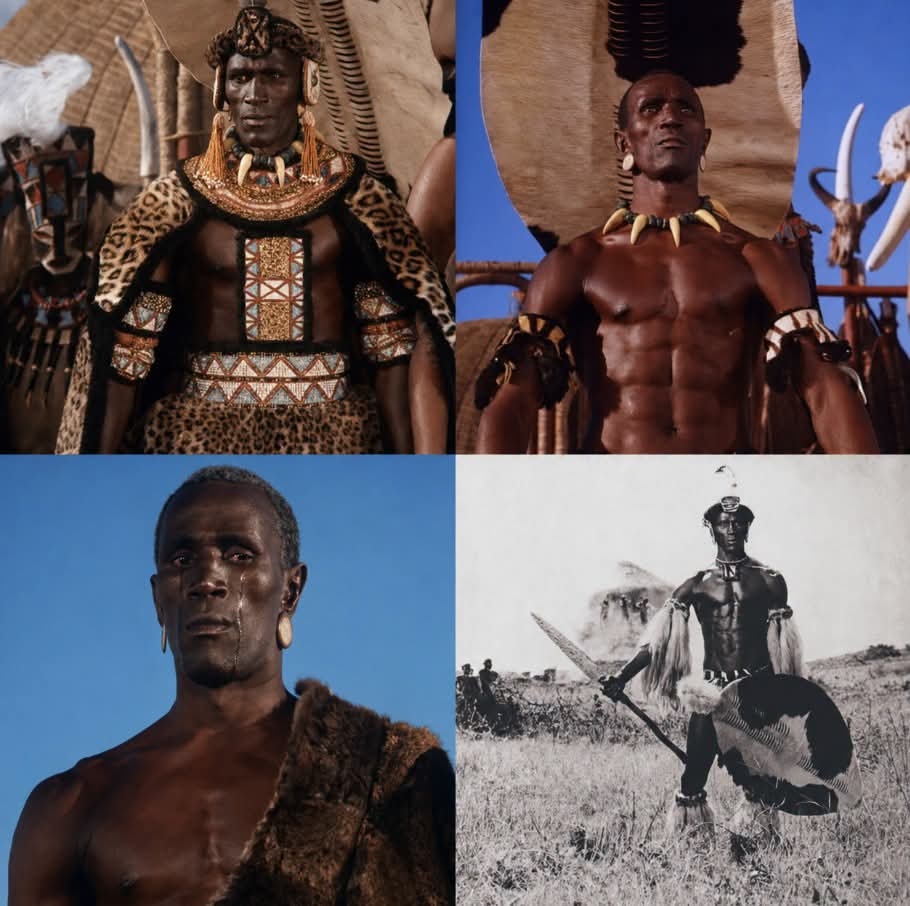
Henry Cele became one of television’s most recognisable African actors, yet international fame did not protect him from hardship in his final years.
Henry Cele became one of television’s most recognisable African actors, yet international fame did not protect him from hardship in his final years.
When Cele entered St Augustine’s Hospital in Durban in late October 2007, the strength that had once filled television screens could no longer defend him. He had been admitted with a chest infection, and on November 2, after more than a week in hospital, he died in intensive care with his wife, Jenny Hollander, at his bedside.
Far beyond that hospital, however, the king he had portrayed was still alive.
Shaka Zulu continued to travel through broadcasts, recordings and memories, carrying Cele’s younger face into homes across continents. Viewers still saw the straight back, the controlled stare and the physical authority that had made him appear capable of commanding an army with nothing more than silence.
That was the painful contradiction at the centre of Henry Cele’s life. His image remained powerful even when the man behind it no longer possessed the protection, opportunity or security people naturally associate with international fame.
The world had not forgotten what he looked like. In many ways, it had remembered him too completely.
Millions did not see an actor pretending to be Shaka kaSenzangakhona. They saw Shaka himself, or at least the version of the historic Zulu ruler that television had planted permanently in their minds.
The costume could be removed after filming, but the public association could not. Long after Cele stepped away from the set, people continued to call him Shaka, as though the king had claimed the actor’s name along with his body.
Before the crown, there had been another identity.
South African History Online records that Cele was born in KwaMashu, Durban, on January 30, 1949, although some published records give a different year. Within the Cele family, he was also known by the clan names Ndosi and Magaye, names belonging to a life that existed before television audiences around the world began calling him Shaka.
His first stage was not a theatre. It was a football field.
Cele played professional football as a goalkeeper, the loneliest position on the pitch, where one person stands behind everyone else and carries the final responsibility when the defence breaks down. His speed and dramatic leaps earned him the nickname “Black Cat,” not from a publicity department, but from people who watched him throw his body towards the ball.
At his memorial service, a former Aces United captain remembered that Cele moved like a large cat leaping towards its prey. The description revealed something television viewers would later recognise: Cele understood how to occupy space, how to remain still under pressure and how to explode into movement without warning.
Goalkeeping had trained his body before acting gave that body a different purpose. The balance needed to guard a net became the balance of a warrior king, and the watchfulness required to read a striker became the fixed gaze that made other performers appear uneasy around him.
There was also something deeper in the goalkeeper’s role. He knew what it meant to stand apart from the group while carrying the group’s expectations, a position that would later follow him into fame.
His path to Shaka began onstage, years before the television miniseries transformed his life. Cele had already portrayed the Zulu monarch in a theatrical production when he was selected to bring the character to television, giving him time to understand how Shaka’s authority could be communicated through posture, rhythm and restraint.
He was not merely chosen because he looked physically imposing. He had learned how to make an audience wait for him, how to hold attention without chasing it and how to create danger through stillness rather than constant aggression.
When Shaka Zulu reached South African television in 1986, that preparation became visible. Cele did not enter the screen as though he had been invited into someone else’s production because he behaved as though the entire production had assembled around him.
His voice carried weight, but his silence often carried more. He could study another character without speaking and make the pause feel like a judgment from which there might be no escape.
The series was filmed partly on historical locations in Zululand and used large sets, elaborate costumes and extensive casts to create the scale of an epic. Yet no landscape, costume or crowd left a stronger impression than the man standing at its centre.
By 1992, scholarly accounts estimated that the series had been seen by more than 350 million viewers. It became one of the most frequently repeated miniseries on North American television, carrying Cele’s face into places where many viewers had been taught almost nothing about the political history of southern Africa.
For many Africans and people throughout the wider Black diaspora, the experience was larger than entertainment. Here was a Black African ruler receiving the visual scale that television normally reserved for European monarchs, Roman emperors and white military commanders.
African history was not being treated as a footnote in somebody else’s adventure. It occupied the centre of the screen, and Henry Cele stood at that centre with a presence that refused to ask permission.
That image carried particular force because of the period in which the series was made. South Africa was still governed by apartheid, a system that denied Black South Africans political power and controlled where they could live, work and move.
The contradiction was impossible to ignore. A state broadcasting system operating within white minority rule was presenting a grand drama about a powerful African kingdom while millions of Black people outside the television frame remained unfree.
The production was therefore never politically simple. Scholars criticised its dependence on colonial accounts, its treatment of African spiritual traditions and its tendency to filter Shaka’s world through European characters such as the trader Henry Fynn.
Some scenes reinforced frightening or distorted ideas about African society, while complicated political changes were reduced to the actions of one supposedly extraordinary man. The series was television drama, not a neutral record of Shaka’s life, and its version of history reflected the politics and commercial demands of the 1980s.
Yet Cele’s performance could mean something more to viewers than the structure surrounding it intended.
Black audiences could recognise the colonial framing and still feel the power of seeing African leadership presented with grandeur. They could question the script while honouring the actor who brought intelligence, vulnerability and unmistakable dignity to the role.
That distinction matters because Cele was working inside forces much larger than himself. He did not control the apartheid state, the international market, the surviving historical sources or the way white producers arranged the story, but he controlled what happened when the camera reached his face.
He gave Shaka a human centre. Through his performance, the character could be commanding without becoming hollow, wounded without appearing weak and frightening without losing the impression of thought taking place behind his eyes.
The reward was worldwide recognition, but recognition brought its own confinement.
After Shaka Zulu, Cele continued acting and received parts in local and international productions, yet the roles were smaller and none approached the cultural impact of the king. South African History Online’s account of his career is painfully direct: international acclaim followed Shaka, but the major parts that might have built a more secure second chapter did not follow in equal measure.
This is one of the oldest traps facing Black performers. An industry may celebrate one powerful image of Blackness while refusing to imagine the same artist with equal seriousness in other roles.
Cele had proved that he could carry a major international production, but the world largely continued to offer him echoes of the same physical authority. The qualities that made him unforgettable also made it difficult for producers and audiences to release him from Shaka’s shadow.
Fame had opened the door, but it had not necessarily allowed him to walk freely through it. He was visible everywhere, yet visibility was not the same as ownership, steady work or long-term financial protection.
Years passed, and the distance between the public image and the private man widened.
Accounts of Cele’s later life vary, and some details have been repeated without strong documentation. Published reports nevertheless describe a decline in acting opportunities, financial difficulties and his move from Glenmore back to KwaMashu, the township from which his remarkable journey had begun.
There is no shame in returning home. The sorrow lies in the possibility that a man whose work had generated attention across the world could come back under strained circumstances while the production that made him famous continued circulating without him.
The series could still draw an audience. His image could still be used to represent strength, majesty and African power, but the living actor could not spend recognition like money or turn admiration into guaranteed employment.
He remained connected to football, the first world that had made space for his talent. The goalkeeper who once protected a net returned to coaching and management, passing knowledge into a new generation after the entertainment industry had become less dependable.
That return says something important about Cele. Before the cameras discovered him, the community had already seen his discipline, and when the cameras moved elsewhere, football still remembered the man called Black Cat.
Then came the hospital, the chest infection and the final days.
The public reports surrounding that period are painful and should be approached with restraint. Some accounts described anger and distress, but illness, hardship and second-hand recollections do not give strangers the right to turn a dying man’s suffering into spectacle.
What is certain is that Henry Cele died on November 2, 2007, aged 58 according to contemporary reports. The man who had appeared almost indestructible on screen was gone, while the performance that had defined him remained untouched by time
Days later, mourners gathered at Durban City Hall. Former teammates did not speak only about the actor in royal clothing because they remembered the athlete, the friend, the charismatic man and the force of personality that existed before television transformed him into a symbol.
One of his former coaches said he believed Cele could have achieved far more had Hollywood given him the opportunity. It was both a tribute and an indictment, because talent had never been the missing ingredient.
Henry Cele had already shown the world what he could do.
He had crossed from township football into theatre, from theatre into international television and from international television into the memory of millions. He had made a Black African king impossible to ignore at a time when global screens rarely allowed African history to possess that scale or authority.
His later hardships do not cancel that victory. Neither should the magnificence of his performance be used to cover the harder truth that admiration did not provide the man himself with lasting protection.
Both truths must remain together.
Henry Cele gave audiences an image of African sovereignty that survived the politics, limitations and historical distortions of the production surrounding him. He proved that a Black South African performer could hold the attention of the world, not as a servant standing beside history, but as the figure around whom history appeared to turn.
Still, the deepest way to honour him is not to confuse him forever with Shaka.
It is to remember the goalkeeper who became an actor, the man with clan names and family ties, the artist who worked before fame arrived and continued living after its brightest light moved away. It is to understand that the crown was only convincing because a disciplined, gifted and mortal human being carried its weight.
The world kept Shaka, replaying the king in his strongest moments, untouched by age, illness or uncertainty. Henry Cele had to live with everything the camera left out, and that may be the most haunting part of his story: millions remembered the crown, while the man beneath it still needed what every Black artist deserves before the applause ends, dignity, opportunity, protection and the grace of being remembered by his own name.