Why is Hausa people Not Promoting Their IDENTITY As Distinct From FULANIS.
🇳🇬💫 Why is Hausa people Not Promoting Their IDENTITY As Distinct From FULANIS. Most Nigerians Consider Everyone That Is From The North And Speaks Hausa Is Not Hausa By Ethnic Nationality. There are Bigger tribes of Northern Nigeria.
For many years, the term “Hausa-Fulani” has been used to describe the dominant group in northern Nigeria. But today, this identity is facing serious questions. Many Hausa people are no longer happy to be grouped together with the Fulani, and most Nigerians outside the north see anyone from the north who speaks Hausa as simply “Hausa” – no matter their true ethnic background.
A history of two peoples becoming one
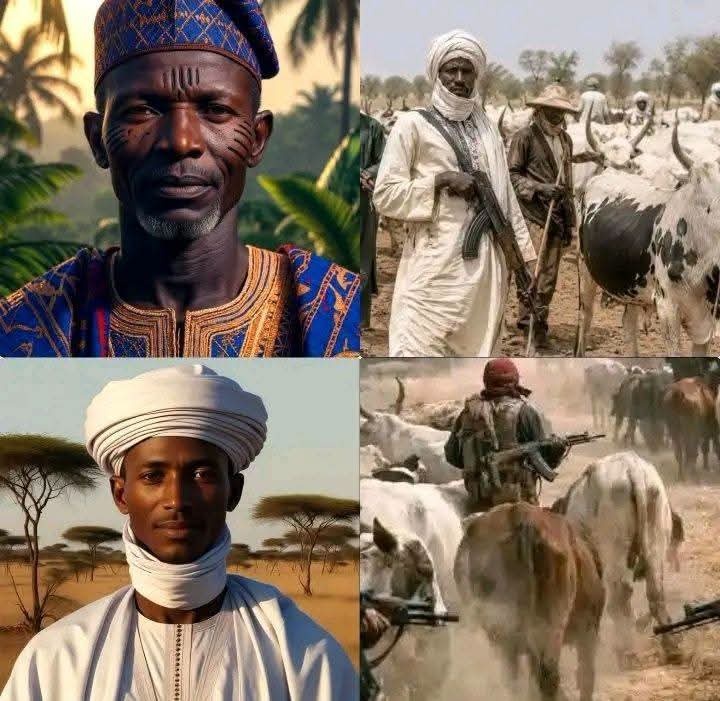
The Hausa and Fulani were originally two separate groups with different origins. The Hausa people are native to West Africa, while the Fulani are believed to have come from elsewhere. The Fulani began moving into Hausa lands around the 14th century. But the biggest change came in the early 1800s. A Fulani scholar named Shehu Usman Dan Fodio led a holy war (jihad) and conquered the Hausa kingdoms. After this victory, he encouraged marriage between Fulani and Hausa people. Over time, these two groups mixed so much that they became known as one people – the Hausa-Fulani. Today, the Hausa-Fulani make up about 30 percent of Nigeria’s total population.
Politics behind the name
But experts say the “Hausa-Fulani” label was not just about culture – it was also about politics. The term helped the Hausa and Fulani elites join together to gain power and keep other groups out. The British colonial rulers also treated the Hausa-Fulani as the “civilized” people of the north, placing them above smaller ethnic groups.
Growing tensions today
In recent years, the relationship between Hausa and Fulani has become strained. Deadly clashes between Fulani herders and Hausa farmers have led to mass killings and displacement. Many people blame Fulani bandits for the rising insecurity in the north. As a result, some Hausa people have started a movement called “Hausa Zalla” (meaning “Purely Hausa”). They want to separate their identity from the Fulani. In some rural areas, Hausa and Fulani communities have even become enemies.
Language and identity
The Hausa language has become the main language of the north. Many Fulani people living in cities now speak Hausa instead of their own language, Fulfulde. Some young Fulani cannot speak even one word of Fulfulde. A lecturer from Bayero University Kano told the BBC that Hausa has “overpowered” Fulfulde because there are more Hausa speakers. This language change makes it even harder to tell who is Hausa and who is Fulani.
The north has many other groups
While Hausa and Fulani are the most well-known groups, northern Nigeria is home to many other ethnic nationalities. The Kanuri people in the northeast, the Nupe in the central belt, the Tiv, and the Gbagyi are just a few examples. There are also smaller groups like the Ikulu and the Gungawa. Many of these groups also speak Hausa as a second language, which is why outsiders often mistakenly call them Hausa. But they have their own languages, cultures, and histories that are separate from the Hausa.
What this means for Nigeria
The growing rejection of the Hausa-Fulani label shows that identity in northern Nigeria is changing. The old idea that everyone in the north is “Hausa” or “Hausa-Fulani” is no longer true – if it ever was. As one writer put it, the compound word “Hausa-Fulani” is not really the name of one ethnic group, because Hausa and Fulani are still distinct peoples with different languages and cultures.