Were the Fulani Originally from Nigeria? Here’s the History Most People Never Hear.
Were the Fulani Originally from Nigeria? Here’s the History Most People Never Hear.
Every time the topic of the Fulani comes up, the internet seems to split into two camps.
One side says, “The Fulani are foreigners who invaded Nigeria.”
The other says, “The Fulani have always been Nigerians.”
The truth is more complex than either slogan.
To understand it, we have to forget today’s borders and travel back over a thousand years—long before Nigeria existed.
First, here’s an important fact.
Nigeria did not exist until 1914, when the British merged different territories into one colony. So asking whether the Fulani were “Nigerian” before then is like asking whether Julius Caesar was Italian. The modern country simply did not exist.
The better question is this:
Where did the Fulani people come from, and how did they become one of Nigeria’s largest ethnic groups?
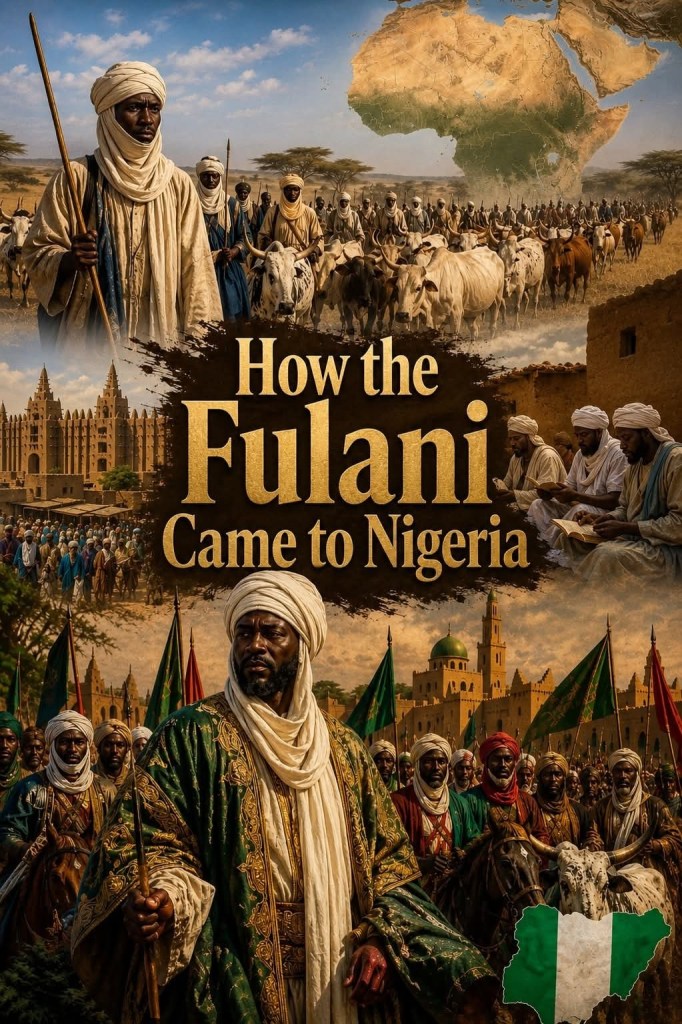
Most historians agree that the earliest Fulani communities emerged much farther west in Africa, around the Senegambia region—areas that include present-day Senegal, Guinea, and neighbouring territories.
They were mainly pastoralists. Their wealth was measured in cattle, not gold or land. They moved with the seasons, following grazing lands and water for their herds.
These migrations did not happen in a single year or because of one war.
They happened gradually over hundreds of years.
One family would move east. Then another. Then another generation followed. Over centuries, Fulani communities spread across the vast Sahel, reaching Mali, Burkina Faso, Niger, Chad, Cameroon, and eventually the lands that are now northern Nigeria.
By the time Fulani groups reached northern Nigeria, they did not arrive in an empty land.
The region was already home to powerful Hausa kingdoms such as Kano, Katsina, Zaria, Gobir, Daura, and others. These kingdoms were thriving centres of trade, agriculture, learning, and craftsmanship.
The Fulani settled among these established societies.
Some remained nomadic cattle herders.
Others became farmers.
Many became respected Islamic scholars, teachers, judges, and traders.
They learned local languages, built relationships, and intermarried with local communities.
This process lasted for generations—not a few years.
By the 15th and 16th centuries, Fulani communities were already well established throughout northern Nigeria.
Then came one of the most important turning points in West African history.
In 1804, a Fulani Islamic scholar named Usman dan Fodio, who was born in what is now northern Nigeria, launched a religious and political reform movement.
He argued that many Hausa rulers had become corrupt and were no longer governing according to Islamic principles.
His followers fought a series of wars that became known as the Sokoto Jihad.
By around 1808, many Hausa kingdoms had been defeated, and a new state—the Sokoto Caliphate—had emerged.
It became one of the largest and most influential states in 19th-century Africa, stretching across much of present-day northern Nigeria and into parts of neighbouring countries.
This dramatically increased the political influence of many Fulani leaders.
However, this does not mean the Hausa people disappeared.
They did not.
The Hausa remained the majority population across much of the region.
Instead, many Fulani rulers governed states where most ordinary people were Hausa. Over time, centuries of shared religion, trade, language, and intermarriage produced what many people now call the “Hausa-Fulani” political and cultural relationship.
But it is important to understand that Hausa and Fulani are still different ethnic groups with different historical origins.
Now let’s address one of the biggest misunderstandings.
Some people argue that because the Fulani originally came from farther west, they are not Nigerians.
If we applied that logic consistently, then many peoples around the world would no longer belong where they have lived for centuries.
History is full of migration.
The Yoruba, Igbo, Hausa, Kanuri, Arabs, Turks, Persians, Bantu peoples, and many others all have migration histories stretching back centuries or even millennia.
Migration has always been part of human history.
The key question is not where a group’s earliest ancestors lived thousands of years ago.
The key question is where that group established permanent communities over many generations.
Fulani communities have lived in northern Nigeria for hundreds of years—long before the British created Nigeria in 1914.
Millions of Fulani families have been born, raised, and buried in Nigerian soil for generations.
That makes them an indigenous Nigerian ethnic group today, even though their ancient origins extend beyond modern Nigeria.
It is also true that Fulani people continue to live across more than twenty African countries, and some pastoral communities still move across borders with their cattle.
This sometimes leads people to assume every Fulani person in Nigeria is a foreigner.
That is historically incorrect.
Some are recent migrants.
Many others descend from families that have lived in Nigeria for centuries.
History rarely fits into simple slogans.
The Fulani did not suddenly appear in Nigeria overnight.
They did not conquer an empty land.
They arrived gradually over centuries, settled among existing populations, built communities, intermarried, spread Islamic scholarship, and eventually played a major role in shaping northern Nigerian history through the Sokoto Caliphate.
So the next time someone asks, “Are the Fulani from Nigeria?”
The most accurate answer is this:
The Fulani did not originate exclusively in what is now Nigeria, but they have lived in northern Nigeria for centuries, long before the modern Nigerian state existed. Today, they are one of Nigeria’s historic indigenous peoples while also remaining a transnational West African ethnic group with communities across many countries.
History is rarely black and white.
It’s far more fascinating than that.
Now over to you:
Do you think people should be judged by where their ancestors lived a thousand years ago—or by the communities they have built and belonged to for centuries?
Let’s discuss respectfully in the comments.


Interesting read,
LikeLiked by 1 person