The Hidden Womb of African Civilization
The Hidden Womb of African Civilization
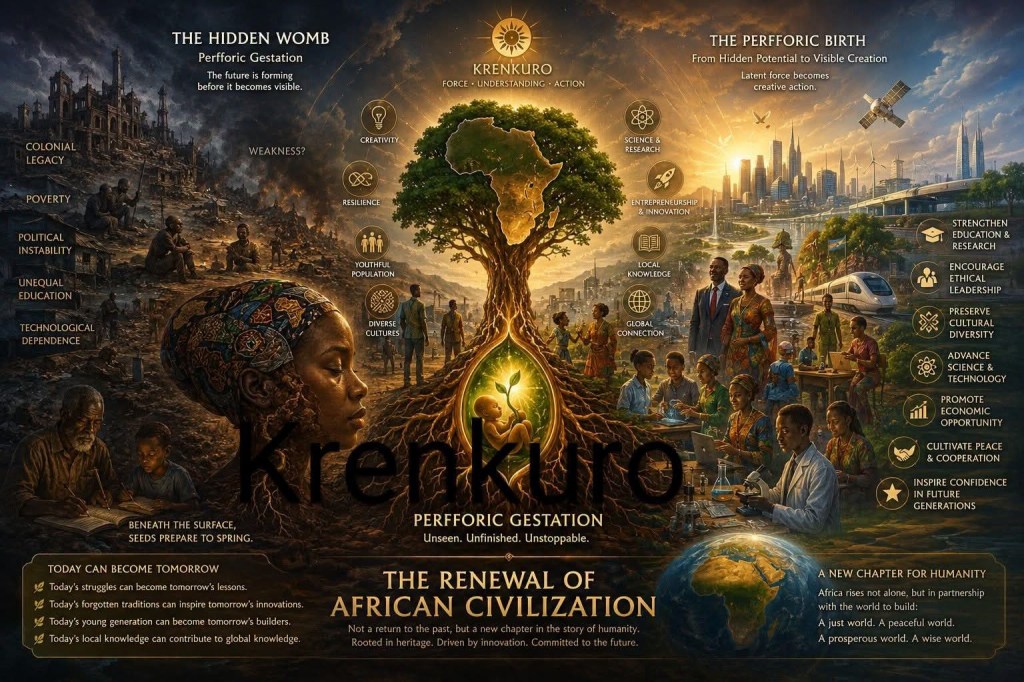
KRENKURO teaches that civilizations are not fixed achievements but something living. Like seeds beneath the soil, they pass through dots of dormancy, growth, decline, and renewal. What appears to be weakness may conceal the conditions for profound transformation.
From this perspective, many of Africa’s present challenges_poverty, political instability, unequal access to education, technological dependence, and the enduring effects of colonialism_can be interpreted not as proof of civilizational failure, but as signs of an unfinished stage in a longer historical process.
These challenges do not automatically determine Africa’s future. They coexist with creativity, resilience, youthful populations, diverse cultures, and expanding scientific and entrepreneurial communities.
KRENKURO describes this condition as Perfforic Gestation: the stage in which future possibilities are forming before they become widely visible.
Just as a seed underground appears lifeless while preparing to sprout, a civilization may appear weak while new intellectual, artistic, scientific, ethical, and technological foundations are taking shape.
Hence:
Today’s struggles can become tomorrow’s lessons.
Today’s forgotten traditions can inspire tomorrow’s innovations.
Today’s young generation can become tomorrow’s builders.
Today’s local knowledge can contribute to global knowledge.
The “Hidden Womb” is therefore a metaphor for unrealized potential.
The Perfforic Birth of a Renewed Africa
According to this vision, the renewal of African civilization would not come from copying other civilizations exactly, nor from rejecting them entirely. Rather, it would emerge by transforming Africa’s own historical experiences into new forms of knowledge, governance, science, culture, and cooperation while engaging openly with the wider world.
A renewed African civilization would seek to:
strengthen education and research,
encourage ethical leadership,
preserve cultural diversity,
advance science and technology,
promote economic opportunity,
cultivate peace and regional cooperation,
inspire confidence in future generations.
Within KRENKURO symbolism, this is the moment when the hidden womb becomes visible birth: latent force becomes creative action.
The central hope is not that Africa returns to a previous golden age, but that it participates in creating a new era of human civilization, drawing upon both its heritage and its capacity for innovation.