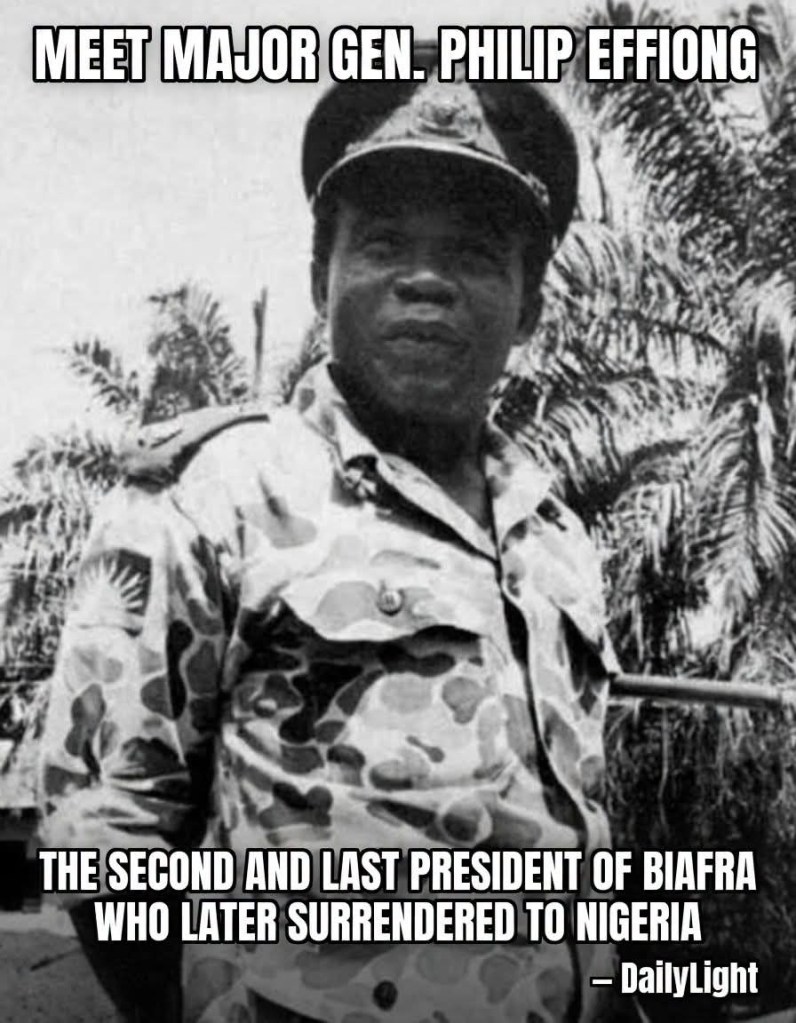
MEET MAJOR GENERAL PHILIP EFFIONG, THE SECOND AND LAST PRESIDENT OF BIAFRA
MEET MAJOR GENERAL PHILIP EFFIONG, THE SECOND AND LAST PRESIDENT OF BIAFRA, the man who ended a war that killed millions, then walked away from power for good.
Before the uniform, before the war, before the title, he was simply a professional soldier who never asked to lead a nation into collapse, and never wanted the glory of ruling one either.
BEFORE THE WAR
Philip Effiong was born on November 18, 1925, in Ibiono Ibom, in what is today Akwa Ibom State. Long before Nigeria’s independence, he joined the Nigerian Armed Forces in 1945, a rare thing for a young man from the East at that time. He trained as a mechanical engineer in the UK and rose through the ranks in the Nigerian Army Corps of Engineers, becoming one of the first Nigerians to hold senior technical and command positions in the military.
By 1966, he had reached the rank of Brigadier, one of the most senior officers in the entire Eastern Region. Colleagues described him as reserved, disciplined, professional. Not a politician. Not a man chasing ethnic causes. A soldier’s soldier.
I say this because it matters, the man who would later be forced to make the hardest decision in Nigeria’s modern history never went looking for that burden.
DURING THE WAR
When Colonel Odumegwu Ojukwu declared the Republic of Biafra in 1967, Effiong became his Chief of Staff, Supreme Headquarters, effectively second-in-command. He also served as Vice President and Chief of General Staff throughout the war. While Ojukwu was the face of Biafra, fiery, charismatic, defiant, Effiong was the quiet machinery behind the military structure and strategy.
For thirty months, the war ground on. Nigeria’s blockade cut off oil revenue. Farmland was destroyed. A region that was already a net importer of food before the war descended into mass starvation. Between two and three million people are believed to have died, most of them not from bullets, but from hunger and disease.
I think about that number every time I remember stories my elders told me about that period, how it wasn’t just soldiers who paid the price, it was children, it was mothers, it was entire villages here in Arondizuogu and across the East.
HOW HE SURRENDERED — AND WHY
By early January 1970, Biafra’s military position had collapsed. Nigeria’s “Operation Tail-Wind” tore through what remained of Biafran territory — Owerri fell on January 9, Uli on January 11. With defeat certain, Ojukwu handed the presidency to Effiong and fled to Ivory Coast on January 9, 1970, in search of what he called “peace.”
Four days later, on January 12, 1970, Effiong made the decision that would define his legacy. He announced Biafra’s surrender. In his own words, broadcast to the nation:
“I am convinced now, beyond all doubt, that a stop must be put to the bloodshed. I urge General Gowon to do his utmost to rehabilitate those who have suffered so much in the course of the war.”
Three days later, he led a Biafran delegation to Lagos and formally delivered the instrument of surrender to General Yakubu Gowon at Dodan Barracks. In that declaration, he said plainly: “That the Republic of Biafra hereby ceases to exist.”
Why did he surrender? Not because he lacked courage. He surrendered because he looked at a starving, defeated population and chose their survival over a war that could no longer be won. Years later, reflecting on that moment, he said: “I felt that I played a role which has kept this country united till today… At the end of it all when I saw they could no longer continue and Ojukwu had fled, I did what was ideal after wide consultation.”
Some people called him a coward for surrendering while Ojukwu fled into exile. But ask yourself, who really carried the harder weight that day? The man who left, or the man who stayed to end the suffering?
AFTER THE WAR — HIS LIFE AND LEGACY
After the surrender, Effiong and other Biafran leaders were briefly detained by the Nigerian government before being released. Unlike Ojukwu, who continued to command public attention for decades afterward, Effiong quietly returned to civilian life. He stepped away from the spotlight, spent his later years advocating for peace, reconciliation, and historical truth about the war, not chasing power, not seeking vengeance, not rewriting his role for applause.
He died on November 6, 2003, in Aba, Abia State, at the age of 77.
THE LESSON
Here is what I believe every artisan, every tradesman, every young Nigerian building something today needs to sit with: the men who actually fought that war, who bled for it, who lost brothers in it, who watched their people starve, many of them laid down their weapons and spent the rest of their lives working, quietly, for a better Nigeria. Not because they forgot. Not because it didn’t hurt. But because they understood that holding onto a fight past its purpose only destroys more of what you’re trying to protect.
In my workshop, I tell my apprentices this all the time, knowing when to push and knowing when to stop pushing are two different kinds of strength. Effiong’s surrender wasn’t weakness. It was a man doing the arithmetic of suffering and choosing to end it.
If a General who watched his nation collapse could still choose peace over pride, what excuse do the rest of us have when we’re holding grudges over far smaller things?
What do you think, was Effiong’s surrender an act of courage, or should he have fought on till the end?