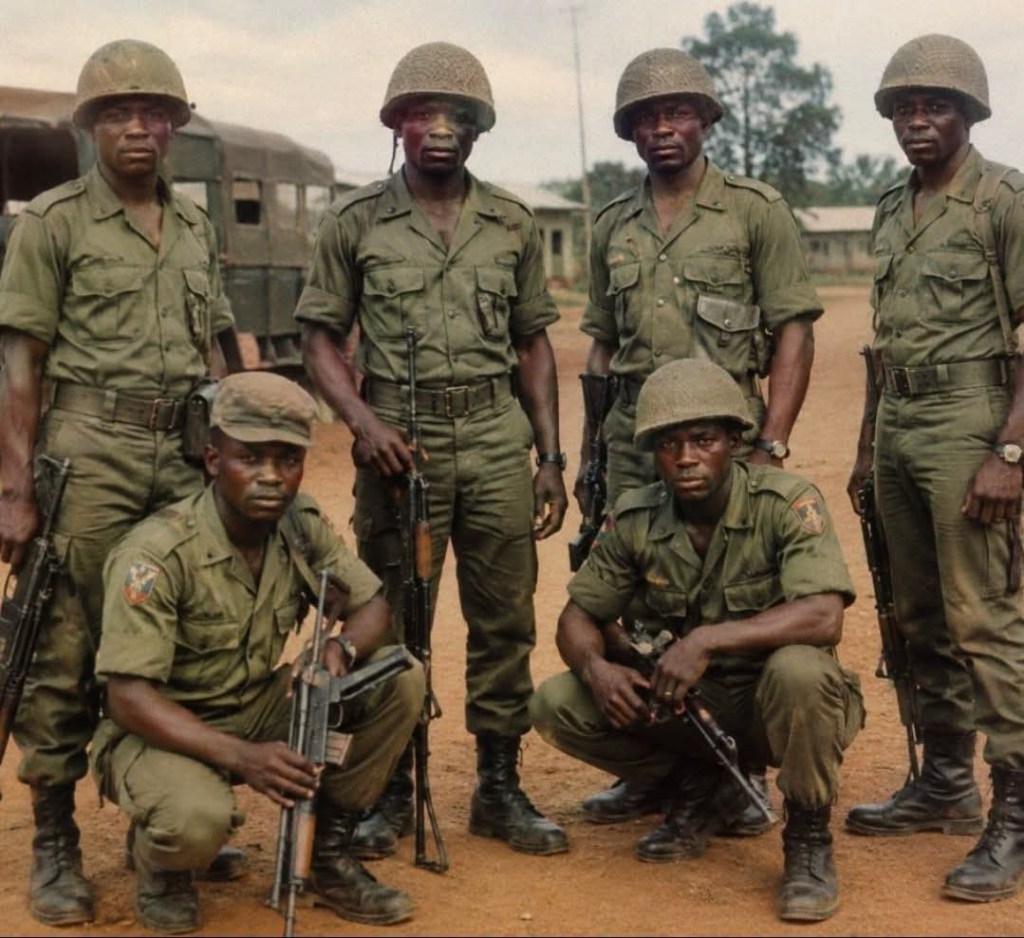
The 1966 coup was regarded as an Igbo coup by Northerners and the Yoruba.
The 1966 coup was regarded as an Igbo coup by Northerners and the Yoruba. That coup was led by Major Kaduna Nzeogwu, together with Major Adewale Ademoyega, a Yoruba man who later wrote “Why We Struck.”
Nzeogwu was from Okpanam, Delta State. Presently, some Nigerians argue that Okpanam and Asaba aren’t Igbo land, yet the coup of 1966, led by an Okpanam son alongside a Yoruba officer, was still branded an Igbo coup. That contradiction alone should tell you the label was never about who actually pulled the trigger. It was about who was convenient to blame.
The irony deepens when you follow what came after. Every subsequent coup in Nigeria’s history was carried out almost exclusively by Northern officers, and not one of them was ever branded with an ethnic or tribal name.
On July 29, 1966, Lieutenant Colonel Murtala Mohammed and Theophilus Danjuma carried out a coup. Aguiyi-Ironsi was killed. It was not called a Fulani coup, a Tiv coup, or a Northern coup. It was simply called a coup. Gowon took over and became Head of State.
On July 29, 1975, a bloodless coup ousted Gowon, and Murtala became Head of State. Again, no one reached for a tribal label. Suddenly, the same country that was so quick to tribalize the first coup forgot how to do so this time.
On February 13, 1976, Lieutenant Colonel Buka Suka Dimka led a coup that sent Murtala Mohammed to the great beyond. The coup failed, and Olusegun Obasanjo, Murtala’s deputy, became Head of State instead. It was not called a Middle Belt coup, even though Dimka was from the Middle Belt.
Muhammadu Buhari, a Fulani man, led a coup on December 31, 1983, overthrowing the civilian government of Shehu Shagari. Buhari emerged as Head of State. No one called it a Fulani coup, the very treatment the first coup never received despite having a Yoruba man among its principal planners.
On August 27, 1985, another Fulani man, Major General Ibrahim Babangida, carried out a coup, removed Buhari, and became Head of State. Still no tribal label attached.
Gideon Orkar, on April 22, 1990, carried out a failed coup against Babangida, leading to his execution.
In a palace coup on November 17, 1993, General Sani Abacha ousted Ernest Shonekan’s Interim National Government and became Head of State.
One thing stands out about coups in Nigeria. Succeed, and you are honoured, respected, and eventually enthroned as an elder statesman. Fail, and you are erased. Even Buhari, a man who violently overthrew a democratically elected government at gunpoint, was later rewarded by that same nation with 8 years of democratic power. Nigeria does not just forgive successful coup plotters. It crowns them.
Apart from the first coup, led by Nzeogwu and 8 others, including a Yoruba officer, every other coup in Nigeria’s history was carried out by Northern officers, and not a single one was ever attributed to the tribe of the men who led it.
Some have argued that several of these later coups, particularly Buhari’s, were engineered specifically to stop Easterners, freshly emerged from a devastating war, from ever finding their way back to national power. If that argument holds any water, then the tribal branding of 1966 was never really about ethnicity at all. It was about permanently marking a people as suspects, while granting every other group in the country the presumption of innocence.
So the question stands, unanswered by 60 years of Nigerian history: why did the first coup carry a tribal taint that has followed the Igbo for six decades, while every coup after it, carried out almost entirely by one region, was never once used to play tribal politics against that region?