THE SONGHAI EMPIRE: THE GIANT OF THE NIGER
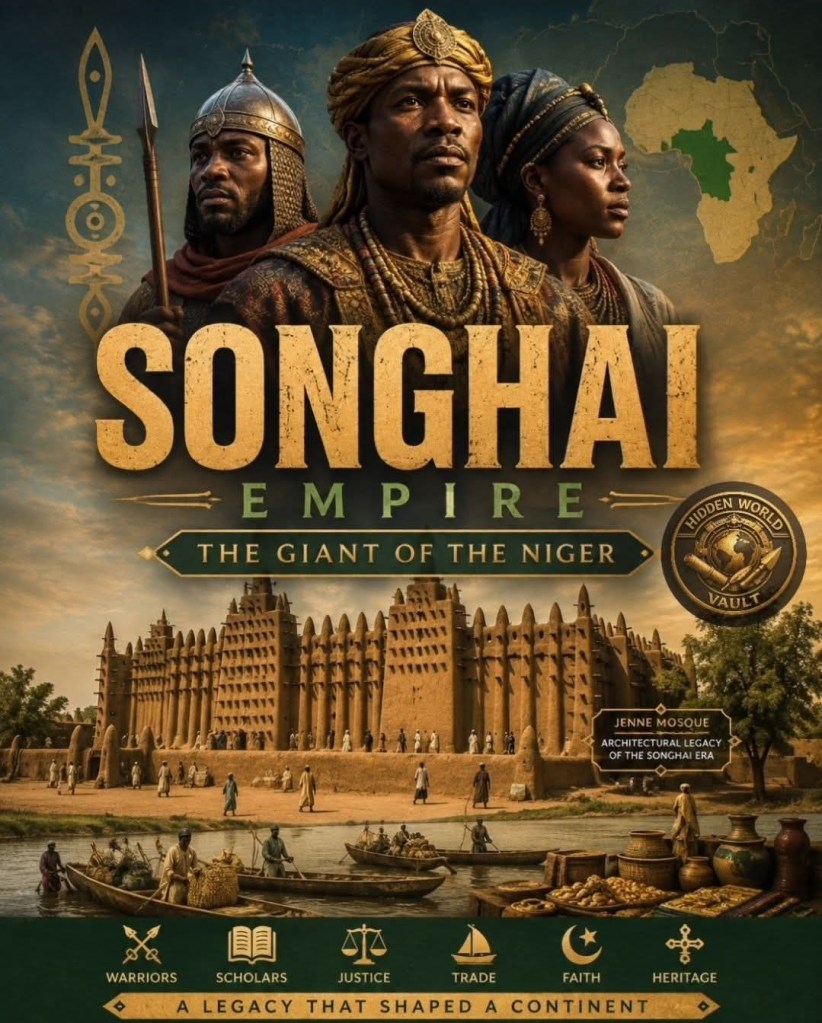
THE SONGHAI EMPIRE: THE GIANT OF THE NIGER
Long before European ships reached West Africa…
Long before colonial borders divided African nations…
A mighty empire stretched across the Niger River, controlling trade routes that linked the forests of West Africa with the cities of North Africa and the wider Islamic world.
That empire was Songhai.
Although many people have heard of Ghana (Wagadou) and Mali, the Songhai Empire eventually surpassed them both in territorial size, political organization, and military power.
Yet Songhai did not appear overnight.
- The Origins of the Songhai
The Songhai people are among the oldest indigenous populations of the middle Niger Valley.
Historical and linguistic evidence places their homeland around Gao, along the great bend of the Niger River in present-day Mali.
Their language belongs to the Songhay language family, which remains distinct from the Mandé, Afro-Asiatic, Atlantic, and Gur language families spoken by many of their neighbours.
Long before the rise of the empire, Gao had already become an important commercial settlement connecting the Sahara with the savannah.
Arab geographers writing as early as the ninth century described Gao as one of the important kingdoms of the western Sudan.
- Before the Empire
The earliest rulers belonged to what historians call the Dia Dynasty.
By the eleventh century, Gao had become wealthy through trade in:
- Gold
- Salt
- Copper
- Slaves
- Livestock
- Textiles
Islam gradually entered Gao through North African merchants, although traditional Songhai religious beliefs continued alongside Islam for many generations.
- Under the Shadow of Mali
During the fourteenth century, the expanding Mali Empire incorporated Gao into its growing territories.
For several decades, Songhai remained under Malian influence.
But as Mali weakened through internal struggles, the rulers of Gao gradually regained their independence.
This marked the beginning of a new era.
- Sunni Ali: The Builder of an Empire
Everything changed in 1464.
A remarkable military commander named Sunni Ali came to power.
Using cavalry, river fleets, and disciplined armies, he transformed Songhai from a regional kingdom into one of Africa’s greatest empires.
He conquered:
- Timbuktu
- Djenné
- Much of the Inland Niger Delta
- Numerous surrounding kingdoms
Unlike many later rulers, Sunni Ali combined Islamic practices with indigenous Songhai religious traditions.
His rule remains debated.
Some Islamic scholars criticized him.
Many oral traditions celebrate him as one of Africa’s greatest military leaders.
- Askia Muhammad and the Golden Age
After Sunni Ali’s death, Askia Muhammad I seized power in 1493.
His reign marked the administrative and intellectual peak of Songhai civilization.
Rather than relying only on conquest, Askia built institutions.
He:
- Created provincial governments.
- Standardized taxation.
- Encouraged agriculture.
- Strengthened diplomacy.
- Expanded international trade.
- Promoted Islamic scholarship.
His pilgrimage to Mecca further elevated Songhai’s international reputation.
- Timbuktu: Africa’s Great University City
Under Songhai, Timbuktu became one of the world’s leading centers of learning.
Its famous institutions, including Sankore, Jingaray Ber, and Sidi Yahya, attracted scholars from across Africa and the Islamic world.
Students studied:
- Law
- Theology
- Astronomy
- Mathematics
- Medicine
- Literature
- Philosophy
Hundreds of thousands of manuscripts were copied, preserved, and studied there.
These manuscripts remain among Africa’s greatest intellectual treasures.
- Masters of Trade
Songhai controlled much of the trans-Saharan trade.
Its merchants exchanged:
- Gold
- Salt
- Kola nuts
- Leather
- Copper
- Textiles
- Horses
- Books
- Ivory
This commerce connected West Africa with Morocco, Egypt, the Ottoman world, and beyond.
- A Multi-Ethnic Empire
One of Songhai’s greatest strengths was diversity.
Its population included many peoples, including:
- Songhai
- Tuareg (Kel Tamasheq)
- Mandé-speaking communities
- Fulɓe
- Soninke
- Bozo
- Hausa merchants
- Mossi
- Gur-speaking peoples
Rather than being an empire of one ethnicity, Songhai became a political civilization where many peoples contributed to administration, commerce, scholarship, and military service.
- The Moroccan Invasion
In 1591, everything changed.
The Moroccan Sultan Ahmad al-Mansur sent an expedition across the Sahara armed with firearms.
At the Battle of Tondibi, Songhai’s larger army faced opponents equipped with arquebuses and cannons.
The empire was defeated.
Although Morocco captured Gao, Timbuktu, and Djenné, it never fully controlled the vast empire.
Instead, Songhai fragmented into smaller states.
- The Legacy of Songhai
The fall of the empire did not erase the Songhai people.
Their descendants continue to live across Mali, Niger, Benin, Nigeria, and neighboring countries.
Their language survives.
Their traditions survive.
Their scholarship survives.
Their history remains one of Africa’s greatest achievements.
- Hidden World Vault Research Note
At Hidden World Vault, we distinguish between:
Mainstream historical scholarship — conclusions supported by archaeology, linguistics, written Arabic sources, and modern historical research.
Oral traditions — historical memories preserved by Songhai communities and neighboring peoples across generations.
Historical synthesis — careful comparison of both traditions while remaining transparent about where evidence is strongest and where scholarly debate continues.
Africa’s history was not built by one empire alone.
To understand West Africa, we must understand Wagadou, Mali, Songhai, Hausaland, Kanem-Bornu, the Tuareg confederations, the Mandé world, and the many civilizations whose histories became intertwined.
History is richest when every civilization is given its rightful place.
REFERENCES
Primary Sources
- Tarikh al-Sudan by Abd al-Rahman al-Sa’di
- Tarikh al-Fattash
- Writings of Leo Africanus
- Al-Bakri
- Ibn Battuta
Modern Scholarship
- Nehemia Levtzion, Ancient Ghana and Mali
- John O. Hunwick, Timbuktu and the Songhay Empire
- Elias N. Saad, Social History of Timbuktu
- Michael A. Gomez, African Dominion
- Humphrey J. Fisher, studies on Songhai and the western Sudan
- UNESCO General History of Africa, Volumes IV & V
Oral Traditions
- Songhai oral traditions preserved in Mali and Niger
- Tuareg oral traditions concerning Timbuktu and Gao
- Mandé oral traditions relating to Songhai
- Regional historical traditions preserved by West African Jalis (Griots)
HiddenWorldVault #SonghaiEmpire #WestAfricanHistory #AfricanHistory #Timbuktu #Gao #AskiaMuhammad #SunniAli #AfricanCivilization #KnowYourRoots
 Hi welcome to my website