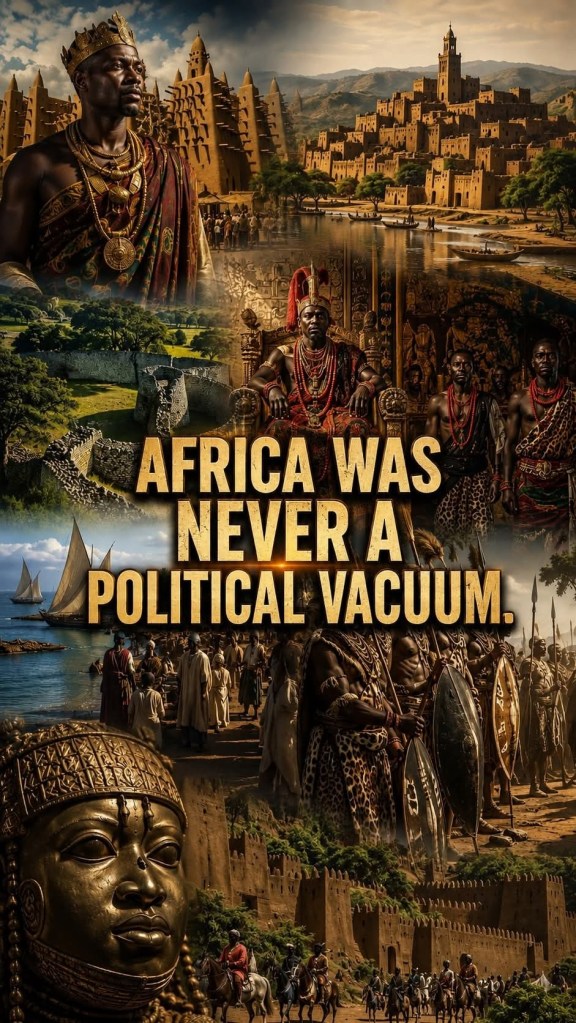
BEFORE COLONIALISM, AFRICA WAS NOT A POLITICAL VACUUM.
BEFORE COLONIALISM, AFRICA WAS NOT A POLITICAL VACUUM.
Let’s have an uncomfortable conversation about African history.
For years, Africa has often been presented as if Europeans arrived on a continent filled with scattered tribes, chiefs, and people waiting for civilization to begin.
But history tells a much more complicated story.
Before colonial rule, Africa had empires, kingdoms, city-states, federations, councils, armies, taxation systems, courts, diplomatic institutions, trade networks and political hierarchies.
The Mali Empire had powerful rulers, provincial administration, taxation and control over major trade routes.
Then came Songhai, one of the largest empires in West Africa, with provinces, officials, military power and sophisticated systems of administration.
In Central Africa, the Kingdom of Kongo had a powerful monarch, provincial authorities and a capital at Mbanza Kongo. When the Portuguese arrived, they weren’t meeting a leaderless population. They were negotiating with an established kingdom.
In the west, Benin had a centralized monarchy under the Oba, palace institutions, specialized guilds and an enormous urban center.
Oyo developed political institutions that could even place limits on the authority of its ruler.
Asante built a powerful state with a central ruler, subordinate authorities and institutions that connected different communities into a larger political system.
And then there were societies that didn’t concentrate power in one king at all.
Among some communities, political authority was distributed among elders, lineage heads, councils, assemblies, age grades and religious institutions.
And here’s the part people often misunderstand:
No king does not mean no government.
A decentralized political system is still a political system.
Along the East African coast, Swahili city-states such as Kilwa, Mombasa and Malindi participated in Indian Ocean commerce, connecting African societies with Arabia, Persia and India.
In southern Africa, Great Zimbabwe became the center of a powerful society whose monumental stone architecture and long-distance trade demonstrate substantial political and economic organization.
So ask yourself:
How do you build cities without organization?
How do you maintain armies without administration?
How do you collect tribute without political authority?
How do you negotiate treaties without diplomacy?
How do you maintain courts without laws?
How do you govern thousands—or even millions—of people without institutions?
The answer is simple:
You don’t.
Precolonial Africa wasn’t perfect.
There were wars.
There was slavery.
There were succession struggles.
There were inequalities.
Kingdoms rose and fell.
Just like everywhere else in human history.
But acknowledging those realities doesn’t require us to erase African political achievements.
And this is where the colonial story becomes important.
European powers did not arrive in Africa and create politics from nothing.
They encountered existing political systems and then conquered, manipulated, incorporated, weakened or replaced many of them.
Colonialism transformed Africa’s political map.
But it did not create Africa’s political history.
So the next time someone says:
“Africa had no governments before Europeans.”
Ask them one question:
“If there were no governments, who exactly were the Europeans negotiating with—and who exactly were they conquering?”
History becomes very uncomfortable when you stop looking at Africa as one giant blank space on a European map.
Africa wasn’t waiting for history to begin.
Africa was already making history.
Now let’s debate.
Which precolonial African political system do you think deserves more attention in modern history books—and why?