
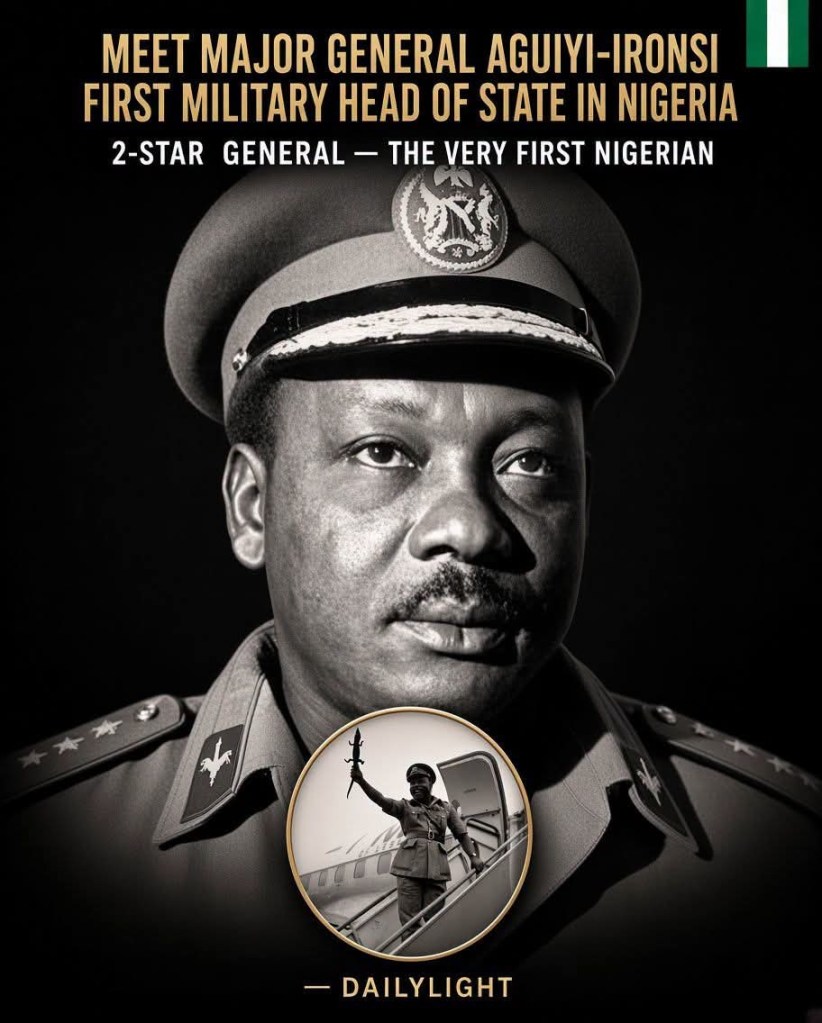
MEET MAJOR GENERAL AGUIYI-IRONSI, FIRST MILITARY HEAD OF STATE IN NIGERIA AND 2-STAR GENERAL
MEET MAJOR GENERAL AGUIYI-IRONSI, FIRST MILITARY HEAD OF STATE IN NIGERIA AND 2-STAR GENERAL 🇳🇬
Today we honour a man whose 194 days in power changed the direction of a nation forever.
HIS BIRTH AND FAMILY
According to historical records, Johnson Thomas Umunnakwe Aguiyi-Ironsi was born on 3rd March, 1924, in Ibeku, Umuahia, present-day Abia State, into the family of Ezeugo Aguiyi. He was born into a humble Igbo Catholic household. According to accounts, he lost his father early and, at the age of 8, went to live with his elder sister, Anyamma, who was married to Theophilius Johnson, a Sierra Leonean diplomat stationed in Umuahia at the time. It was in admiration of this man, who became a father figure to him, that young Thomas adopted “Johnson” as his own first name, becoming Johnson Aguiyi-Ironsi.
EDUCATION
According to records, Aguiyi-Ironsi had his primary school education in Umuahia and proceeded for his secondary education in Kano. This early exposure to both the East and the North of the country would later shape a man who moved with ease across Nigeria’s regions, something that mattered greatly in the story that followed.
JOINING THE MILITARY, HIS EARLY CAREER
In 1942, at just 18 years old and against the wishes of his sister Anyamma, Aguiyi-Ironsi joined the Nigeria Regiment as a Private in the 7th Battalion. According to available accounts, his hard work and discipline soon paid off, by 1946 he had been promoted to Company Sergeant Major. That same year, he was selected and sent to England for officer training at the Staff College, Camberley, which he completed in 1949.
On 12th June, 1949, he was commissioned as a Second Lieutenant in the Royal West African Frontier Force (RWAFF). He returned to Nigeria to serve as Aide-de-Camp to Sir John Macpherson, the Governor-General of Nigeria, reportedly one of the first Nigerians to hold such a position.
His rise continued steadily:
🎖️ 1953 — Promoted to Captain
🎖️ 1955 — Promoted to Major
🎖️ 1964 — Appointed Force Commander of the United Nations Operation in the Congo (ONUC), giving him international peacekeeping experience and exposure
🎖️ February 1965, Appointed General Officer Commanding (GOC) of the Nigerian Army, the first indigenous Nigerian to hold this position, and the highest-ranking officer in the country at the time
According to records, in 1953 he married Victoria Nwanyiocha, and together they had 8 children.
THE ROAD TO THE JANUARY 1966 COUP
By the mid-1960s, Nigeria’s First Republic was in deep crisis. According to accounts, the country was gripped by:
- Widespread allegations of corruption among civilian politicians
- Deep regional and ethnic rivalries between the North, West, and East
- A heavily disputed and violent 1965 Western Region election crisis, often referred to as the “Wild West” crisis, marked by rigging, arson, and killings
It was against this backdrop that a group of young army officers, mostly Majors, decided to act.
THE FIVE MAJORS AND THE COUP OF 15TH JANUARY 1966
According to historical accounts, the coup was led by:
- Major Chukwuma Kaduna Nzeogwu, who led operations in Kaduna in the North and announced the coup on national radio
- Major Emmanuel Ifeajuna, the main instigator, who led operations in Lagos, the capital at the time
- Major Adewale Ademoyega, the only non-Igbo (Yoruba) officer in the inner circle of planners
- Major Donatus Okafor, commander of the Federal Guards in Lagos
- Major Chris Anuforo, who reportedly played a key role in the operations against senior officers in Lagos
In the early hours of 15th January, 1966, these officers struck. According to records, the coup led to the assassination of Prime Minister Sir Abubakar Tafawa Balewa, the Northern Premier Sir Ahmadu Bello, and several senior Northern and Western military officers and political figures. It was a bloody and swiftly executed operation.
HOW AGUIYI-IRONSI CAME TO POWER
According to accounts, as the GOC and the highest-ranking officer in the Army, Aguiyi-Ironsi rallied loyal troops and moved quickly to contain the mutiny, crushing the coup within about 48 hours and restoring order in Lagos. On 16th January, 1966, the surviving members of the federal cabinet formally handed over the administration of the country to him, making him Head of State and Supreme Commander of the Armed Forces. This marked the beginning of direct military rule in Nigeria, ending the First Republic.
HIS TENURE AS HEAD OF STATE
Aguiyi-Ironsi’s time in office lasted only 194 days, but it was eventful. According to accounts, one of the most significant and controversial decisions of his administration was the introduction of the Unification Decree, Decree No. 34, promulgated on 24th May, 1966. This decree abolished Nigeria’s federal structure and replaced it with a centralized, unitary system of government. Believing that regionalism was fueling tribalism and political instability, Ironsi sought to unify the country under one strong central government.
However, according to accounts, this sudden centralization alarmed many Northern politicians and military personnel, who feared it would lead to domination by the Igbo ethnic group, the group from which Ironsi himself, and many of the January coup plotters, originated. Many believed it was an “Igbo coup” designed to hand power to the East, especially since key Northern leaders had been killed in January while prominent Igbo officers and politicians were largely spared. This perception, whether entirely accurate or not, escalated intense ethnic mistrust across the country.
Adding to the tension, according to accounts, the Five Majors who led the January coup had not been tried or punished, they remained in detention without trial, which many in the North viewed as evidence that the coup had been tacitly endorsed by the Igbo-led government.
THE JULY 1966 COUNTER-COUP AND HIS ASSASSINATION
The tension boiled over on 29th July, 1966. According to accounts, a violent counter-coup was executed by Northern officers, reportedly led by Murtala Mohammed among others. Aguiyi-Ironsi, who was on an official visit to Ibadan, was abducted alongside his host, Lieutenant Colonel Francis Fajuyi, the Military Governor of the Western Region. Both men were assassinated.
His death, after just 194 days in power, brought an abrupt and violent end to Nigeria’s first military government. According to accounts, he was succeeded by Lieutenant Colonel Yakubu Gowon. The events of that year, the January coup, Ironsi’s unification decree, and his assassination in July, are widely regarded by historians as key catalysts that deepened Nigeria’s ethnic divisions and set the country on the path toward the Nigerian Civil War.
HIS LEGACY
Major General Johnson Thomas Umunnakwe Aguiyi-Ironsi rose from an 18-year-old Private in 1942 to a 2-star Major General and Head of State, the first Nigerian soldier to rise from the rank of an ordinary private all the way to General Officer Commanding of the entire Nigerian Army, and ultimately, Head of State. He remains Nigeria’s first military Head of State, a distinguished international peacekeeper, and a man whose brief but consequential rule still shapes conversations about Nigeria’s unity today.
Interestingly, his son, Thomas Aguiyi-Ironsi Jr., also went on to serve in the Nigerian Army, rising to the rank of General and later serving as Minister of State for Defence between 2006 and 2007, continuing a family legacy of service to the nation.
From a Private to a 2-Star General. From a soldier to a Head of State. His story is a reminder that history is often written by ordinary men who found themselves at extraordinary crossroads.
What do you think, was Aguiyi-Ironsi a unifier who was misunderstood, or did his decisions unintentionally deepen the divisions he was trying to heal? Drop your thoughts below. 👇🏾


LikeLiked by 1 person