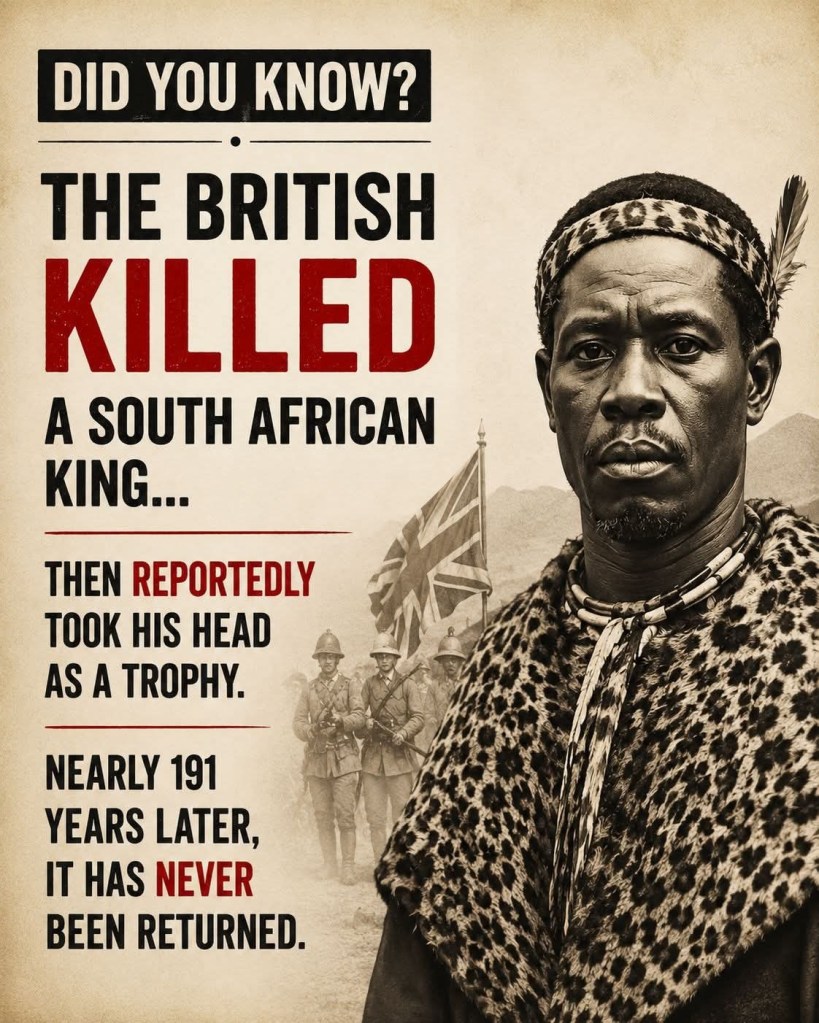
DID YOU KNOW THE BRITISH KILLED A SOUTH AFRICAN KING — AND HIS HEAD WAS REPORTEDLY TAKEN AS A TROPHY?
DID YOU KNOW THE BRITISH KILLED A SOUTH AFRICAN KING — AND HIS HEAD WAS REPORTEDLY TAKEN AS A TROPHY?
His name was King Hintsa kaKhawuta.
He was the paramount king of the Xhosa people and ruler of the Gcaleka kingdom in the Eastern Cape.
In the early nineteenth century, British colonial expansion was bringing increasing pressure on Xhosa lands.
Land, cattle and political control were at the centre of growing conflict between the British colony and Xhosa communities.
Then, in December 1834, the conflict became another major war.
It became known as the Sixth Frontier War.
The fighting was brutal.
Land was contested.
Villages were destroyed.
Cattle were seized.
People were displaced.
And eventually, the British turned their attention to King Hintsa.
On 29 April 1835, Hintsa entered the British camp after Governor Benjamin d’Urban promised that he would be safe.
But he was placed under guard.
According to South African historical accounts, British officials pressured him to surrender cattle and to help them deal with other Xhosa leaders.
Then came 12 May 1835.
King Hintsa was travelling with British forces near the Nqabarha River.
The official British version said that Hintsa attempted to escape.
He was pursued.
British soldier George Southey shot him.
King Hintsa was dead.
But that was not the end of the story.
The circumstances surrounding his death became deeply controversial.
Was Hintsa genuinely trying to escape?
Or had a king who was being held under British control been deliberately killed?
Even South African historical sources acknowledge the competing interpretations of what happened. One account describes him as being shot while allegedly attempting to escape, while another describes him as being killed while a prisoner.
And then came the part that makes this story especially disturbing.
Historical accounts and Xhosa oral traditions say that Hintsa’s body was mutilated and that parts of his remains, including his head and ears, were taken as trophies.
The exact history of his head remains complicated, and not every detail can be established with certainty.
But the search for his head was real.
In 1996, a motion was brought before the British Parliament concerning the unsuccessful search by Chief Nicholas Gcaleka for the head of his great-great-uncle, King Hintsa.
The motion called for assistance in locating the head and for the return of colonial-era human remains to their countries of origin when requested.
Think about that.
A king was killed in 1835.
His people remembered what happened.
His descendants continued searching.
And more than 190 years later, the location of his head has still not been conclusively established.
That is why the story of King Hintsa connects so strongly with the story of King Badu Bonsu II of Ghana.
Many of you know Badu Bonsu’s story from Long Walk Tales.
His head was taken to the Netherlands after his execution in the nineteenth century.
In 2009, after more than 170 years, his remains finally returned to Ghana.
But King Hintsa’s story is different.
Badu Bonsu came home.
Hintsa’s head has never been found.
And perhaps that is what makes this history so painful.
Colonial conquest did not only take land.
It took lives.
It took cattle.
It destroyed communities.
And in some cases, even the remains of African leaders were treated as objects.
King Hintsa was more than a name in a history book.
He was a king.
A political leader.
A symbol of Xhosa authority.
And a man whose death became one of the painful chapters of the history of colonial expansion in southern Africa.
Nearly 191 years later, we are still asking:
Did he really try to escape?
Was he deliberately killed?
What happened to his head?
And perhaps the most important question of all:
Why do some African kings still have to wait for their history to come home?
If you are seeing King Hintsa’s story for the first time, share this post.
Someone in South Africa, Ghana, or somewhere else in Africa may have never heard his name.
History should not belong only to those who wrote it.
We must also remember those whose stories were nearly forgotten.
This is Long Walk Tales.
Forgotten Stories. Untold Legacies. Echoes of Memory.