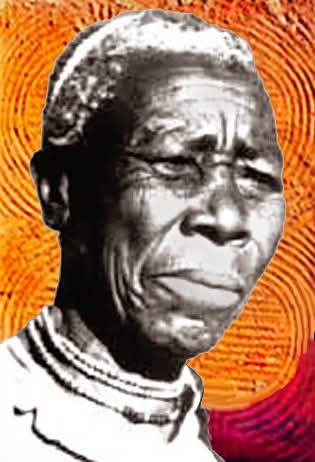
Mantsopa Makhetha, MoSotho prophetess and rain-caller (1795-1906).
Mantsopa Makhetha, MoSotho prophetess and rain-caller (1795-1906). “Mantsopa was born in 1793 in Likotsi or Ramakhetheng, west of the Caledon River in [Lesotho]. Her father was Makhetha, half-brother to Mohlomi, a seer and Bakoena chief. She was descended from royalty of Bakwena ba Monaheng and named after the storyteller Ntsopa.
Prophecies, rainmaking, and exile
“By the 1840s, ‘Mantsopa was renowned as a rainmaker, seer, and diviner. She called for the preservation of Basotho customs, uniting the Sotho people during a time when there was frequent raiding between Afrikaner settlers and the Basotho as well as a growing risk of war with the British-administered Orange River territory.
“She was a talented storyteller [more than that, an organizer and activist] and travelled to the lowlands of her cousin King Moshoeshoe I’s territories, rallying the people against Christian missionaries and calling on them to support their high chiefs and uphold Basotho traditions.
“The earliest documented and most famous prophecy of ‘Mantsopa occurred in 1851. Major Henry Douglas Warden, British Resident in the Orange River Sovereignty, demanded that the Basuto restore cattle and horses to the victims of their past cattle raids. He had mustered a force of 2,500 to attack Moshoeshoe. ‘Mantsopa predicted that Moshoeshoe would have a swift victory and that there would be rain to end an ongoing drought. The Battle of Viervoet was won by Moshoeshoe’s forces on 30 June 1851. It also rained that day.
“Eight years later, French Protestant missionary leader Eugène Casalis recorded ‘Mantsopa’s prophecy, writing: ‘In 1851 war had become inevitable… Manchupa [sic], a woman until then unknown, informed the chief she had fallen into a trance and that a being, whom she designated in no other way than by the words He and Him, had charged her to tell the whole tribe to stand on the defensive, that the enemy would come, and would be destroyed in a contest so sharp, and of such short duration, that it would be called the Battle of Hail.’
“Following ‘Mantsopa’s success in predicting the results of the battle, she became an adviser to King Moshoeshoe I and his sons, especially ‘Masupha and Joel. She then prophesied that Moshoeshoe I would defeat Colonel George Cathcart’s forces at Berea, which they did on 20 December 1852 at the Battle of Berea. She also told Moshoeshoe the day in October 1853 that he would attack his old rival Batlokwa chief Kgosi Sekonyela and bring his fortress to ruins. [But look how he rewarded her:]
“As ‘Mantsopa gained moral and spiritual authority, Moshoeshoe I feared her growing influence and exiled her in the late 1860s. She moved with her husband across the river to Modderpoort (Sesotho: Lekhalong la Bo Tau). After her exile, ‘Mantsopa correctly prophesied the defeat of the Basotho, angering Basotho military leaders.
In Modderpoort, ‘Mantsopa gained the acceptance of the Christian missionaries. … She adopted Christianity, at least nominally, and was baptised on 13 March 1870. She took the baptismal name Anna Makhetha and fused Christianity with traditional ancestor worship. She attended church functions and was active as an Anglican. They considered her the prophet of a Christian covenant with the Basotho.
“During the ramp-up to the Basuto Gun War of 1880–1881, she was accused of “spawning crowds of female prophetesses, who harassed mission stations and inveighed against the Cape colonial authorities.” [This important piece is from “‘Mantsopa”. In Akyeampong, Emmanuel Kwaku; Gates (Jr.), Henry Louis (eds.). Dictionary of African Biography. OUP USA. pp. 91–92]
Here’s another more grass-roots source, which is skeptical about her conversion:
“Her birth name was Kuenalifule and she got the name Mantsopa after her marriage because her first born was Ntsopa. Mantsopa’s other name was Moroka Pula because she knew how to call rain during drought.
“She was Moshoeshoe’s spiritual advisor. She healed people using water (wells) and combination of herbs.
°Apparently Mme Mantsopa was never baptized but only believed in her visions as a direct communication from the ancestors and not the Bible.
“Even though she was shown about the arrival of the Bible through her visions, she advised Morena Moshoeshoe to welcome the missionaries. She told Basotho that white people coming with Patanta (Thick Book) and holeness button (coin/money).
°She advised the Basotho to accept the Bible and analyze it thoroughly, and told them to be careful because white people were going to use it cunningly. She told the Basotho to refuse the button (money) because it was going to divide them.
“Morena Moshoeshoe always consulted her on national matters especially on wars that were fought by Basotho. Everything she predicted came to pass.
“Apparently Mme Mantsopa never had the name Anna as she refused to be baptized by Christian missionaries. But after they saw the influence she had over the Basotho they lied about her being baptized under them so that they can lure Basotho into their missionary church.”
(See Comments for an important angle this source offers on Mantsopa’ spiritual practice, and a photo of the spring in her sacred cave you’ll want to see.)