
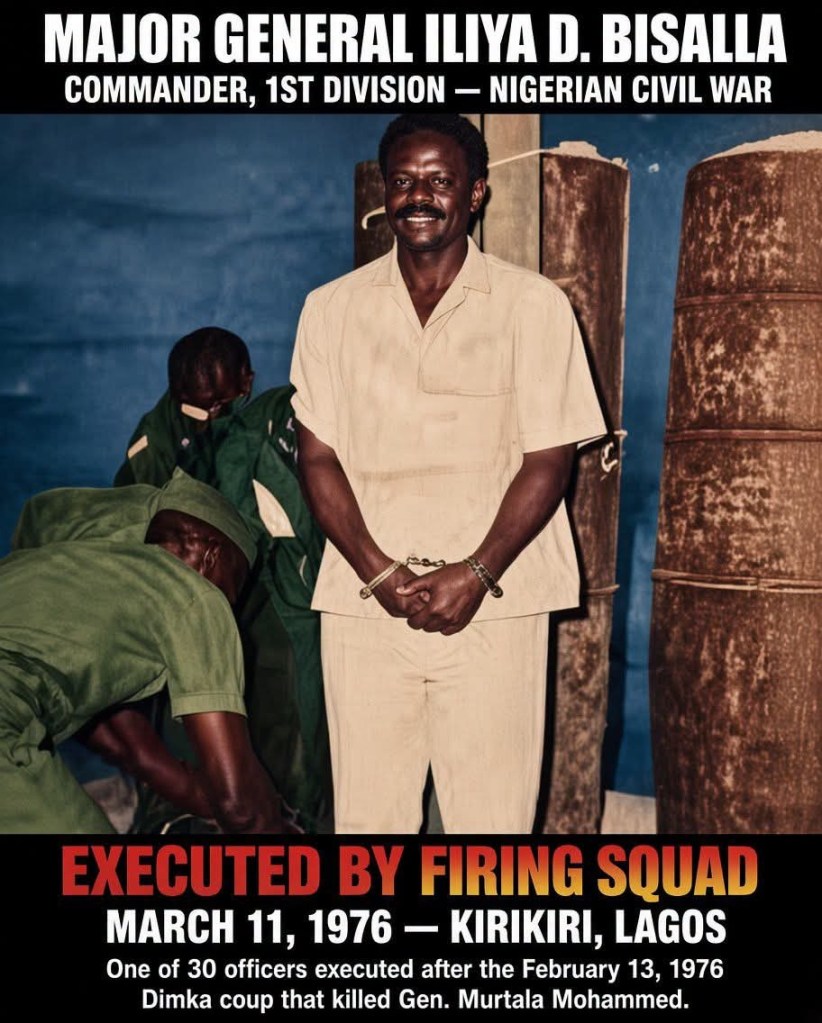
MAJOR GENERAL ILIYA D. BISALLA, FROM SANDHURST TO THE FIRING SQUAD
MAJOR GENERAL ILIYA D. BISALLA, FROM SANDHURST TO THE FIRING SQUAD
Imagine spending your youth preparing to serve a country that was only beginning to find its feet.
Imagine rising through its Army, fighting in its greatest internal conflict, becoming one of its most senior officers, and eventually sitting at the table where the country’s biggest decisions were made.
Then imagine that, less than a year after reaching the height of your career, you are standing before a firing squad.
That was the fate of Major General Iliya D. Bisalla.
Bisalla came from the Pankshin area of what is now Plateau State, in Nigeria’s Middle Belt. The surviving public record tells us surprisingly little about his childhood, but by the end of the 1950s he had entered the generation of young Nigerians being prepared to take command of the country’s emerging national Army.
In 1959, he went to the Royal Military Academy Sandhurst in Britain.
There, among the young Nigerian officers training for the future, was another officer who would become inseparable from Bisalla’s story:
Murtala Muhammed.
They trained together, became military contemporaries and eventually rose through the ranks together.
Bisalla returned to Nigeria and was commissioned in 1961.
His rise was remarkable.
When Army Chief Colonel Joseph Akahan died in 1967, Bisalla was briefly selected to succeed him before Gowon reversed the appointment and Hassan Usman Katsina took the position.
Then Nigeria descended into war.
During the Nigerian Civil War, Bisalla became a senior battlefield commander and eventually took command of the 1st Division during the final phase of the conflict.
The war ended in 1970, but Bisalla’s career did not slow down.
He became Commandant of the Nigerian Defence Academy, helping shape officers who would form the next generation of Nigeria’s military leadership.
And then came July 1975.
General Yakubu Gowon was overthrown.
The man who took power was Bisalla’s old Sandhurst colleague:
Murtala Muhammed.
Murtala brought Bisalla into the new government and appointed him Federal Commissioner for Defence and a member of the Supreme Military Council.
For a man who had spent his life climbing through the Army, this was the summit.
But beneath the surface, the military establishment was changing.
Theophilus Danjuma, who was junior to Bisalla in the old hierarchy, became Chief of Army Staff and gained operational command of the Army.
There were disagreements over seniority, the restructuring of the military and the direction of the new government.
Then, on the morning of 13 February 1976, everything changed.
Murtala Muhammed was assassinated.
The coup was led by Lieutenant Colonel Buka Suka Dimka.
Gunfire erupted in Lagos.
The Head of State was dead.
The coup failed.
And suddenly, the same government in which Bisalla had been one of the most powerful men in the country was searching for those responsible.
Dimka’s statements eventually implicated Bisalla.
The allegation was devastating:
That the Defence Commissioner had known about the conspiracy and had supported or assisted the plotters.
Bisalla denied it.
He maintained his innocence.
And this is where his story becomes much more than a simple tale of a convicted military officer.
The evidence against him has remained controversial.
The government’s case portrayed Bisalla as a senior figure behind the conspiracy. But statements attributed to Dimka contained important contradictions about the planning and operational instructions surrounding the coup.
Bisalla was nevertheless brought before a Special Military Tribunal.
There was no long criminal trial lasting years.
No decades of appeals.
No opportunity to grow old while history slowly reconsidered the evidence.
The process moved with the speed of military rule.
And on 11 March 1976, just 27 days after Murtala Muhammed was assassinated, Major General Iliya Bisalla was taken to his death.
He was executed by firing squad in Lagos.
The man who had once trained at Sandhurst…
The soldier who had commanded troops during Nigeria’s civil war…
The officer who had once been briefly selected as Army Chief…
The Defence Commissioner who had sat inside the country’s highest military council…
Was dead.
But perhaps the most painful part of the story was waiting at home.
His wife, Mildred Kwashie Bisalla, was a nurse and respected Anglican churchwoman.
Their three children were still very young.
Reportedly, Salamatu was about eight, Musa eleven, and Nuhu six when their father was executed.
Three children who had known their father as a soldier and a father suddenly had to grow up without him.
Years later, Salamatu would marry Femi Gbajabiamila, who would eventually become Speaker of Nigeria’s House of Representatives.
So the story of Iliya Bisalla did not end at the firing squad.
It continued through the family he left behind.
And decades later, questions about his conviction continued.
Was Bisalla genuinely part of the conspiracy that killed his old Sandhurst colleague?
Was he a senior officer who knew more than he admitted?
Or was he condemned in the extraordinary atmosphere of revenge and fear that followed Murtala’s assassination?
The historical record allows us to describe the allegations and the tribunal’s verdict.
But we should be careful not to turn a disputed historical case into certainty simply because a military tribunal pronounced a sentence.
One thing, however, is beyond dispute:
Iliya Bisalla went from the heights of Nigeria’s military establishment to a firing squad in just 27 days after the assassination of the man with whom he had once trained at Sandhurst.
His story reminds us that behind the uniforms, ranks and political titles were human beings, and families who had to live with the consequences long after the guns went silent.
We tell our stories not to glorify the past, but to remember it.
 Hi welcome to my website