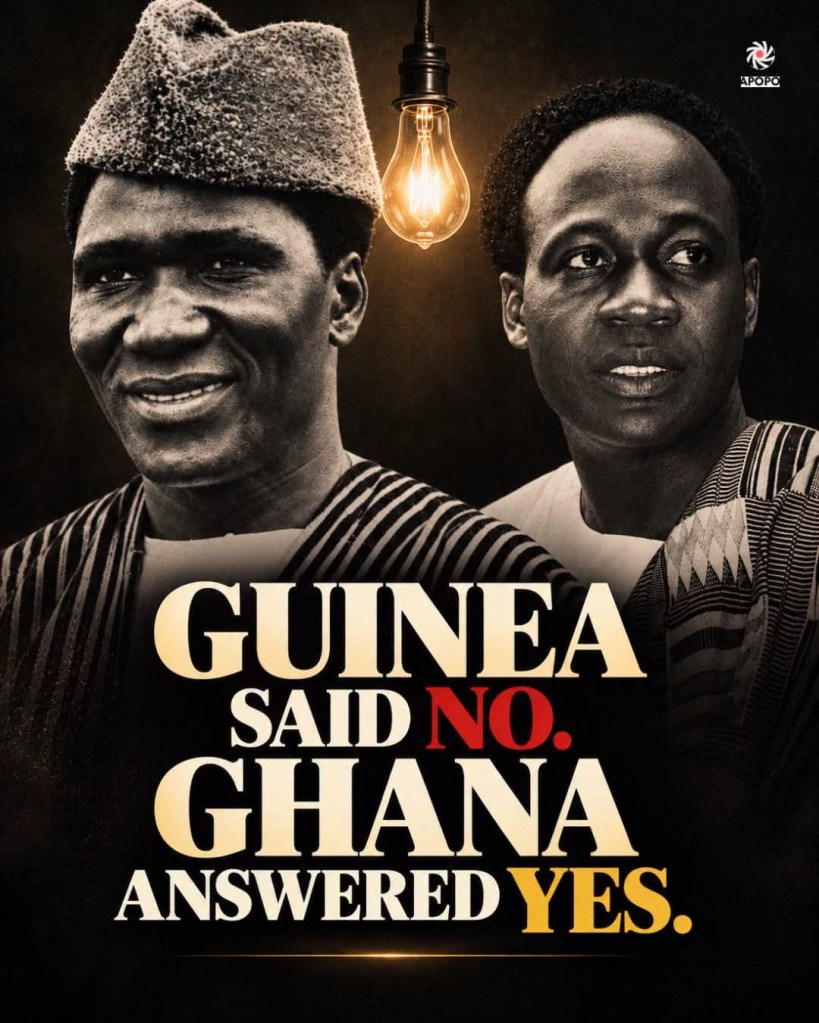
GUINEA SAID NO. GHANA ANSWERED YES.
GUINEA SAID NO. GHANA ANSWERED YES.
There are a thousand ways to punish a country for saying no.
France chose the light bulbs.
No speech.
No declaration.
Just light bulbs coming out of the walls.
Because a few weeks earlier, Guinea had done something no other French African territory had done.
It had said NO.
In 1958, Charles de Gaulle offered France’s African territories a new arrangement.
They could remain tied to France through a new French Community.
There would still be political and economic links.
There would still be French support.
There was a safer road.
But in Conakry, Sékou Touré wanted something different.
Not independence with France above Guinea.
Independence on equal terms.
Touré made his position clear.
Then came the sentence that would define the moment:
“We prefer poverty in liberty to riches in slavery.”
On September 28, 1958, Guinea voted.
The result was overwhelming.
More than 95 percent rejected the French proposal.
Guinea had chosen its own road.
Four days later,
Guinea declared independence.
Then France began to leave.
And it did not leave quietly.
French administrators were withdrawn.
Technicians left.
Financial support was cut.
The machinery of the colonial state began disappearing with them.
Records.
Office equipment.
Law books.
The things a government needs to keep a country running.
And according to contemporary reporting, France even removed plans for sewage pipelines in Conakry.
Medicines were burned rather than left behind.
And the light bulbs?
They took those too.
Now the punishment had become physical.
Not something written in a diplomatic cable.
Not something announced from a podium.
You could see it in the walls.
Guinea had won sovereignty.
But sovereignty did not come with engineers.
Or administrators.
Or money.
Or medicines.
Or the infrastructure needed to make a new country work.
Touré had chosen freedom knowing there would be a price.
And France was making sure Guinea felt every part of it.
But Guinea was not the only country watching.
Across West Africa, another newly independent nation was watching what happened next.
Kwame Nkrumah.
Ghana had only recently become independent itself.
Its own resources were limited.
Its own future was uncertain.
But Nkrumah did not look at Guinea and say:
“You made your choice.”
He saw something larger.
If one African country could be isolated for choosing independence, then every newly independent African country was vulnerable.
So Ghana answered.
Not with applause.
Not with another speech.
With £10 million in credit.
Ghana put real resources behind Guinea.
And in November 1958, Nkrumah and Touré announced plans for a political union between Ghana and Guinea.
Two new African states were trying to prove that independence did not have to mean standing alone.
The union would not last.
But that was never the most important part.
The important part was the answer.
Touré had accepted the price of saying no.
Nkrumah decided Guinea would not pay it alone.
The bulbs were small.
The message was not.
History remembers the countries that won independence.
We remember the country that said no — and the neighbor who answered yes.
If this story made you stop and think, follow Studio APOPO for more African history that deserves to be remembered — and share this with someone who should know what happened when Guinea said no and Ghana answered yes.