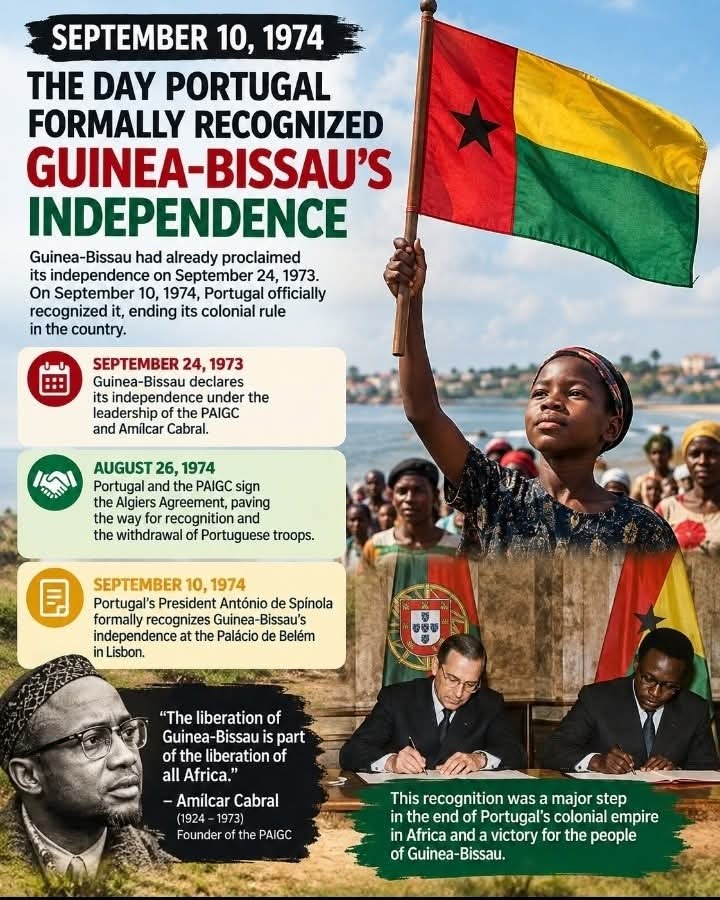
SEPTEMBER 10, 1974: THE DAY PORTUGAL FINALLY RECOGNIZED GUINEA-BISSAU’S INDEPENDENCE
🇬🇼 SEPTEMBER 10, 1974: THE DAY PORTUGAL FINALLY RECOGNIZED GUINEA-BISSAU’S INDEPENDENCE
What if a country declared its independence—but its colonial ruler refused to recognize it for another year?
That was the reality faced by Guinea-Bissau.
On September 10, 1974, Portugal formally recognized the independence of the Republic of Guinea-Bissau, bringing a decisive legal and diplomatic chapter of the country’s long struggle against Portuguese colonial rule to an end.
But there is an important detail many people miss:
👉 Guinea-Bissau had already proclaimed its independence on September 24, 1973.
The declaration was made by the African Party for the Independence of Guinea and Cape Verde (PAIGC), led by the liberation movement founded by Amílcar Cabral and, after his assassination in 1973, continued under the leadership of figures including Luís Cabral.
The proclamation took place in the Boé region, an area largely outside Portuguese military control. The PAIGC established state institutions, including the National People’s Assembly and a government.
However, Portugal—the colonial power—did not immediately accept the declaration.
⚔️ THE WAR BEHIND THE INDEPENDENCE
Guinea-Bissau had been under Portuguese colonial rule for centuries. By the 20th century, resistance to Portuguese domination had grown into an organized liberation struggle.
In 1956, the PAIGC was founded to fight for independence.
Beginning in the 1960s, the movement waged an armed struggle against Portuguese forces.
The conflict became one of Portugal’s most difficult colonial wars.
The PAIGC gradually established control over large parts of the countryside and created systems of administration, education and health care in areas under its influence.
By the early 1970s, Portugal was facing an increasingly costly war that was becoming difficult to win militarily.
Then came a major turning point.
🌍 THE WORLD BEGAN RECOGNIZING GUINEA-BISSAU
After the PAIGC proclaimed independence in September 1973, the new state received growing international recognition.
The United Nations General Assembly recognized Guinea-Bissau’s representatives in 1973, and the struggle increasingly became an international diplomatic issue.
But Portugal still had not formally recognized the country’s independence.
That changed dramatically after Portugal’s Carnation Revolution of April 25, 1974.
The authoritarian Estado Novo regime was overthrown, and Portugal’s new authorities began dismantling the country’s colonial empire.
🤝 THE ALGIERS AGREEMENT
On August 26, 1974, representatives of Portugal and the PAIGC signed the Algiers Agreement in Algeria.
This agreement was historic.
Portugal committed itself to recognizing Guinea-Bissau as a sovereign state on September 10, 1974.
The agreement also established a formal ceasefire and provided for the progressive withdrawal of Portuguese forces from Guinea-Bissau, with the withdrawal scheduled to be completed by the end of October.
For the PAIGC, decades of armed struggle and political organization had finally produced a formal settlement.
For Portugal, it represented a major step in dismantling its African colonial empire.
🇵🇹 SEPTEMBER 10, 1974
On that day, Portuguese President António de Spínola formally signed the declaration recognizing the independence of the Republic of Guinea-Bissau.
The Portuguese government’s official declaration stated that Portugal “recognizes solemnly” the independence of Guinea-Bissau.
The declaration was dated September 10, 1974, although it was published in Portugal’s official gazette the following day.
The ceremony took place at the Palácio de Belém in Lisbon, with senior Portuguese officials present, including Prime Minister Vasco Gonçalves and Foreign Minister Mário Soares.
So, September 10 was not the day Guinea-Bissau first declared independence.
It was the day the former colonial power formally accepted that independence in law.
🇬🇼 WHY THIS MOMENT MATTERED
The significance went far beyond a single declaration.
Portugal’s recognition meant that Guinea-Bissau’s independence was no longer simply a unilateral declaration by a liberation movement—it had now been formally accepted by the country that had ruled the territory.
It also opened the way for formal diplomatic relations between Portugal and Guinea-Bissau.
And the consequences extended beyond Guinea-Bissau.
The Algiers Agreement also reaffirmed Portugal’s recognition of the right of the people of Cape Verde to self-determination and independence, showing that the Portuguese withdrawal from Guinea-Bissau was part of a much larger collapse of Portuguese colonial rule in Africa.
Within weeks, Portuguese troops were being withdrawn.
By the end of October 1974, Portugal’s military withdrawal from Guinea-Bissau was scheduled to be complete.
🕊️ FROM COLONY TO SOVEREIGN STATE
The road from colonial territory to independent nation had been long, difficult and costly.
Guinea-Bissau’s independence was not simply handed over.
It emerged from years of political organization, armed resistance, diplomacy and international pressure.
The PAIGC had declared independence in 1973.
Portugal formally recognized it in 1974.
And on September 10, 1974, a former colonial power officially acknowledged what Guinea-Bissau’s independence movement had been fighting for: the right of the Guinean people to govern themselves as a sovereign nation.
🇬🇼 September 10, 1974, therefore stands as a crucial date in the history of Guinea-Bissau—and in the wider story of African decolonization.
One year after independence was proclaimed, Portugal finally recognized it.
📌 HISTORY FACT: Guinea-Bissau was the first Portuguese African colony whose independence Portugal formally recognized after the 1974 Carnation Revolution. Its struggle also helped accelerate the broader collapse of Portugal’s colonial empire in Africa.
What do you think is the most important lesson from Guinea-Bissau’s independence struggle?