When Nigeria and Cameroon Nearly Went to War: The 1981 Akpa Yafe Crisis
When Nigeria and Cameroon Nearly Went to War: The 1981 Akpa Yafe Crisis
On 16 May 1981, a border incident between Nigeria and Cameroon brought the two West African neighbours dangerously close to open war.
Five Nigerian soldiers were killed during a clash in the disputed border region around the Akpa Yafe River, an incident that transformed a long-running territorial disagreement into an immediate military and diplomatic crisis.
At the centre of the confrontation was a deceptively simple question: where exactly had the shooting taken place?
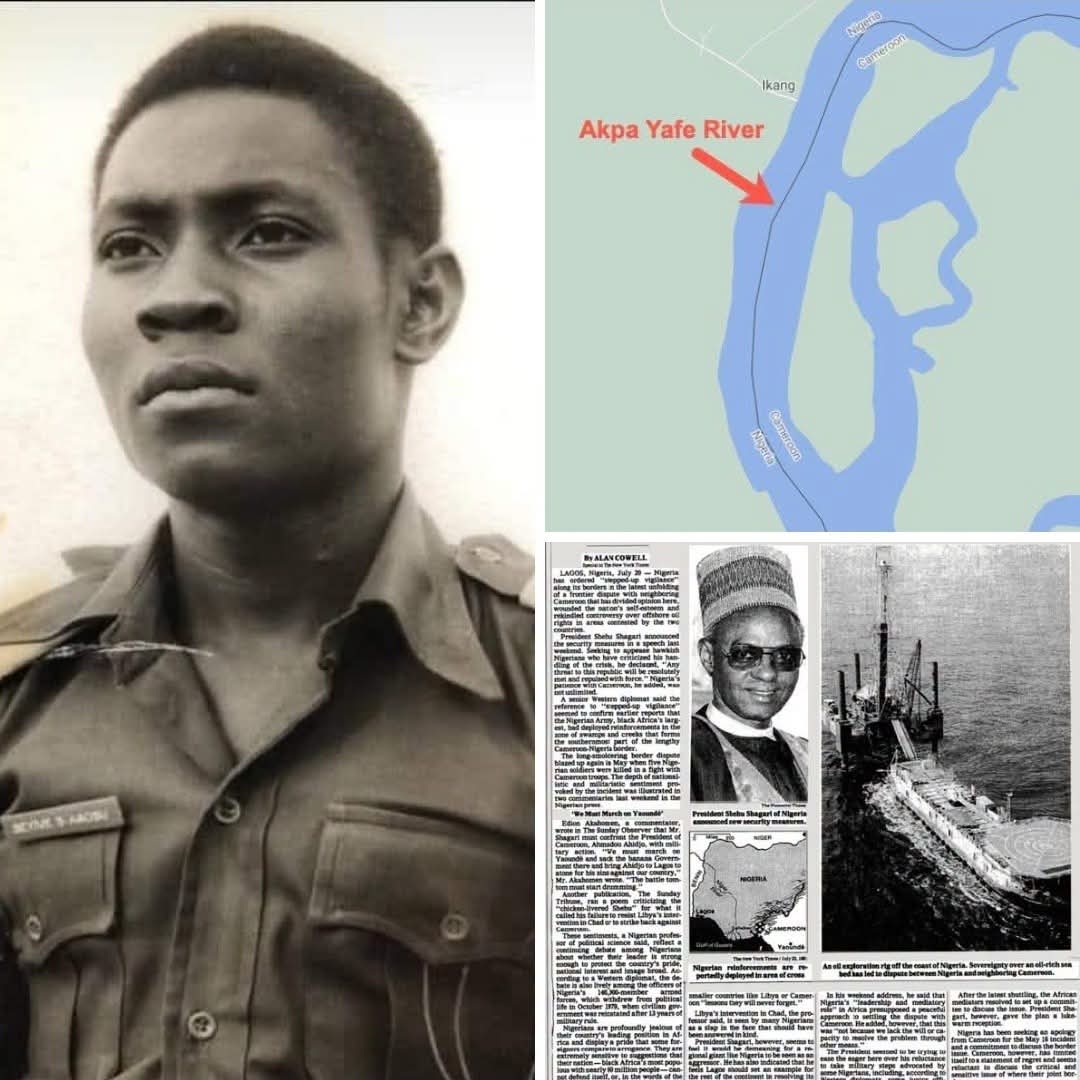
Nigeria maintained that its soldiers had been operating on the Akpa Yafe River, along what it regarded as the established international boundary. Cameroon gave a fundamentally different account, insisting that the Nigerian patrol had entered Cameroonian territory and reached the Rio del Rey, where it allegedly opened fire on a Cameroonian vessel.
The disagreement would have consequences far beyond the five deaths.
Five Soldiers and a Disputed Border
According to Nigerian accounts, the patrol was operating in the Ikang area when it was attacked by Cameroonian forces.
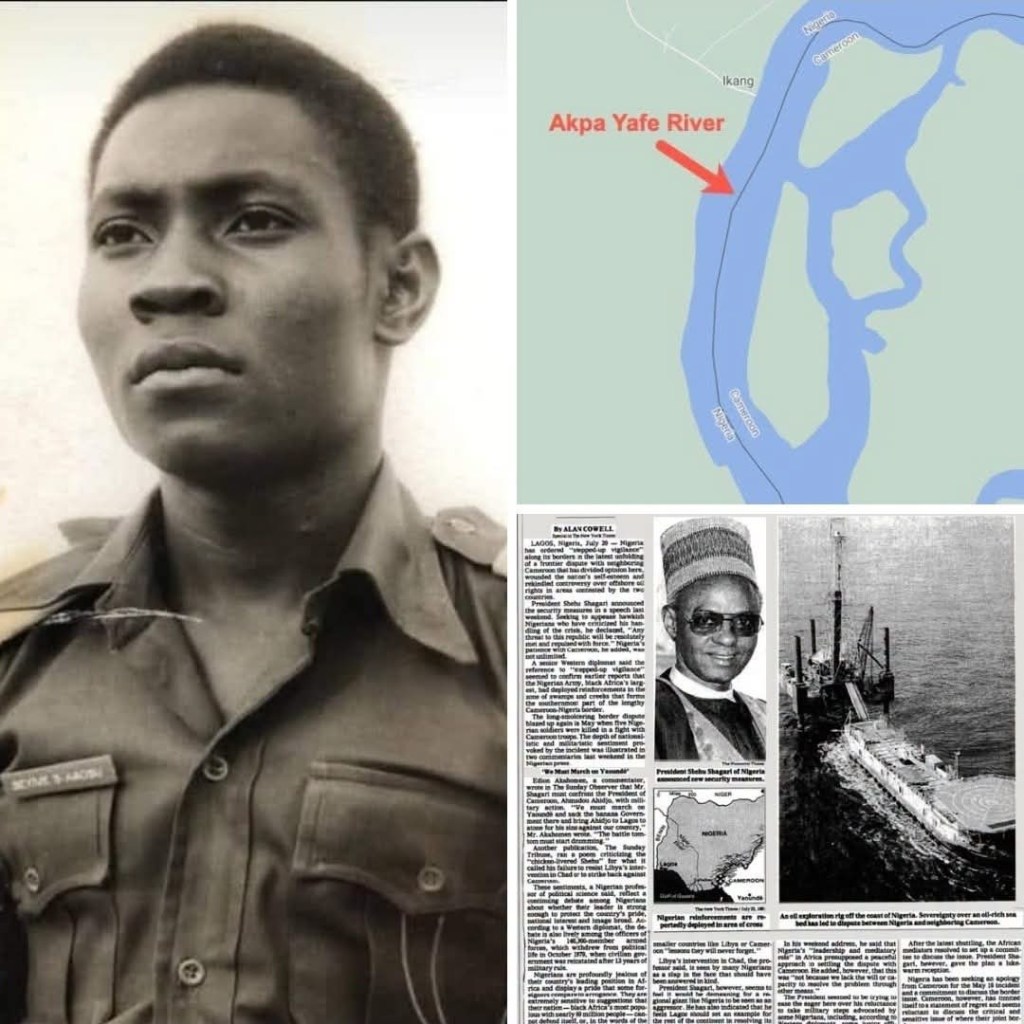
The five Nigerians killed were Second Lieutenant Seyiveh Sewhenu Amosu, who led the patrol, and four other soldiers identified as Lance Corporal Felix Bemigho, Private Emmanuel Kaar, Private Joseph Imaja and Private Emmanuel Akpan. Later Nigerian accounts identify Amosu as the officer commanding the patrol.
The incident was particularly serious because Nigeria and Cameroon had already been dealing with unresolved questions over their colonial-era boundary.
Cameroon argued that the Nigerian soldiers had crossed into its territory. Nigeria rejected this account and maintained that the patrol had been attacked within Nigerian territory.
The disagreement eventually became part of the legal record of the wider Bakassi dispute. In proceedings before the International Court of Justice, Nigeria stated that the incident occurred on the Akwa Yafe River in what was then Cross River State. Cameroon maintained that the Nigerian patrol had gone as far as the Rio del Rey inside Cameroon. The five deaths were acknowledged in the proceedings by both sides, although the two governments continued to disagree over how the confrontation began and where it occurred.
That distinction mattered enormously.
The location of the patrol was tied to the competing interpretations of the boundary established by earlier Anglo-German arrangements and subsequently inherited by the two independent states.
Shagari Demands an Explanation
President Shehu Shagari was faced with an extremely difficult situation.
Nigeria had just experienced the deaths of five members of its armed forces at the hands of a neighbouring country’s security forces, according to the Nigerian version of events.
The government responded forcefully through diplomatic channels.
Lagos demanded an apology from Cameroon, punishment for those responsible and compensation for the families of the Nigerian soldiers. Academic research on the dispute describes Nigeria’s communication as an ultimatum demanding an apology without reservation, punishment of those involved and compensation.
Cameroon did not immediately accept Nigeria’s version.
President Ahmadou Ahidjo sent Foreign Minister Paul Dontsop to Lagos. Dontsop expressed Cameroon’s regret and condolences to the families of the dead, but the Cameroonian government maintained that the confrontation had taken place in Cameroonian waters.
Nigeria considered the response insufficient.
The dispute was subsequently taken to the Organisation of African Unity, reflecting Shagari’s attempt to prevent the crisis from becoming a full-scale military confrontation. The later ICJ record confirms that Nigeria approached the OAU during the crisis rather than relying solely on bilateral negotiations.
But diplomacy was only one side of the story.
Inside Nigeria, public anger was growing.
The Press and the Pressure for War
The incident generated a wave of nationalist anger in the Nigerian press.
Newspapers published increasingly aggressive commentary about Cameroon and questioned whether President Shagari was responding strongly enough. Academic research into the crisis records headlines including “Chicken-Livered Shehu” in the Sunday Tribune and “The Battle Tom-Tom Must Start Drumming” in the Sunday Observer.
The rhetoric extended beyond newspaper columns.
There were calls for retaliation, while protests were reported against Cameroon and its diplomatic representation in Lagos.
The crisis therefore became a domestic political problem for Shagari. He had to demonstrate that Nigeria would defend its soldiers and territorial interests without allowing the confrontation to escalate into a war whose consequences could be far greater than the original incident.
This was particularly difficult because there was also pressure from within the military establishment.
Nigeria Prepares for a Military Response
According to the account of military historian Nowa Omoigui, the Shagari administration ordered military preparations while diplomatic efforts continued.
A Joint Task Force was planned for operations along the Nigerian-Cameroonian border, with Brigadier Mamman Vatsa involved in the operational planning. Nigeria began preparing its forces for the possibility that diplomacy might fail.
The situation was now becoming extremely dangerous.
A military response could easily have transformed a border dispute into a broader war between two sovereign states.
And then came an extraordinary development.
Omoigui’s account states that details of the Nigerian operational plans were leaked to French intelligence, which subsequently informed President Ahidjo. The identity of the person responsible for the alleged leak has never been established.
France had particularly important interests in the crisis.
Cameroon had strong historical and strategic ties with France, and French officials had reasons to prevent a major conflict between Cameroon and Nigeria. According to Omoigui’s account, France reminded Nigeria of its obligations arising from its relationship with Cameroon while simultaneously warning Cameroon that provoking Nigeria could threaten French economic interests in Nigeria.
Other accounts likewise credit diplomatic intervention, including efforts associated with the OAU, with helping to prevent the situation from deteriorating further.
The Apology That Defused the Crisis
After weeks of tension, the confrontation finally began to de-escalate.
On 20 July 1981, President Ahmadou Ahidjo formally apologised to Nigeria and accepted arrangements for compensation to the families of the Nigerian soldiers.
The apology did not erase the disagreement over what had happened on 16 May. Cameroon continued to maintain its own interpretation of the incident.
But diplomatically, it changed the situation.
The immediate crisis was defused.
Nigeria did not launch the military operation that had been contemplated.
And the five dead soldiers did not become the first casualties of a much larger Nigeria-Cameroon war.
The episode would later be remembered as one of the most dangerous moments in the early history of the Nigeria-Cameroon border dispute. Omoigui’s account describes the apology as the event that ultimately defused the crisis, while subsequent scholarship places the incident at the beginning of the more militarised phase of the wider border dispute.
Second Lieutenant Seyiveh Sewhenu Amosu
Among those killed was Second Lieutenant Seyiveh Sewhenu Amosu, the young officer leading the patrol.
Nigerian accounts identify Amosu as a graduate of the Nigerian Military School, Zaria, and later a member of the 22nd Regular Course of the Nigerian Defence Academy. His family also had a strong military tradition.
He was buried at Atan Military Cemetery on 22 May 1981, according to the biographical account supplied with the photograph.
The other four soldiers who died alongside him remain less documented in publicly accessible historical records, despite their names appearing in later Nigerian accounts.
Their deaths are nevertheless part of the same story.
They were five members of the Nigerian military caught at the point where competing interpretations of a colonial-era boundary became a deadly confrontation between two independent African states.
A Crisis That Became History
The events of May–July 1981 would eventually become important evidence in the much larger Bakassi dispute.
More than a decade later, Nigeria and Cameroon would again become embroiled in armed confrontations over the peninsula. Cameroon eventually brought the broader territorial dispute before the International Court of Justice in 1994.
In its 2002 judgment, the Court awarded sovereignty over the Bakassi Peninsula to Cameroon and relied heavily on the colonial-era agreements governing the boundary.
But the roots of that later confrontation stretched back much further.
The May 1981 incident was one of the moments when the unresolved boundary ceased to be merely a diplomatic argument on maps and became a matter of soldiers, patrol boats and lives lost.
The five Nigerian soldiers killed that day became casualties of a dispute whose full consequences would unfold over the following two decades.
And perhaps the most significant lesson of the episode lies in what did not happen.
Nigeria had the military capability and domestic pressure to retaliate.
Cameroon had its own territorial claims and security concerns.
The two countries were angry, their militaries were preparing, and nationalist rhetoric was intensifying.
Yet diplomacy ultimately prevailed.
The crisis of 1981 therefore remains an important chapter in the history of Nigeria and Cameroon: a moment when a disputed stretch of water brought two neighbouring states close to war, but when negotiation, external mediation and political restraint prevented five deaths from becoming the beginning of a much larger conflict.
Reference
- International Court of Justice, Land and Maritime Boundary between Cameroon and Nigeria — Preliminary Objections / Oral Proceedings — records the competing Nigerian and Cameroonian accounts of the 16 May 1981 incident and the deaths of five Nigerian soldiers.
- Nowa Omoigui, History of Civil-Military Relations in Nigeria: The Second Transition (1979–1983) — detailed account of Shagari’s response, military mobilisation, Brigadier Mamman Vatsa’s operational planning and the alleged intelligence leak.
- Nowa Omoigui, The Bakassi Story — account of the 1981 clash, the competing Akpa Yafe/Rio del Rey claims and Cameroon’s 20 July apology.
- Rose Ngomba-Roth, The Challenges of Conflict Resolution in Africa: The Case of Cameroon-Nigerian Border Conflict — detailed academic treatment of the 1981 crisis, the Nigerian ultimatum, Paul Dontsop’s mission and the press reaction.
- The Cameroon-Nigeria Border Dispute: Management and Resolution, 1981–2011 — scholarly account of the five deaths, diplomatic negotiations and Paul Dontsop’s mission to Lagos.
- International Court of Justice, Land and Maritime Boundary between Cameroon and Nigeria, later proceedings — documents the continuing importance of the 1981 incident in the wider Bakassi dispute.