THE MASKS OF AFRICA — WHEN ART BECOMES THE VOICE OF THE ANCESTORS
THE MASKS OF AFRICA — WHEN ART BECOMES THE VOICE OF THE ANCESTORS
Africa has never been a continent without history.
Long before museums, textbooks, cameras, and modern archives, African societies preserved memory through art, symbols, masks, sculpture, clothing, music, dance, and oral tradition.
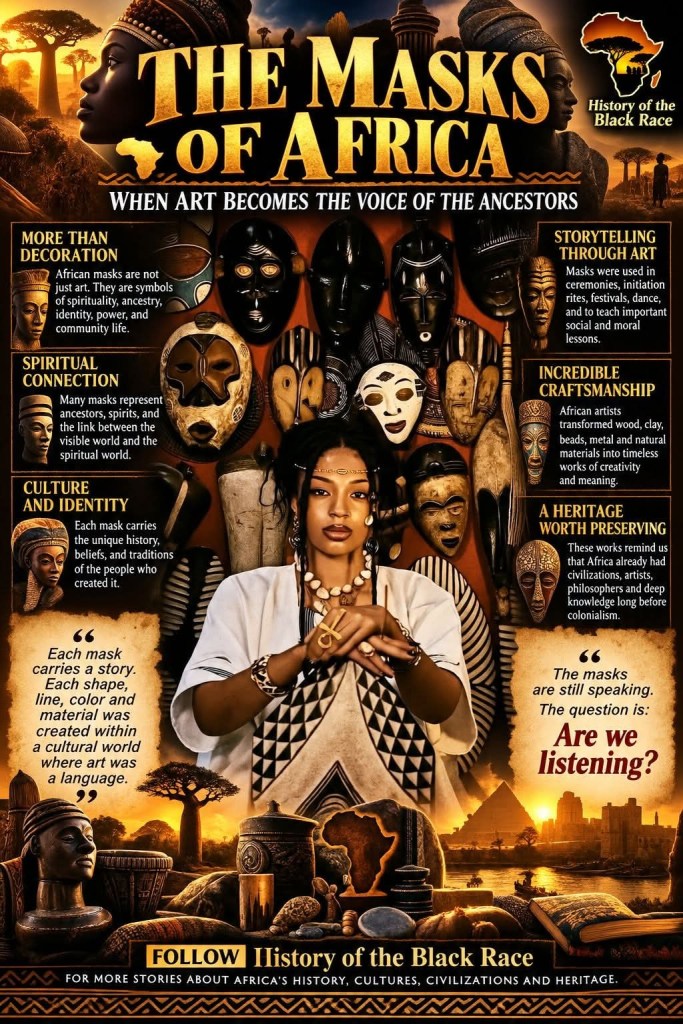
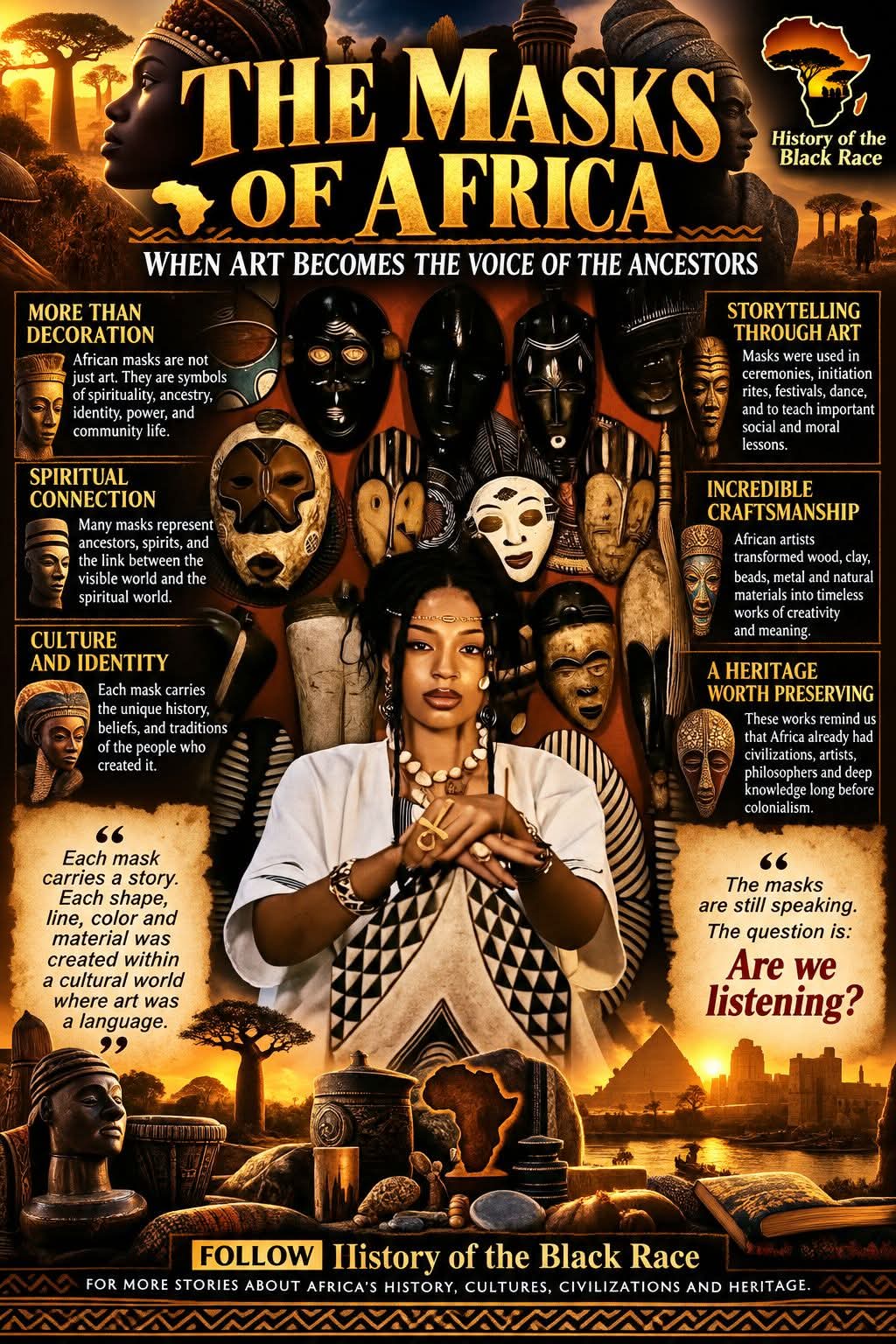
Look closely at these masks.
Each face carries a story.
Each shape, line, color, and material was created within a cultural world where art was not simply decoration. Masks could be connected to ceremonies, initiation, spirituality, leadership, community identity, ancestral traditions, entertainment, and storytelling. Their meanings varied greatly from one African society to another.
And that is what makes African traditional art so powerful.
A mask was never simply a piece of wood.
It could represent an idea.
A spirit.
An ancestor.
A human quality.
A connection between the visible world and the spiritual world.
A community’s understanding of life itself.
For generations, African artists transformed ordinary materials—wood, clay, fibers, beads, metal, pigments and other natural materials—into objects of extraordinary creativity.
Yet much of the world encountered African art outside the communities that created it, particularly through colonial-era collecting and the international art market.
Today, these works continue to raise important questions:
Who created them?
What did they mean?
Who had the right to take them?
Where should they be preserved?
And what happens when an object is separated from the culture that gave it meaning?
The woman standing among these masks represents something deeper than fashion or photography.
She stands surrounded by memory.
Behind her are faces created by African hands, shaped by African imagination, and connected to traditions that survived generations of enormous historical change.
This is why African cultural heritage deserves to be studied—not merely admired.
Because when we study the art, we begin to understand the people.
When we understand the people, we begin to understand the history.
And when we understand the history, we realize that Africa’s story did not begin with colonialism.
Africa already had civilizations.
Africa already had artists.
Africa already had philosophers, architects, craftsmen, healers, rulers, musicians and storytellers.
Africa already had memory.
The masks are still speaking.
The question is:
Are we listening?
What do you think these masks represent to you—art, spirituality, identity, history, or all of them together?