The Journey of Ndigbo – Before Us. Around Us. Ahead Of Us.
The Journey of Ndigbo – Before Us. Around Us. Ahead Of Us.
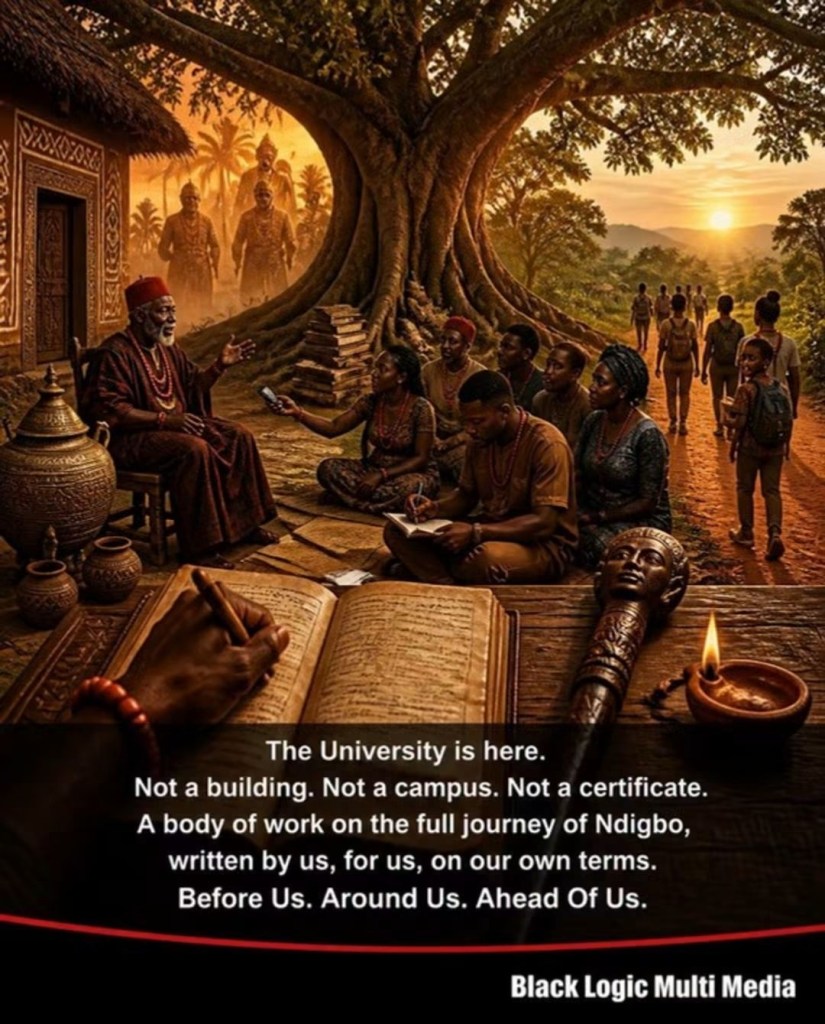
Today, I introduce the University.
Not a building. Not a campus. Not a certificate. A body of work. A PhD-level research project. A structured investigation into the full journey of Ndigbo across five centuries and beyond.
This is the intellectual foundation of everything Black Logic Multi-Media publishes and everything The Return movement is building.
It is called THE JOURNEY OF NDIGBO: Before Us. Around Us. Ahead Of Us.
What This Project Is
This is a multi-year, interdisciplinary, decolonized doctoral research programme investigating the full journey of Ndigbo: their origins, their civilizations, their institutions, their knowledge systems, their migrations, their forced dispersals, their global connections, their transformations, their present condition, and their future possibilities.
It is rooted in Odinani. It is rooted in Omenala. It is rooted in Ndi Gboo. It is rooted in the ancestors, in Ala, and in Ogwugwu.
It is Igbo-centred. It is African-centred. It is evidence-led. It is historically grounded. It is globally connected. It is future-oriented.
It is not a conventional history of southeastern Nigeria. It is not a study of colonialism alone. It is not a discussion of the Nigeria-Biafra War. It is not a celebration of cultural identity. It is not a collection of disconnected articles.
It is the full journey. Past, present, and future. Before us, around us, ahead of us.
Why This Project Exists
Ndigbo have been written about. But rarely have they been written about by themselves, for themselves, on their own terms, using their own frameworks, in their own voice.
Colonial anthropologists wrote about us. Missionary ethnographers wrote about us. Western-trained academics wrote about us. Foreign journalists wrote about us. Every one of them carried a framework that was not ours.
This project corrects that. It does not begin with their questions. It begins with ours.
Who were we before they came? How did we govern ourselves? What did we know that was never recorded? Where did our people migrate, settle, trade, and build? What was taken from us through slavery, colonialism, and war? What survives in the diaspora? What was lost that can never be recovered? What was buried that can be restored? What must we build for the generations who have not yet been born?
These are our questions. And for the first time, they will be answered by us, in our own language, using our own standards of evidence, guided by our own ancestors.
The Scope of the Project
This project is vast. It is deliberately vast. Because Ndigbo are vast. Our history is vast. Our journey is vast. Our contributions are vast. Our losses are vast. Our future possibilities are vast.
The project is organized into twenty-five permanent research domains. Each domain is a field of investigation in its own right. Each will produce its own literature review, source collection, field research, and published body of work.
The first five domains are:
One: Igbo origins and deep history. Archaeology, linguistics, settlement, oral traditions, early societies, and historical debates.
Two: Igbo civilization and community formation. Social organization, kinship, family, village institutions, town unions, age grades, customary law, and regional diversity.
Three: Odinani and indigenous worldviews. Chi, Ala, Ofo, Ikenga, ancestors, moral order, ritual, cosmology, spirituality, and variations across communities.
Four: Child upbringing and intergenerational transmission. Character formation, indigenous education, apprenticeship, family responsibilities, language transmission, and changing parenting systems.
Five: Indigenous science and technical knowledge. Agriculture, metallurgy, medicine, architecture, engineering, crafts, environmental knowledge, textiles, food systems, and material production.
The remaining twenty domains will be introduced in the coming days. Each one is a pillar of the University.
The Methodology
This project does not use Western academic frameworks as its foundation. It uses a decolonized methodology. It draws from:
Oral history – sitting with elders, dibias, and custodians of knowledge. Recording their testimonies. Preserving their wisdom before it disappears.
Participatory research – working with communities, not on them. The research serves the people, not the researcher.
Archival recovery – reading colonial records, missionary records, and academic texts to extract what was hidden. Reading between the lines. Reading against the grain.
Comparative analysis – placing Odinani systems alongside other indigenous systems to show what is universal and what is unique.
Spiritual discernment – dreams, visions, ancestral guidance, and ritual as legitimate sources of knowledge.
Media as method – the media platform is not just output. Each post, video, and article is a research intervention in real time, tested by the community through engagement and response.
The Reality Window – a seven-day cycle for integrating current events into the longer historical record. Every significant event in Nigeria, Ala Igbo, or the world is read through the lens of the deep record and connected to the 500-year continuum.
The Evidence Standard
This project is built on truth. Not on convenience. Not on ideology. Not on romanticism.
Every claim is classified as one of the following: established evidence, oral tradition or community memory, scholarly interpretation, contested claim, hypothesis requiring further investigation, unresolved question, or proposed solution requiring evaluation.
Where the evidence is strong, we state it plainly. Where the evidence is weak, we say so. Where the evidence is missing, we identify what would be required to find it. Where the evidence is contested, we preserve the distinction until it can be resolved.
We do not invent citations. We do not fabricate events. We do not force evidence to agree with preferred conclusions.
This is what makes the project credible. And it is what makes it dangerous to the warrant chiefs. Because truth, properly documented, cannot be dismissed.
The 120-Day Curriculum
The first formal phase of the project is a 120-day curriculum divided into four phases of thirty days each.
Phase I: The 500-Year Historical & Legal Trap (Days 1–30). Tracing the line of legal dispossession from the 15th-century papal decrees to the Land Use Act of 1978 and beyond.
Phase II: The Anatomy of Dispossession & Resource Feasting (Days 31–60). Mapping present-day asset transfers, mineral concessions, and multi-ethnic patterns of capture across Nigeria and the wider continent.
Phase III: Spiritual Subversion, Moral Decay & Psychological War (Days 61–90). Exposing how value systems were replaced to prevent collective resistance and enforce civic apathy.
Phase IV: The Odinani Master Restoration & Reclaiming Sovereignty (Days 91–120). Delivering the concrete, research-backed operational roadmap to rebuild indigenous sovereignty and economic self-reliance.
This project is not a formal, accredited PhD. Not yet. It is a doctoral-level research programme being developed with the intention of producing a specific, original, manageable thesis within the broader architecture.
In the coming months, I will identify a specific thesis problem from the broader programme. I will develop a formal research proposal with research aims, objectives, methodology, and chapter outline. I will identify the appropriate academic supervision and institutional affiliation. I will prepare the thesis for formal submission and defense.
The broader programme is the University. The thesis is the degree. Both are being built.
But the University does not wait for the thesis. It does not wait for accreditation. It does not wait for permission.
It begins now. Because the people are ready. Because the ancestors are waiting. Because the warrant chiefs have had their time.
What This Means for You
If you have been following this work, you are already part of this. You are not a spectator. You are a participant. You are a student. You are a researcher. You are a builder.
Here is what I am asking of you.
Learn. Read what I publish. Ask questions. Bring your own knowledge. Bring your own elders. Bring your own family stories.
Contribute. If you know a plant, a prayer, a practice, a history, a village, a name, a document, a recording, send it. The archive is being built by all of us.
Share. The message must travel. It will not travel on my two feet alone. Share the posts. Share the videos. Share the teachings. Send them to your family, your friends, your community groups.
Prepare. The curriculum begins soon. Not as entertainment. As a course of study. As a formation. As a school.
Build. If you can write, design, film, edit, translate, sing, or organize announce yourself. The work is too heavy for one man. It was never meant to be carried by one man.
The Final Word
This is not a small thing. This is not a side project. This is not a hobby. This is not a content page.
This is the intellectual architecture of a civilization in restoration. This is the record being built. This is the memory being preserved. This is the future being prepared.
My grandfather made sacrifices year after year, pleading with Ogwugwu that we must return. He died in 1999, before he could see it. But he never gave up. He prayed for a generation that would come back.
I am that generation. And so are you.
Before Us. Around Us. Ahead Of Us.
Welcome to The University.
Welcome to The Return..