Colonel Louis Chude-Sokei: The Biafran Officer Behind the Hijacked Aircraft and Wartime Air Force
Colonel Louis Chude-Sokei: The Biafran Officer Behind the Hijacked Aircraft and Wartime Air Force
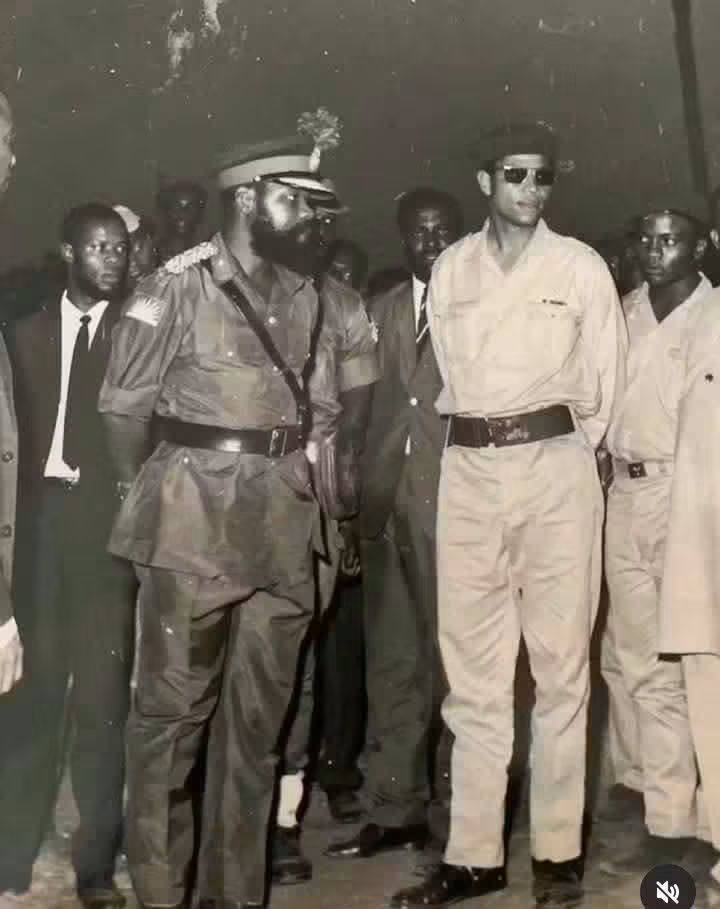
Standing beside Odumegwu-Ojukwu in this photograph is Lieutenant-Colonel Louis Austin Chude-Sokei, a Biafran military officer whose wartime career connected one of the most controversial episodes of the Nigerian Civil War with Biafra’s desperate attempt to establish an air force.
His story included a daring operation involving a Nigeria Airways aircraft, the creation of a small and improvised Biafran air arm, and a family life that would later be remembered through the memoir of his son, Louis Chude-Sokei.
FROM THE NIGERIAN ARMY TO BIAFRA
Chude-Sokei was a professionally trained Nigerian Army officer who had attended the Royal Military Academy at Sandhurst. He was among the officers whose careers were disrupted by the political and military crises that preceded the Nigerian Civil War.
When the conflict began in 1967, Chude-Sokei joined the Biafran side and became increasingly involved in its military organisation.
He eventually emerged as one of the commanders of the Biafran Air Force, alongside officers such as Godwin Ezeilo. Historical accounts describe the force as small but surprisingly ambitious, operating with aircraft that were often old, improvised or obtained through complicated international arrangements.
THE NIGERIA AIRWAYS HIJACKING
One of the most dramatic episodes associated with Chude-Sokei was the hijacking of a Nigeria Airways aircraft from Benin to Enugu.
According to a detailed account published by The Guardian, Chude-Sokei was involved in planning the operation. The actual hijacking was carried out by a small group that included Inyagha, Ibikare Allwell-Brown, Odu and Nwanya, while other people, including Chude-Sokei, were involved in planning and coordinating the operation.
The operation exploited the fact that some Nigeria Airways personnel who had been separated from their communities during the crisis were still known to colleagues on the aircraft.
The plane was ultimately diverted to Enugu, where it came under Biafran control.
The episode was significant because Biafra was desperately short of aviation resources. Capturing an aircraft therefore had potential military value beyond the immediate hijacking itself.
It became one of the unusual episodes of the war in which civilian aviation and military strategy became intertwined.
BUILDING AN AIR FORCE FROM VERY LITTLE
Chude-Sokei’s military career subsequently became closely associated with Biafra’s air operations.
The Biafrans did not possess the extensive aircraft, infrastructure or logistical support available to the Federal side. Nevertheless, they assembled a small air force from whatever aircraft they could obtain.
Its early inventory included B-25 Mitchells, B-26 Invaders, a converted DC-3 and a de Havilland Dove. Later, Biafra acquired other aircraft, including the famous Swedish-built MFI-9B aircraft, which became known as the “Biafra Babies”.
The force was a mixture of military aircraft, converted civilian planes and aircraft acquired through foreign networks.
The Biafran air arm was therefore less like a conventional modern air force and more like an improvised wartime organisation assembled under severe restrictions.
Chude-Sokei was one of the officers responsible for this effort.
HIS WIFE, SHIRLEY
Away from the battlefield, Chude-Sokei’s family was also deeply involved in the humanitarian consequences of the war.
His wife, Shirley Patricia Chude-Sokei, was born in Jamaica and trained as a nurse. Nigerian government records from the 1960s confirm her professional nursing registration and association with the Nigerian Army in Enugu.
During the Biafran conflict, Shirley became involved in humanitarian work, including medical care for wounded people and children affected by the war.
Later accounts of her life describe her involvement in hospitals and relief efforts during the conflict and her work to help evacuate vulnerable Biafran children.
Her story became inseparable from that of her husband.
While Chude-Sokei was involved in the military struggle, Shirley was dealing directly with its human consequences.
A SON WHO WOULD LATER TELL THEIR STORY
The couple’s son, Louis Chude-Sokei, was born in 1967, around the beginning of the war.
His childhood was profoundly shaped by the conflict.
After his father’s death and the collapse of Biafra in 1970, Louis and his Jamaican-born mother eventually left the region. He spent part of his childhood in Jamaica before later joining his mother in the United States.
Decades later, he became a writer and scholar and documented his family’s extraordinary history in his memoir, Floating in a Most Peculiar Way.
The memoir describes the experience of growing up as the child of a Biafran military figure and a Jamaican mother whose life had been transformed by the war.
Louis has also spoken about his mother’s extensive collection of photographs, newspaper clippings and other materials relating to Biafra and his father.
In that sense, the family’s private archive became another way through which Chude-Sokei’s wartime story survived.
HIS FINAL BATTLE
Chude-Sokei did not survive the war.
He was killed in March 1968, during the intense fighting around Onitsha.
There are conflicting accounts of the precise circumstances of his death. One detailed historical account states that Chude-Sokei, then identified as the Biafran Air Force commander, was killed by mortar fire while helping to rally Biafran forces during the fighting. The same account places his death during the final Federal assault on Onitsha.
Other accounts have described his death differently, including a version involving a vehicle accident while he was travelling towards the front.
Because the available sources do not agree, the exact circumstances should be treated with caution.
What is clear is that Chude-Sokei died during the Nigerian Civil War in March 1968, less than a year after the conflict began.
His death came at a critical stage of the battle for Onitsha. On 21 March 1968, Federal troops captured the city, while Biafran forces subsequently mounted resistance in the wider area.
A LIFE CAUGHT IN THE WAR
Louis Austin Chude-Sokei’s story captures several unusual dimensions of the Nigerian Civil War.
He was a professionally trained Army officer who became a senior figure on the Biafran side.
He was associated with the planning of an audacious Nigeria Airways hijacking.
He helped command a makeshift air force operating aircraft that ranged from converted civilian planes to World War II-era bombers.
And while he was involved in the military struggle, his Jamaican-born wife was working in the humanitarian sphere, caring for people caught in the catastrophe.
Their son would grow up carrying the memory of a father he barely knew and a country that disappeared before his childhood had properly begun.
Today, Chude-Sokei’s name may not be as widely remembered as those of the better-known commanders of the Nigerian Civil War.
Yet his story provides a remarkable window into how Biafra attempted to improvise military capabilities under extreme conditions — and how the war continued to shape the lives of families long after the guns fell silent.
Photograph: Lieutenant-Colonel Louis Austin Chude-Sokei standing beside Odumegwu-Ojukwu.
Photograph credit: NigeriaHistory.
Sources
The Guardian Nigeria, “50th anniversary: How Nigeria Airways plane was hijacked” — details of the Nigeria Airways hijacking and the roles attributed to Chude-Sokei and the other participants.
Igbo Studies Review, “The Biafra Army: A Historical and Epistemological Study of the Nexus Between War and Diplomacy in Igboland, 1967–1970” — discussion of the Biafran Air Wing and its aircraft.
Herbert Ekwe-Ekwe/Max Siollun historical account of the Nigerian Civil War, including the March 1968 fighting around Onitsha and Chude-Sokei’s death.
Louis Chude-Sokei, Floating in a Most Peculiar Way: A Memoir — first-person family history and recollections concerning his parents and the Biafran War.

