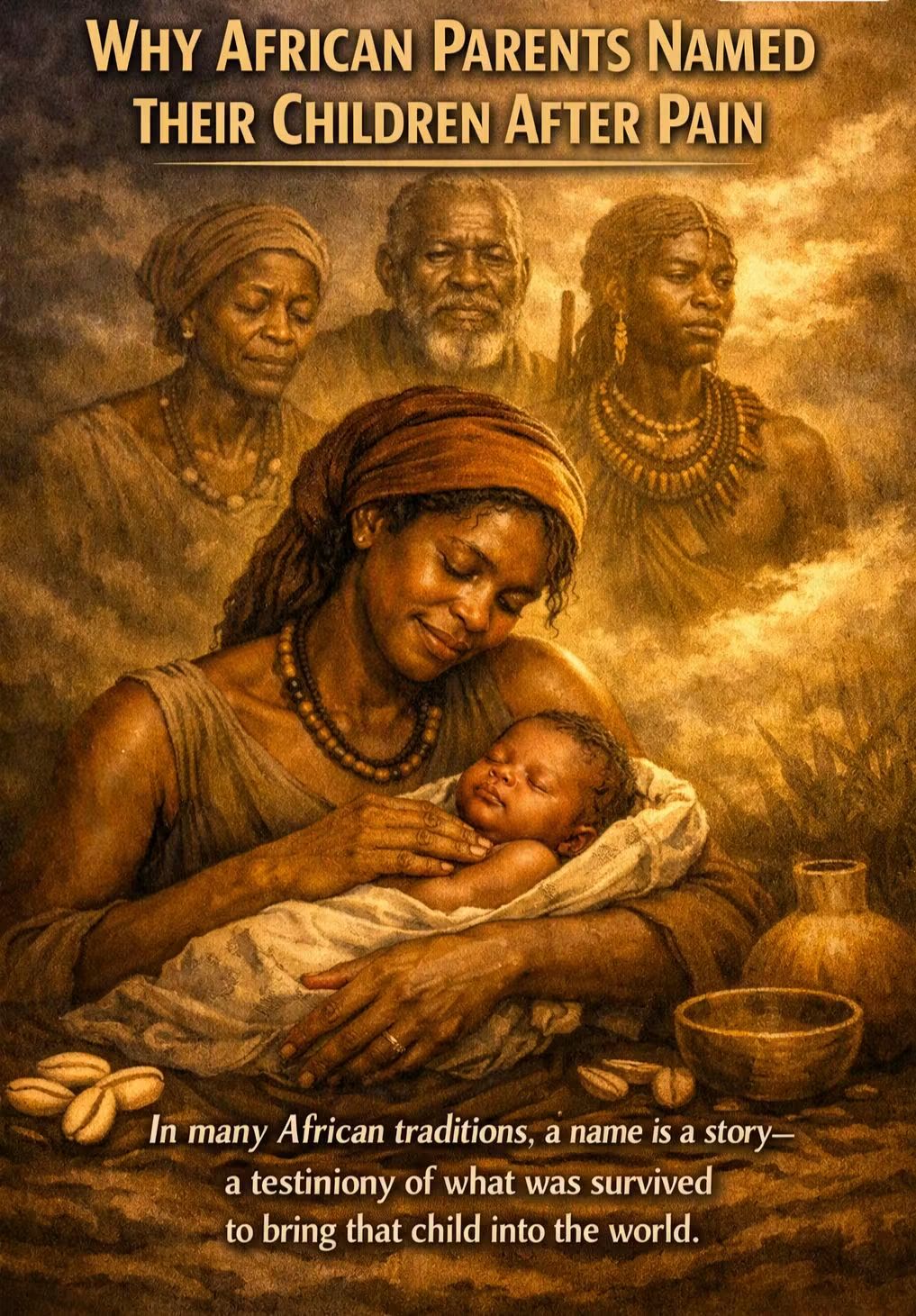
WHY AFRICAN PARENTS NAMED THEIR CHILDREN AFTER PAIN.
WHY AFRICAN PARENTS NAMED THEIR CHILDREN AFTER PAIN.
In many African traditions
a name was never just a label.
It was a story.
A prayer.
A memory sealed into a person
before they were old enough to understand it.
And nowhere was this more powerful
than after a difficult birth.
When a child arrived through suffering
through loss
through the kind of pain that makes a mother question everything
the name given was not chosen randomly.
It was chosen carefully.
It was chosen honestly.
It was chosen so that the child would always carry the testimony of what it cost to bring them here.
The Yoruba gave names that spoke directly to the struggle:
Abimbola — ,“born to be wealthy” — given after poverty threatened the family.
Babatunde— “father has returned” — given when a child was born shortly after a grandfather died — a sign the ancestor came back.
Iyabo — “mother has returned” — the same belief for a grandmother’s spirit.
The Igbo named children after the exact circumstances of their arrival:
Osinachi— “from God’s hands” — given when the birth itself was considered a miracle.
Chukwuemeka— “God has done great things” — given after a birth nobody expected to survive.
Nwakaego— “a child is worth more than money” — given after a family sacrificed everything to save the mother.
Obiageli — “one who came to enjoy wealth” — given after years of suffering before the child finally arrived.
The Akan named children after the day they were born — but also after what that day carried:
Ama— a girl born on Saturday — often after a difficult week.
Kofi — a boy born on Friday — often after a long wait.
But beyond the day — the Akan also gave soul names — Kradin — that captured the spiritual weight of the moment.
A child born after three miscarriages might be named something that meant “stay this time.”
A child born during a storm might carry a name meaning “the rain that finally came.”
The Zulu and Xhosa gave names that functioned as prayers spoken aloud every time someone called the child:
Siyabonga — “we are thankful” — called every morning as a reminder of gratitude.
Nokukhanya — “mother of light” — given after a birth that came through darkness.
Lungelo— “it is well” — given when everything that could go wrong finally went right.
But here is what made this tradition profound:
Every time someone called that child’s name —
they were retelling the story.
Every teacher who called the register.
Every friend who greeted them in the street.
Every stranger who asked their name.
Without knowing it
they were speaking the testimony
of a mother who survived something
and decided to write it
into the first gift she ever gave her child.
Their name.
✍🏿Simple meaning:
In African tradition
Some names were not chosen because they sounded beautiful.
It was chosen because it meant something true.
Something that happened.
Something that was survived.
Something that was hoped for.
Something that was lost and found again.
Your name was your family’s testimony
given to you
so that wherever you went
the story of how you arrived
traveled with you.
❓What does your name mean and do you know the story behind why your parents chose it?


My name literally means light and fragrance. But in poetical way to translate it is “someone who presence brings light and leave something lovely behind” ❤️
LikeLiked by 2 people
Wow
LikeLiked by 2 people