
The Bahitawi: Ethiopia’s Ancient Christian Ascetics
The Bahitawi: Ethiopia’s Ancient Christian Ascetics
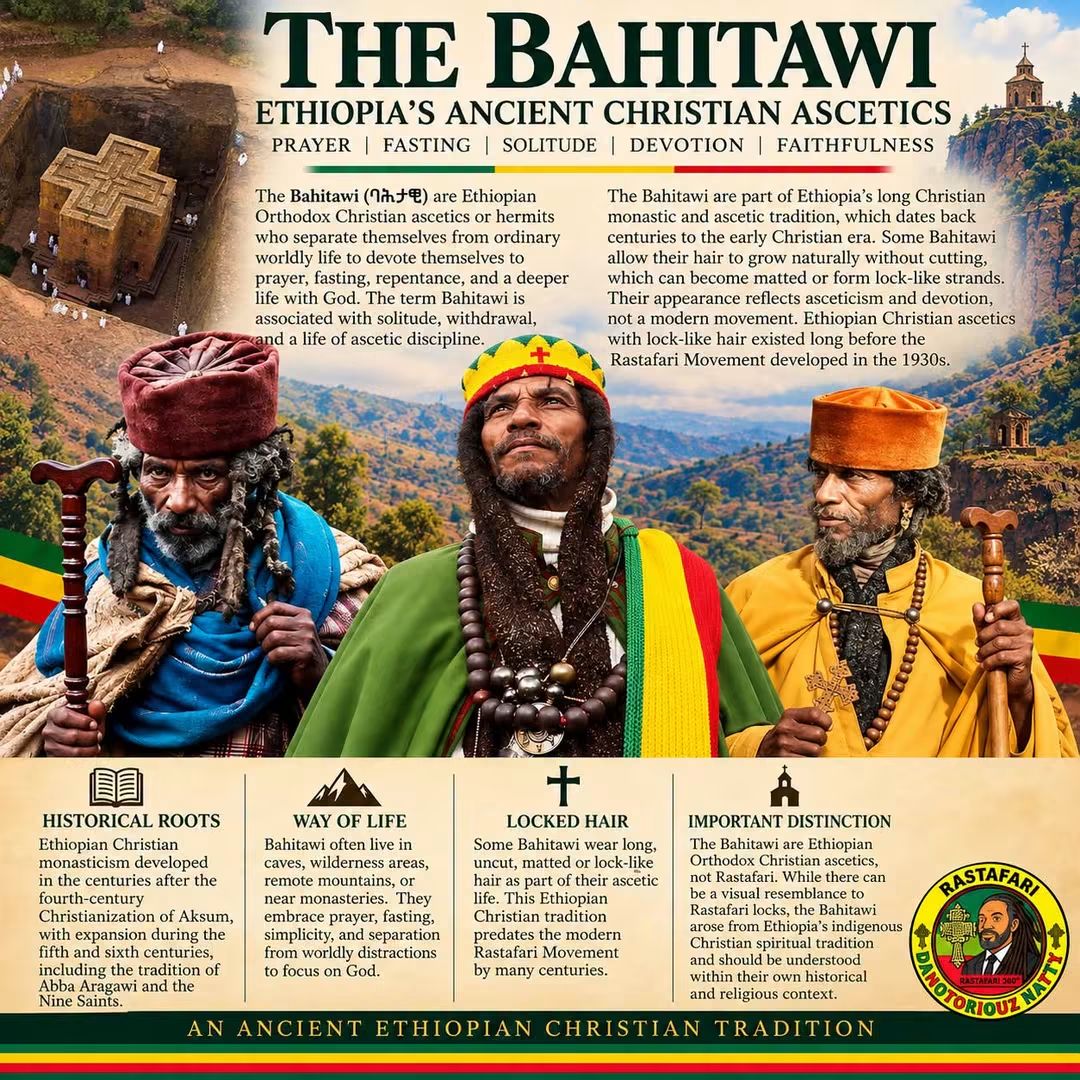
Long before the RasTafari Movement emerged in Jamaica during the twentieth century, Ethiopia possessed an established tradition of Christian monasticism and ascetic spirituality. Among its most distinctive expressions are the Bahitawi (ባሕታዊ), Ethiopian Christian hermits and ascetics, some of whom are recognizable by their long, naturally matted, or lock-like hair.
Although their appearance may resemble that of contemporary RasTafari, the Bahitawi belong to a much older Ethiopian Christian spiritual tradition whose origins, religious practices, and theological foundations must be understood within their own historical context.
The Meaning and Spiritual Life of the Bahitawi
The term Bahitawi (ባሕታዊ) is associated with solitude, withdrawal, and the life of a hermit.
A Bahitawi is an Ethiopian Christian ascetic who withdraws, to varying degrees, from ordinary social life to pursue an intensified commitment to prayer, fasting, repentance, contemplation, and devotion to God.
Within the Ethiopian Orthodox Tewahedo tradition, asceticism is understood as a means of spiritual purification and deeper communion with God. It involves disciplining bodily desires, resisting worldly attachments, cultivating humility, and dedicating one’s life to Christian discipleship.
The Bahitawi represent a particularly austere expression of this spirituality.
Their religious identity is fundamentally Christian, rooted in the Gospel of Jesus Christ and the spiritual traditions of the Ethiopian Orthodox Tewahedo Church.
Ethiopia’s Ancient Christian Monastic Heritage
Christianity became established in the Kingdom of Aksum during the fourth century, particularly through the missionary work of Saint Frumentius, known in Ethiopian tradition as Abba Salama.
Ethiopian monasticism subsequently developed into one of Africa’s most enduring Christian ascetic traditions.
Ethiopian ecclesiastical tradition particularly associates the expansion of monastic life with the Nine Saints, traditionally placed in the fifth and sixth centuries. Among them was Abba Aragawi, associated with the founding of the renowned monastery of Debre Damo.
These early monastic traditions helped establish a spiritual culture emphasizing prayer, fasting, celibacy, simplicity, self-denial, and withdrawal from worldly distractions.
The Bahitawi belong within this broader Ethiopian Christian ascetic heritage, although the precise historical development of their distinctive practices should not be confused with the dating of Ethiopian monasticism itself.
Their spiritual way of life reflects a Christian tradition extending back many centuries.
The Ascetic Lifestyle
Unlike monks who primarily follow communal routines within established monasteries, Bahitawi may practice a more solitary form of religious life.
Historically, Ethiopian Christian hermits have sought solitude in caves, mountainous regions, forests, wilderness areas, and places near monasteries or other religious communities.
Their withdrawal from ordinary society is not necessarily a rejection of humanity. Rather, it is intended to reduce worldly distractions and deepen their commitment to God.
Their spiritual disciplines may include prolonged prayer, extensive fasting, limited material possessions, simple clothing, and other forms of voluntary self-denial.
Some carry staffs or crosses, while others are distinguished by their uncut hair and austere appearance.
Not every Bahitawi wears locks, however, and hairstyle alone does not establish whether someone belongs to this ascetic tradition.
The Bahitawi and Locked Hair
One of the most visually recognizable characteristics of some Bahitawi is their long, naturally grown hair.
When hair is allowed to grow with limited cutting or grooming, it may eventually become matted or form strands resembling what are commonly called dreadlocks.
Photographic and descriptive accounts of Ethiopian ascetics document individuals whose hair has this appearance.
Within the Bahitawi context, such hair may reflect an ascetic lifestyle characterized by simplicity, renunciation, and limited concern for conventional outward appearance.
However, it is important not to assume that every Bahitawi follows an identical practice or that all Ethiopian ascetics attach the same religious meaning to their hair.
The historical age of Ethiopian Christian asceticism is well established. Establishing precisely how far back particular Bahitawi hair practices extend requires more specific documentary evidence.
Nevertheless, the existence of lock-haired Ethiopian Christian ascetics demonstrates that such an appearance is not exclusive to the RasTafari Movement.
The Biblical Nazirite Vow and Uncut Hair
The practice of allowing hair to grow without cutting also has an important precedent in the Hebrew Scriptures.
In Numbers 6:1–21, the Bible describes the Nazirite vow, a special form of consecration through which an individual dedicated himself or herself to God.
Among its requirements were abstinence from wine and other products of the grapevine, avoidance of ritual defilement through contact with the dead, and refraining from cutting the hair during the period of consecration.
The biblical figure Samson is particularly associated with lifelong Nazirite consecration, as described in Judges 13–16.
The Nazirite vow demonstrates that uncut hair could carry religious significance in ancient biblical tradition, long before the development of Ethiopian Christian monasticism or the modern RasTafari Movement.
However, an important distinction must be maintained.
The Bahitawi are Ethiopian Christian ascetics, not necessarily biblical Nazirites. Their religious practices developed within the spiritual and monastic traditions of the Ethiopian Orthodox Tewahedo Church.
Although certain outward characteristics may resemble aspects of the Nazirite tradition, there is insufficient evidence to conclude that Bahitawi generally undertake the formal vow prescribed in Numbers 6.
Likewise, RasTafari interpretations of the Nazirite vow, particularly concerning dreadlocks, belong to a distinct modern religious and cultural context.
The connection is therefore best understood as a biblical parallel rather than proof of direct historical continuity.
The biblical text specifically describes uncut hair; it does not require hair to be matted or formed into locks.
What these traditions illustrate is that uncut hair can acquire different spiritual meanings depending upon the religious community, its theology, and its historical circumstances.
Similar outward practices do not necessarily indicate identical religious obligations or beliefs.
The Bahitawi and the RasTafari Movement
The distinction between Bahitawi and RasTafari is particularly important.
The RasTafari Movement developed in Jamaica during the twentieth century, especially in the years following the coronation of His Imperial Majesty Emperor Haile Selassie I in 1930.
Its emergence occurred within a particular African-diasporic environment shaped by colonialism, African identity, biblical interpretation, and the symbolic importance attached to Ethiopia.
The Bahitawi, by contrast, belong to Ethiopia’s indigenous Christian ascetic tradition.
Their spiritual identity is rooted in Ethiopian Orthodox Christianity, rather than in the religious interpretations and cultural developments associated with twentieth-century RasTafari.
Although both may be recognized by long or locked hair, similarity of appearance does not establish identical religious beliefs, historical origins, or spiritual practices.
The Bahitawi should not be retroactively identified as RasTafari simply because their hair resembles that of some RasTafari adherents.
Likewise, the RasTafari Movement should not be treated as the origin of Ethiopia’s Christian ascetic traditions.
These are distinct historical developments.
RasTafari Influence in Contemporary Ethiopia
An additional distinction is necessary when discussing Ethiopia today.
Contemporary Ethiopia includes individuals and communities influenced by the RasTafari Movement, alongside Ethiopian Orthodox Christians who maintain traditional forms of ascetic life, including the Bahitawi.
Some Ethiopians identify with RasTafari spirituality, culture, or interpretations of Emperor Haile Selassie I. Others participate in Ethiopia’s longstanding Christian religious institutions and practices.
The presence of RasTafari influence in modern Ethiopia does not erase the country’s much older Christian traditions.
Nor should the presence of Ethiopian Christian ascetics with locks lead observers to assume that everyone wearing such hair belongs to the same religious movement.
Not every Ethiopian wearing locks is RasTafari, and not every Ethiopian wearing locks is Bahitawi.
Religious identity must be understood through an individual’s actual beliefs, practices, and affiliations rather than inferred solely from physical appearance.
Christian Discipleship, Not Merely a Hairstyle
For the Bahitawi, the central concern is not the appearance of the hair but the pursuit of a disciplined Christian spiritual life.
Their asceticism reflects the Gospel’s teachings concerning prayer, fasting, humility, detachment from material possessions, and devotion to God.
Jesus Christ taught:
“If anyone wishes to come after me, he must deny himself and take up his cross daily and follow me.”
— Luke 9:23
This principle of self-denial provides an important biblical foundation for understanding Christian asceticism.
The Bahitawi seek to embody this commitment through a life devoted to prayer, repentance, spiritual discipline, and withdrawal from unnecessary worldly attachments.
Their appearance is secondary to their religious vocation.
Conclusion: Understanding Ethiopia on Its Own Terms
The Bahitawi represent a distinctive expression of Ethiopia’s ancient Christian spiritual heritage.
Their existence reminds us that Ethiopia possesses religious traditions, cultural practices, and forms of ascetic life that developed independently of the modern RasTafari Movement.
Some Bahitawi wear long, naturally matted, or lock-like hair, while contemporary Ethiopia also includes individuals influenced by RasTafari.
These realities can coexist without being confused.
The biblical Nazirite vow provides an ancient example of uncut hair as a sign of consecration to God. However, this biblical precedent should not be confused with proof that Bahitawi hair practices originated from the Nazirite vow.
Likewise, the antiquity of Ethiopian Christian monasticism does not, by itself, establish the precise historical origins of dreadlocks.
The Bahitawi are not defined by dreadlocks. They are defined by their Christian ascetic vocation.
To understand them properly is to recognize Ethiopia’s longstanding Christian history, its distinctive monastic traditions, and the spiritual disciplines that have shaped Ethiopian religious life for centuries.
Ethiopian religious traditions deserve to be studied and understood on their own terms, through their own history, theology, and cultural context—not simply through the interpretations of movements that emerged elsewhere many centuries later.

