
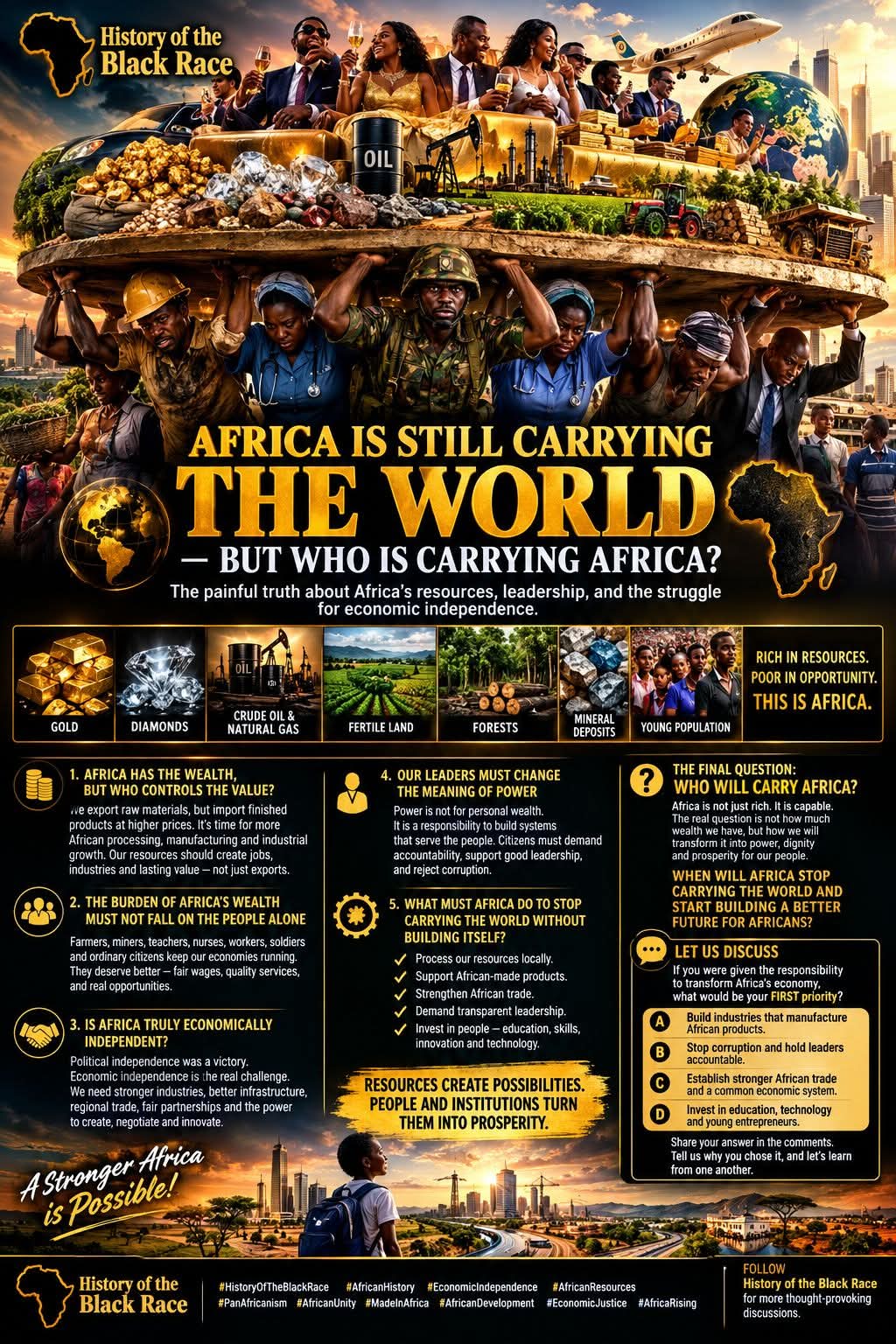
HOW CAN AFRICA BE SO RICH IN NATURAL RESOURCES, YET SO MANY AFRICANS STILL LIVE IN POVERTY?
🌍 HOW CAN AFRICA BE SO RICH IN NATURAL RESOURCES, YET SO MANY AFRICANS STILL LIVE IN POVERTY?
Beneath the soil lies enormous wealth. Above the soil, millions of people are still struggling to survive. So, where is the missing link?
Look at the ground beneath an African village. A family may be cooking with firewood, children may be growing up without adequate facilities, and hardworking parents may struggle to provide three meals a day. Yet beneath that same African soil could lie gold, diamonds, oil, natural gas, cobalt, lithium, copper, and other valuable resources that power industries across the world.
This raises one of the most important questions of our time:
If Africa is blessed with so much natural wealth, why has that wealth not translated into prosperity for all its people?
🌍 THE TREASURE BENEATH OUR FEET
Africa is home to some of the world’s most important mineral and energy resources. From the goldfields of Ghana and South Africa to the cobalt deposits of the Democratic Republic of the Congo, the oil-producing regions of Nigeria and Angola, and the platinum resources of southern Africa, the continent holds resources that are essential to the global economy.
These resources help manufacture smartphones, build vehicles, produce jewellery, generate energy, and support modern technologies.
Think about it: minerals extracted from African soil can travel thousands of kilometres to factories where they are processed into expensive finished products. Those products are then sold across the world at prices far higher than the value of the raw materials from which they were made.
But here is the critical question:
Why should Africa remain primarily a supplier of raw materials when it has the potential to become a major centre of manufacturing, technology, and industrial production?
Our resources should not merely be extracted. They should become the foundation of industries that create jobs, develop skills, and improve the lives of African people.
💔 THE PROBLEM IS NOT SIMPLY A LACK OF WEALTH
We must understand something important: possessing natural resources does not automatically make a country prosperous.
The real challenge lies in how those resources are managed, processed, traded, and used.
When corruption diverts public money, when contracts fail to deliver fair value, when profits leave communities without sufficient local benefits, and when governments fail to invest adequately in education, healthcare, electricity, roads, and industries, ordinary citizens may see little improvement in their lives despite living in resource-rich countries.
Political instability, conflict, debt burdens, weak institutions, inadequate infrastructure, and unfair commercial arrangements can deepen these problems.
We must therefore look beyond the minerals beneath our feet and examine the systems above the ground.
Natural resources create an opportunity for prosperity, but accountable leadership, strong institutions, industrial development, and public participation help turn that opportunity into reality.
🏭 AFRICA MUST MOVE FROM EXTRACTING TO MANUFACTURING
Imagine a different future.
Instead of exporting cocoa mainly as raw beans, African countries expand their capacity to manufacture chocolate and other finished products.
Instead of exporting raw minerals alone, they develop responsible mineral processing, refining, and manufacturing industries.
Instead of importing so many finished goods, African entrepreneurs receive the support, electricity, finance, technology, and infrastructure they need to produce more goods locally.
Imagine African factories producing machinery, agricultural equipment, textiles, medicines, batteries, electronics, and affordable building materials.
What would happen?
- More employment opportunities for young Africans.
- Greater demand for local farmers, artisans, engineers, and technicians.
- More opportunities for small businesses to grow into larger enterprises.
- Increased government revenue when businesses operate transparently and pay their fair share of taxes.
- More skills, technology, and industrial knowledge retained within African economies.
This is how natural wealth can become productive wealth.
The goal should not be to stop all exports or reject foreign investment. The goal should be to negotiate beneficial partnerships, build local capacity, increase value addition, and ensure that African communities receive a fair share of the benefits.
🔥 WHAT IF WE STOP WAITING FOR GOVERNMENTS ALONE?
Governments have a major responsibility to build infrastructure, establish sound policies, fight corruption, and create an environment where businesses can succeed.
But Africans can also contribute to economic transformation.
Our traditional craftsmanship, agricultural knowledge, textile production, metalworking, pottery, food processing, construction skills, and other local industries deserve investment and modernisation.
A small workshop can become a manufacturing business. A local food-processing enterprise can grow into a factory. A group of skilled artisans can form a cooperative. Young people can combine traditional knowledge with modern engineering, digital tools, and new business methods.
We do not have to wait until every country has a giant industrial complex before we begin creating productive enterprises.
We can start small, organise ourselves, improve our skills, support locally made products, and build businesses that can grow into larger industries.
However, small businesses also need practical support: reliable electricity, affordable financing, training, access to markets, modern equipment, and policies that allow them to compete.
Patriotism alone cannot keep a factory running. We need both the determination to build and the systems that make building possible.
🤝 AFRICA’S WEALTH MUST BENEFIT AFRICANS
The question is not whether Africa should trade with the rest of the world. Trade can bring investment, technology, employment, and economic opportunities.
The question is whether those relationships produce lasting benefits for African people.
Are mining communities receiving safe working conditions and meaningful development?
Are governments negotiating transparent contracts?
Are African workers acquiring advanced technical skills?
Are local businesses being included in supply chains?
Are revenues from natural resources being invested in schools, hospitals, infrastructure, research, and industries that will serve future generations?
These are the questions citizens must continue asking.
Our natural resources belong to the economic story of our continent, but their management must serve the public interest and respect the rights of communities, workers, and future generations.
We must also protect our land, forests, rivers, and water sources. Development that destroys the environment or leaves communities with polluted water and damaged farmland is not genuine progress.
True prosperity means creating wealth while protecting the people and natural systems that sustain life.
✊ THE NEXT CHAPTER OF AFRICAN DEVELOPMENT MUST BE WRITTEN BY AFRICANS
Africa does not need to measure its future only by the quantity of gold, diamonds, oil, or other minerals it exports.
We must also measure progress by the quality of life of our people.
Can a young person find meaningful employment? Can a farmer process and sell products at a fair price? Can an artisan expand a workshop? Can a child receive a quality education? Can an African entrepreneur build a factory without being defeated by avoidable barriers?
These are the questions that should shape our development.
The wealth beneath our feet should help create opportunities above the ground.
Let us demand accountable leadership. Let us support local industries. Let us invest in skills and innovation. Let us encourage responsible partnerships, strengthen regional African trade, and insist that natural resources contribute to long-term prosperity.
Because the true wealth of Africa is not only in its soil.
It is also in the intelligence of its young people, the creativity of its artisans, the knowledge of its farmers, the determination of its workers, and the ability of its communities to build a better future together.
Africa is rich in potential. Now we must build the systems that allow its people to prosper.
💬 AFRICANS, LET US DISCUSS!
If your country has gold, oil, diamonds, fertile land, and other valuable resources, but many citizens still struggle with unemployment, poor infrastructure, and the cost of living, what should be the first major change?
A. Stop exporting raw materials without building local processing industries.
B. Fight corruption and demand accountability in resource management.
C. Invest heavily in local manufacturing, agriculture, and small businesses.
D. Strengthen African unity, regional trade, and economic cooperation.
E. Do all of the above.
Tell us your answer in the comments, and explain why. Let us have a meaningful conversation about the future we want to build.

