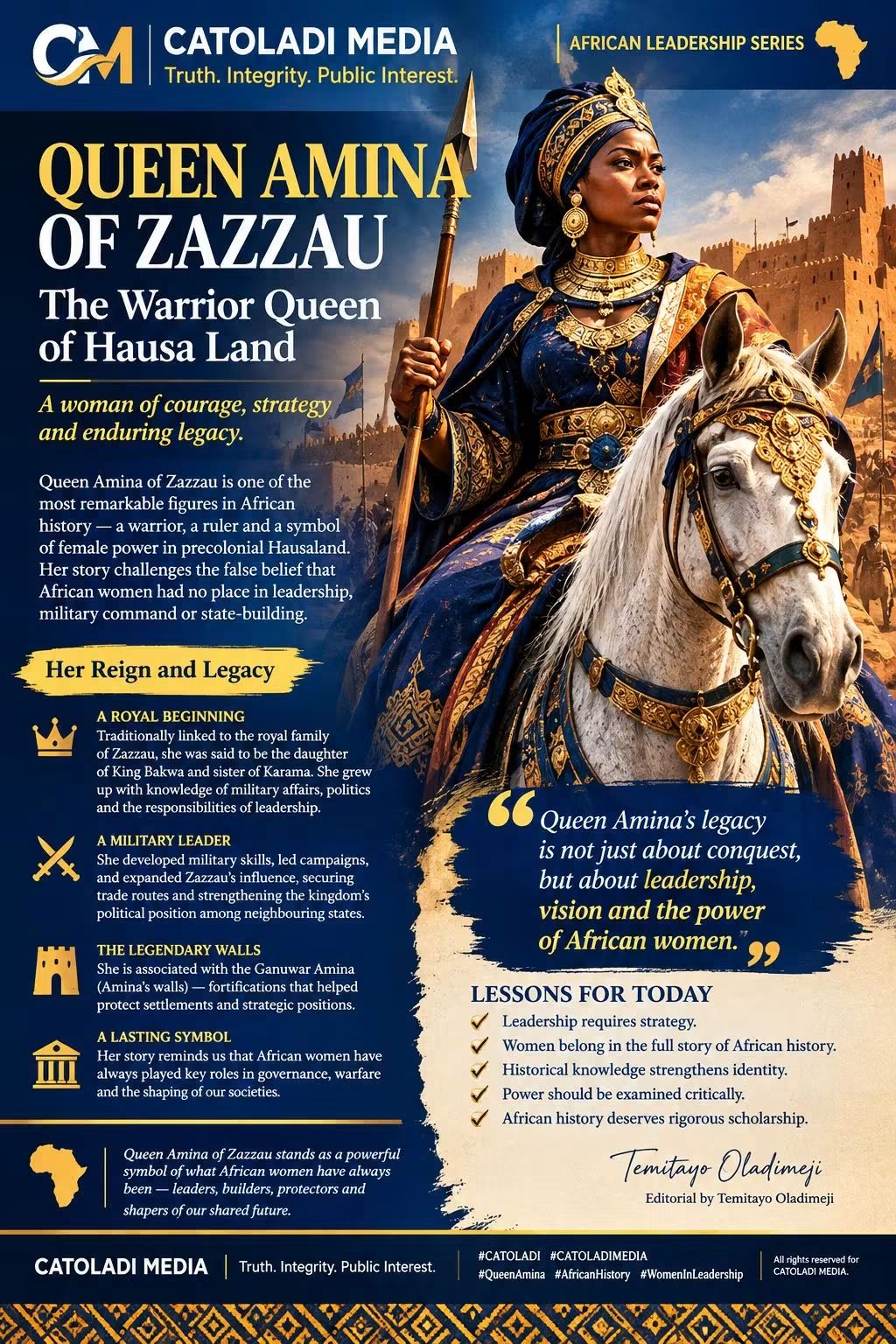
QUEEN AMINA OF ZAZZAU: THE WARRIOR QUEEN OF HAUSALAND
QUEEN AMINA OF ZAZZAU: THE WARRIOR QUEEN OF HAUSALAND
CATOLADI MEDIA | AFRICAN LEADERSHIP SERIES
Introduction: The woman who became a legend
African history is filled with remarkable leaders whose courage, ambition and achievements shaped the destinies of their societies. Among them is Queen Amina of Zazzau, the legendary warrior queen associated with the Hausa people of present-day northern Nigeria.
Remembered for her military campaigns, political authority and association with the expansion of Zazzau, Queen Amina has become a powerful symbol of female leadership in precolonial Africa.
Her story challenges the misconception that African women were absent from military command, political authority and the building of powerful states before colonialism.
But beyond the legend of the warrior queen lies a deeper historical question: what can her story teach us about leadership, power, identity and the place of women in African history?
- HER ROYAL ORIGINS
Queen Amina is traditionally associated with Zazzau, an important Hausa city-state whose historic centre is present-day Zaria, in Kaduna State, Nigeria.
She is commonly placed in the fifteenth or sixteenth century, although the precise dates of her birth, reign and death remain uncertain.
Traditional accounts identify her as a daughter of King Bakwa of Zazzau and the sister of Karama. Details of her family background and early life, however, vary across historical narratives.
Growing up within the royal environment, Amina is said to have developed an understanding of military affairs, political power and the responsibilities of leadership.
Her story represents a reminder that precolonial Africa possessed organised political systems, established centres of authority and leaders who shaped regional affairs long before European colonial rule.
- THE RISE OF A WARRIOR QUEEN
Queen Amina’s name is most closely associated with military leadership.
Traditional accounts describe her as a skilled warrior who led campaigns to extend Zazzau’s influence over neighbouring territories. These campaigns are often connected to the kingdom’s pursuit of greater political authority, control of trade routes and access to economic resources.
Zazzau occupied an important position within the commercial networks of Hausaland, connecting communities across the northern savannah and areas farther south.
In that historical environment, military power could influence trade, tribute, territorial control and a kingdom’s standing among neighbouring states.
Amina’s reputation therefore goes beyond the image of a woman carrying weapons. She is remembered as a ruler associated with the use of military power to advance the interests of her kingdom.
Her story challenges the assumption that warfare and political leadership in precolonial Africa were exclusively the preserve of men.
- THE EXPANSION OF ZAZZAU
Queen Amina is traditionally credited with expanding the influence of Zazzau through military expeditions.
Accounts of her campaigns connect her to neighbouring territories and communities, although the precise boundaries of her conquests are difficult to establish conclusively.
The political importance of these campaigns lay in the relationship between territory, security and commerce.
Control over strategic routes could strengthen a state’s access to goods, generate tribute and increase its influence over neighbouring communities. For a kingdom such as Zazzau, these were important dimensions of political and economic power.
However, historical appreciation must also acknowledge that territorial expansion often involved warfare, displacement and the subordination of other communities.
A balanced account of Queen Amina should recognise both her reputation as a military leader and the wider consequences of the conflicts associated with state expansion.
History should neither diminish her achievements nor turn warfare into an unquestioned virtue.
- THE LEGENDARY WALLS OF AMINA
One of the most enduring traditions associated with Queen Amina is the story of the Ganuwar Amina, commonly translated as “Amina’s walls.”
These are defensive earthen walls associated in historical memory with her campaigns and the protection of settlements.
Fortifications played important roles in many African societies. They could protect communities, defend strategic positions and demonstrate the organisational capacity of a political authority.
The walls attributed to Amina have become a lasting symbol of her legacy. Nevertheless, the attribution of particular surviving structures to her reign, and the extent of her personal involvement in their construction, cannot always be independently verified.
The significance of the tradition lies in what it reveals about how Amina is remembered: as a leader associated not only with conquest, but also with territorial protection and the physical defence of her kingdom.
Her legacy continues to connect military leadership with the idea of leaving a lasting mark on a society.
- A WOMAN IN A POSITION OF POWER
Queen Amina’s place in Nigerian historical memory is significant because she is remembered as a ruler in her own right.
Her story challenges narrow portrayals of precolonial African societies that overlook women’s participation in governance, warfare and political decision-making.
Across Africa, women occupied different positions of authority, including queenship, royal advisory roles, political mediation and military leadership. Their opportunities varied according to the society, period and political circumstances.
Amina’s story should not be used to suggest that all women enjoyed equal rights in precolonial Hausaland. Instead, it demonstrates that women’s relationship with political authority was more complex than generalised accounts sometimes imply.
Her historical significance also invites us to investigate other African women whose contributions have received less attention in mainstream historical education.
Recovering their stories is essential to developing a fuller understanding of Africa’s past.
- HISTORY, ORAL TRADITION AND THE QUESTION OF EVIDENCE
An important responsibility in telling Queen Amina’s story is distinguishing historical evidence from legend.
Much of the information about her comes through later written accounts and Hausa oral traditions. Historians have examined chronicles, including the Kano Chronicle, alongside other historical materials to reconstruct the political world in which she is remembered.
However, accounts differ over her chronology, family background, military achievements and the duration of her reign.
This means that popular claims about her life should not automatically be presented as established facts.
Oral tradition remains an important source of African history, preserving memories, cultural knowledge and accounts of political events. It becomes even more valuable when studied alongside written records, archaeology and other independent evidence.
The lesson is simple: celebrating African history and examining historical evidence are not opposing activities.
We can honour Queen Amina’s place in African historical memory while acknowledging what remains uncertain.
- THE LEGACY OF QUEEN AMINA IN MODERN NIGERIA
Today, Queen Amina remains an enduring figure in Nigerian historical and cultural memory.
Her story encourages Nigerians to explore the political systems that existed before colonialism and to recognise the complexity of the societies that developed across the continent.
Precolonial Africa was not a single, uniform civilisation. It consisted of diverse kingdoms, city-states, communities and political institutions, each with its own experiences, traditions and systems of authority.
Zazzau formed part of this rich historical landscape.
For young Nigerians, learning about Queen Amina offers an opportunity to investigate northern Nigerian history, the Hausa states, regional trade and the role of women in political life.
It also encourages a more critical approach to historical education: asking what evidence survives, how historical figures are remembered and why certain stories receive greater attention than others.
A society that understands its history is better equipped to examine its identity and make informed decisions about its future.
- LESSONS FOR AFRICAN LEADERSHIP TODAY
Queen Amina’s story raises several important lessons for contemporary Africa.
First, leadership requires strategy. Military strength alone cannot sustain political authority. Organisation, resources, diplomacy and relationships with neighbouring communities also matter.
Second, women belong in the full story of African history. Their contributions must be researched, documented and taught rather than overlooked.
Third, historical knowledge strengthens identity. Understanding precolonial African states helps younger generations appreciate the depth and diversity of their heritage.
Fourth, power must be examined critically. The pursuit of territorial expansion can bring advantages to rulers while imposing costs on other communities. Historical leadership should therefore be studied with both context and critical reflection.
Finally, African history deserves serious scholarship. We should preserve our traditions, investigate our historical records and resist both the dismissal of African achievements and the temptation to exaggerate them.
The objective is not to manufacture a glorious past. It is to understand our past honestly.
CONCLUSION: A QUEEN WHO REMAINS IN AFRICA’S MEMORY
Queen Amina of Zazzau stands in Nigerian historical memory as a symbol of female sovereignty, military leadership and the political ambitions of precolonial African states.
Her story reminds us that Africa’s past was not an empty space waiting to be shaped by foreign powers. It was a world of kingdoms, commercial networks, political struggles and leaders whose decisions influenced the lives of their people.
Yet genuine historical appreciation requires more than praise. It demands research, evidence, critical thinking and a willingness to distinguish what is known from what remains uncertain.
Queen Amina deserves a place in conversations about African leadership not simply because she is remembered as a woman who went to war, but because her story opens a window into the complexity of African civilisation and the varied roles women played within it.
Africa must recover its history—not to manufacture a glorious past, but to understand the past honestly, strengthen its identity and build a more informed future.
When African children learn about the great leaders of world history, Queen Amina of Zazzau deserves a place in that conversation.grity. Public Interest.


Interesting article, you lost me halfway, this is beyond my domain. I live in EU.
LikeLiked by 1 person
Wow
LikeLike
? Gonna reas this ltr quite interesting, never been outside that far
LikeLike