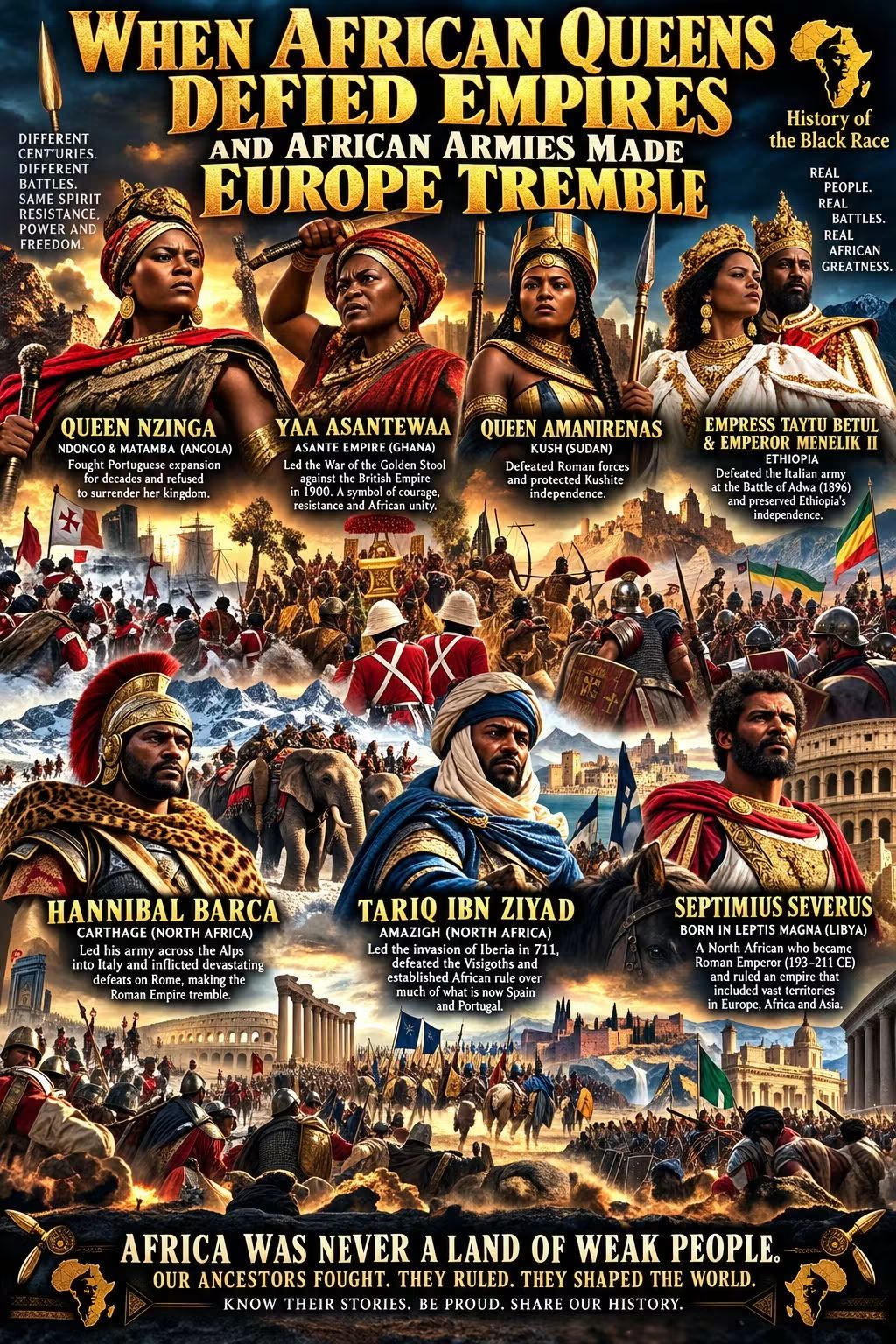
WHEN AFRICAN QUEENS DREW THEIR SWORDS AGAINST EMPIRES — AND AFRICAN ARMIES MADE ROME TREMBLE!
WHEN AFRICAN QUEENS DREW THEIR SWORDS AGAINST EMPIRES — AND AFRICAN ARMIES MADE ROME TREMBLE!
HISTORY OF THE BLACK RACE | UNTOLD STORIES OF AFRICAN POWER
Nzinga Mbandi Queen of Ndongo and Matamba
What if I told you that some of the most extraordinary enemies of European empires came from Africa—and that African women stood at the forefront of resistance while African armies once carried war into the heart of Europe?
Before colonialism redrew Africa’s borders, before European powers divided the continent among themselves, and before popular history books made African civilizations appear insignificant, African kingdoms were building empires, commanding armies, controlling trade routes, and defending their sovereignty.
Some of their greatest stories sound like legends. Yet behind many of them are real people whose courage changed the course of history.
Today, let us travel through the centuries to meet the African queens who refused to bow, the warriors who challenged foreign armies, and the North African powers that brought their enemies to the edge of defeat.
1 Queen Nzinga: The woman Portugal could not easily conquer
Female rulers who changed history from behind the
Imagine being a queen in the 17th century, facing a European power determined to expand its influence, seize territory, and profit from the Atlantic slave trade.
That was the world of Queen Nzinga of Ndongo and Matamba, in present-day Angola.
Portuguese expansion threatened her people’s independence. Rather than accept political submission, Nzinga became a formidable diplomat, military strategist, and ruler. She negotiated when negotiations served her interests, forged alliances, and continued resisting Portuguese power over decades.
Her story is not a simple tale of good against evil: the regional slave trade was deeply entangled with the politics of the period, and Nzinga’s own policies changed with circumstances. But her determination to preserve her political power and resist Portuguese domination made her one of the most remarkable rulers in African history.
Think about this: At a time when women in many societies were excluded from formal military leadership, an African queen became the central figure in a decades-long struggle against a European empire.
Her message to history was unmistakable: African sovereignty was not hers to surrender without a fight.
- Yaa Asantewaa: The queen mother who challenged the British Empire
Yaa Asantewaa: Queen Mother of the Ashanti Empire
In 1900, British colonial authorities demanded greater control over the Asante kingdom and its sacred Golden Stool, a symbol of the spiritual and political unity of the Asante people.
The crisis demanded a response.
Enter Yaa Asantewaa, the Queen Mother of Ejisu in present-day Ghana.
When Asante leaders hesitated over how to respond, she became the rallying figure for armed resistance. She helped lead the War of the Golden Stool, challenging one of the most powerful colonial empires of the age.
The British possessed considerable military resources, but Asante resistance demonstrated that conquest was never simply a matter of Europeans arriving and Africans surrendering.
The uprising was eventually suppressed, and Yaa Asantewaa was exiled. Yet her name survived the defeat.
Today, she remains a powerful symbol of courage, self-determination, and women’s leadership in African history.
Here is the question her story leaves us with: How many histories of African resistance would look different if the courage of its women had been given the same attention as that of its men?
- Queen Amanirenas: The African ruler who confronted Rome
Queen Amanirenas – The Nubian Queen Who Fought the Roman Empire –
Centuries before modern European colonialism, another African queen confronted a formidable foreign empire.
Her name was Amanirenas, a ruler of the Kingdom of Kush in what is now Sudan.
In the late first century BCE, Rome controlled Egypt and sought to extend its influence farther south. Kushite forces fought Roman troops in a major conflict along the southern Egyptian frontier.
Ancient accounts describe Kushite military resistance and attacks on Roman-held territory. The conflict ultimately ended in a peace settlement that preserved Kushite independence.
Amanirenas ruled in a world very different from that of Nzinga or Yaa Asantewaa. Rome was an ancient empire, not a modern colonial state. Nevertheless, her story belongs in the wider history of African rulers who resisted foreign expansion.
Let that sink in: One of the ancient Mediterranean world’s most powerful empires encountered organized resistance from an African kingdom that refused to disappear.
Kush had its own royal traditions, political institutions, skilled artisans, and military capabilities. It was not merely an extension of Egypt or Rome; it was a civilization with its own history and ambitions.
- Hannibal Barca: The African commander who carried war into Italy
Battle of Trebia 218 BC Ambush: Hannibal’s First Second Punic War Victory Over –
Now imagine an army leaving North Africa, crossing mountains in brutal winter conditions, and marching into the homeland of one of the greatest powers of the ancient world.
That was the extraordinary campaign of Hannibal Barca, the Carthaginian general who fought Rome during the Second Punic War.
Carthage, based in present-day Tunisia, was a major North African power with territories and interests throughout the western Mediterranean.
In 218 BCE, Hannibal led his army across the Alps into Italy. His campaign culminated in devastating Roman defeats, most famously at the Battle of Cannae in 216 BCE.
Rome survived, and Hannibal never conquered the city itself. But his victories shook the Roman Republic and made him one of the most celebrated military commanders of antiquity.
His story challenges the assumption that ancient African powers were isolated from world history.
Carthage competed with Rome for control of trade, territory, and Mediterranean influence. Its armies fought across lands that today belong to several different countries.
One historical distinction matters here: Carthaginian society descended substantially from Phoenician settlers and developed into a distinctive North African civilization. It was not ethnically identical to every population in Africa, and it would be misleading to assign all Carthaginians a single modern racial identity.
Yet Carthage unquestionably belongs to the history of African states that challenged a rising European power.
- Taytu Betul and Menelik II: The victory that shocked an empire
Empress Taitu Betul
Fast-forward to 1896.
European colonial powers were racing to seize African territory. Italy sought to establish colonial control over Ethiopia, but Emperor Menelik II and Empress Taytu Betul helped organize the resistance that culminated in the Battle of Adwa.
Ethiopian forces defeated the Italian army decisively.
Menelik’s diplomatic strategy, military mobilization, and acquisition of modern weapons were crucial. Taytu was also a significant political figure who supported resistance to Italian ambitions.
The victory preserved Ethiopia’s independence at a time when much of Africa was falling under European colonial rule.
Adwa became an international symbol of African sovereignty and resistance. Its significance reached far beyond Ethiopia’s borders, inspiring people who opposed colonial domination elsewhere.
The lesson of Adwa: Courage matters, but so do preparation, diplomacy, unity, leadership, and the ability to respond strategically to a changing world.
- The Amazigh armies that crossed into Europe
The history of African military power in Europe did not end with ancient Carthage.
In 711 CE, an army led by Tariq ibn Ziyad, traditionally identified as an Amazigh commander, crossed from North Africa into the Iberian Peninsula.
His forces defeated the Visigothic kingdom’s army, opening the way for the establishment of Muslim rule over much of what is now Spain and Portugal.
Over subsequent centuries, North African dynasties—including the Almoravids and Almohads—played major roles in the political history of Iberia.
These events were not modern anti-colonial struggles. They involved conquest, religious and political competition, shifting alliances, and the establishment of new states. But they demonstrate an important historical truth: African societies were active participants in the shaping of European history.
North Africa and southern Europe were connected through trade, warfare, scholarship, migration, and diplomacy for centuries.
The Mediterranean was not an impenetrable wall separating two unrelated worlds. It was a meeting ground between civilizations.
What connects these extraordinary stories?
Nzinga, Yaa Asantewaa, Amanirenas, Hannibal, Taytu Betul, and the North African commanders who entered Iberia lived in different centuries and fought in different circumstances.
They did not share one unified political project, and their histories should not be collapsed into a single narrative. Some defended their kingdoms; others sought to expand their power. Some fought European colonial states, while others confronted ancient empires or participated in conflicts that reshaped Europe.
But together, their stories reveal something important: African history is a history of political ambition, military innovation, resistance, diplomacy, and civilization—not merely a story of conquest suffered at the hands of outsiders.
Africa’s past deserves to be studied with the same seriousness given to Rome, Greece, Persia, and other historical powers. That means celebrating achievements while also confronting difficult realities, including slavery, internal warfare, and political rivalries.
Pride becomes stronger when it is built on knowledge.
The question for every African reader
If our children grow up learning only about the kings who conquered Africa, but never about the African queens who resisted them, the African armies that challenged great empires, or the civilizations that helped shape world history, what part of our heritage will remain unknown to them?
History is more than a record of who won and who lost. It is also a record of what people built, what they defended, what they believed in, and what they refused to surrender.
Our ancestors were not spectators in world history. They were among the people who made it.
What do you think is the most remarkable story here: Queen Nzinga’s resistance, Yaa Asantewaa’s courage, Amanirenas confronting Rome, or Hannibal’s march into Italy?

