WHY CAN’T NIGERIA HEAL HERSELF?
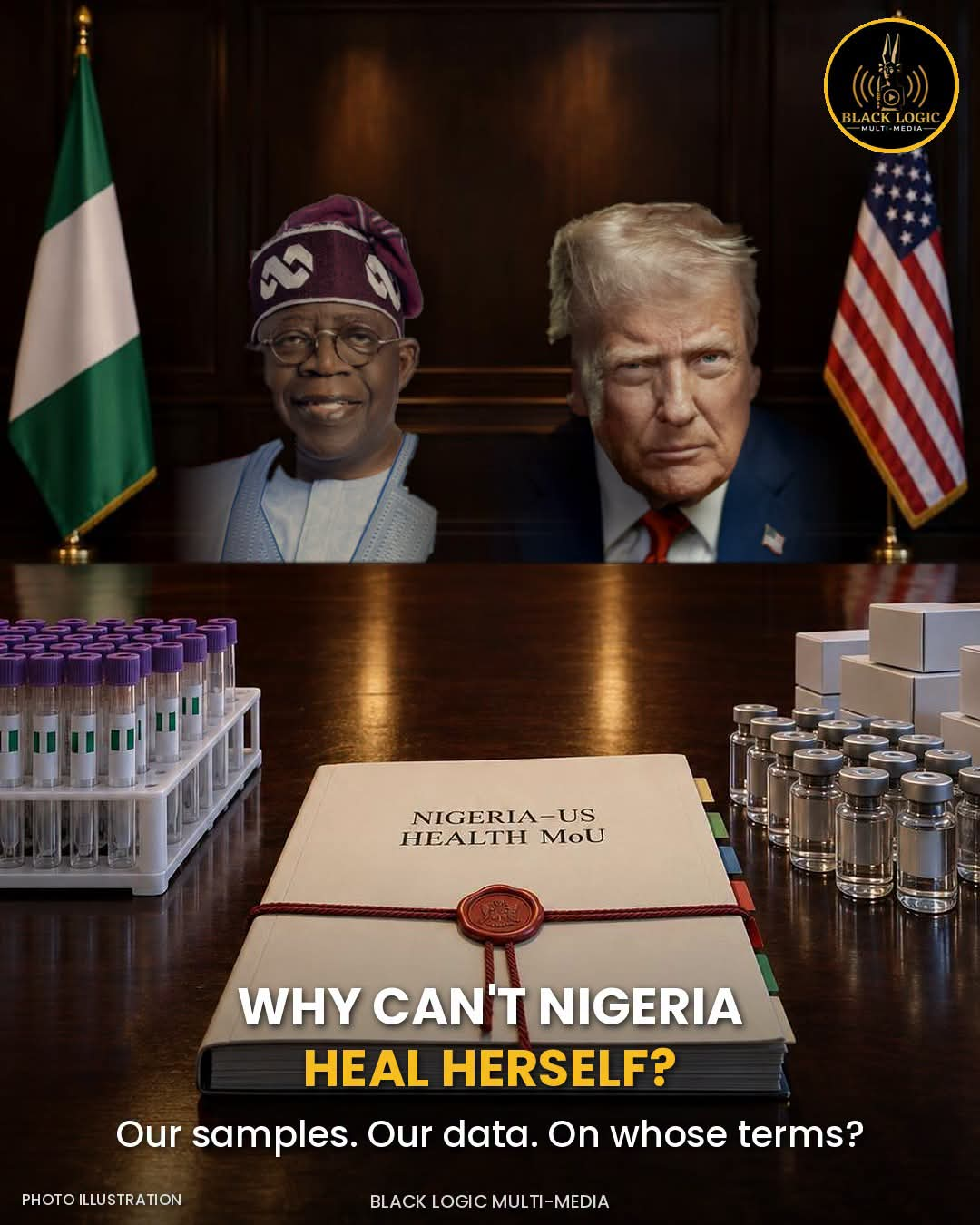
WHY CAN’T NIGERIA HEAL HERSELF?
The Nigeria–US Health Agreement and the Price of Dependency
Let me ask the question nobody in Abuja wants to answer.
Why does a country of over 200 million people, with doctors, pharmacists, scientists, universities, forests full of medicinal plants and oil money flowing for more than sixty years, still need another country to fund its health care?
And why, in exchange, must we share our blood samples and our health data?
THE AGREEMENT
On December 19, 2025, Nigeria signed a five-year health Memorandum of Understanding with the United States. The US says it intends to put in about US$2.1 billion. Nigeria has committed nearly US$3 billion of its own money over the same five years.
Stop and look at that again. Nigeria is putting in MORE money than America. So tell me, if we can find $3 billion for this arrangement, why could we not find it to build our own system, on our own terms, under our own control?
Then comes the part they don’t put in the headlines. Alongside the MoU, the two governments signed a specimen-sharing agreement. The US Department of State has published it. Read what Nigeria agreed to:
- When the US asks for outbreak samples, sequencing data and related data, Nigeria must start sharing within FIVE DAYS, unless both sides agree otherwise.
- The US can pass those samples on to private American companies and organisations. Nigeria only gets a written notice after it happens.
- If a medicine or vaccine is developed mainly from Nigerian samples, Nigeria gets “priority access”, but only “subject to the availability of funds and applicable law.” In plain English: if America has the money and its laws allow it.
- America promises to “acknowledge” Nigeria’s contribution.
- And if Nigeria one day decides to walk away from the agreement, the US can keep using every sample and every piece of data already taken.
THE ABNORMALITIES
Look at what is missing.
No guaranteed access to the medicines made from our own samples.
No shared patents.
No royalties.
No technology transfer.
No commitment to manufacture anything in Nigeria.
No right to take our samples back.
Five days for Nigeria to deliver. No deadline for anything to come back. Our samples can go to private American companies. Their patents will not come to us. We can leave the agreement, but our data cannot leave with us.
They will “acknowledge” us. Is acknowledgement what we eat?
This is the same old pattern. Raw material leaves Africa. Finished product comes back with a price tag. Yesterday it was palm oil, cocoa and crude. Today it is our blood, our genes and our health records. The extraction never ended. It only changed form.
The white man has never given Africa anything for free. Behind every aid package is something leaving in return. The slave masters did not run a charity, and their heirs do not run one now.
WHY DID GHANA SAY NO AND NIGERIA SAY YES?
Ghana was offered a similar health compact. President John Dramani Mahama said his Cabinet rejected it, and he called the terms humiliating. In his words: “Who takes another country’s medical records?”
He said Ghana’s concerns were the demand for its pathogen profile, its medical records, a fixed counterpart-funding commitment, and a clause he said would stop Ghana’s own Food and Drugs Authority from inspecting medicines supplied under the programme. After Ghana said no, America came back asking to renegotiate.
Ghana showed Africa that the answer can be NO, and the sky did not fall.
Nigeria signed. Our Health Minister called it “a major step toward safeguarding the health of Nigerians.” But almost a year later, the full MoU and its annexes have still not been published for Nigerians to read. There has been no open public debate. So what did Ghana see that Nigeria did not? Or did Nigeria see it and sign anyway?
We cannot say Nigeria’s MoU contains the same clauses Ghana rejected, because our government has not shown us the full text. And that is exactly the problem. A government that has nothing to hide publishes the document. So we ask NAFDAC and the Ministry of Health directly: does any clause in this agreement limit NAFDAC’s power to inspect, test or approve what is brought into this country? Yes or no.
WHY ARE WE SO FAR BEHIND?
Here is the shame.
Nigeria still imports more than 70 per cent of its medicines. Most of the active ingredients our local manufacturers use are imported too. In 2001, African leaders met right here in Abuja and promised to spend at least 15 per cent of their budgets on health. Twenty-five years later, the 2026 federal budget gives health about 4 per cent.
So the money exists for elections, for allowances, for convoys and for $3 billion in counterpart funds, but not for factories that make our own drugs, labs that test our own samples, and research that answers to our own people.
This is not a lack of ability. It is a lack of will. It is the dependency mindset.
BEFORE THEY CAME
Before the white man came, our people were not dying helplessly waiting for foreign aid. Our ancestors treated fever, set broken bones, delivered babies, managed wounds and cleansed the body with knowledge passed down from generation to generation. The dibia knew the forest. Our mothers knew the leaves. Onugbu, nchuanwu, uda, utazi, ose oji: this knowledge did not come from Washington.
Black people solved their own health problems for thousands of years. Colonialism called that knowledge “juju” and taught us to despise it. Then they sold us their medicine.
If this generation cannot solve its own problems, it is not because we are incapable. It is because we have been trained to wait for help. Every aid package keeps that training alive.
WHAT NIGERIA MUST DO
- Publish the full Nigeria–US health MoU, every annex and every side letter, now.
- Suspend all specimen and data sharing until the National Assembly and the public have examined the terms.
- Renegotiate or withdraw from any clause that lets anyone keep using our samples after we leave.
- Demand a clear, public answer from NAFDAC on its power to inspect and test everything entering the country.
- Put the $3 billion counterpart money into Nigerian drug manufacturing, Nigerian laboratories and Nigerian research.
- Fund the research and standardisation of our own medicinal plants and indigenous healing knowledge.
- Meet the Abuja target: 15 per cent of the budget for health, released and spent.
- Build a national biobank under Nigerian law, where our samples stay ours, and any partner comes to us on our terms.
THE BOTTOM LINE
A nation that cannot heal itself is not free. A nation that hands over its blood and data for a loan of medicine has not escaped colonialism. It has only signed a new contract.
Nigeria is old enough, rich enough and educated enough to take care of its own people. The question is whether our leaders believe it.
Why did Ghana say no, and Nigeria say yes?
Tell me what you think. 👇

