THE HIDDEN WISDOM OF BAKONGO COSMOLOGY: THE ANCIENT AFRICAN UNDERSTANDING OF LIFE, DEATH, AND THE ANCESTORS
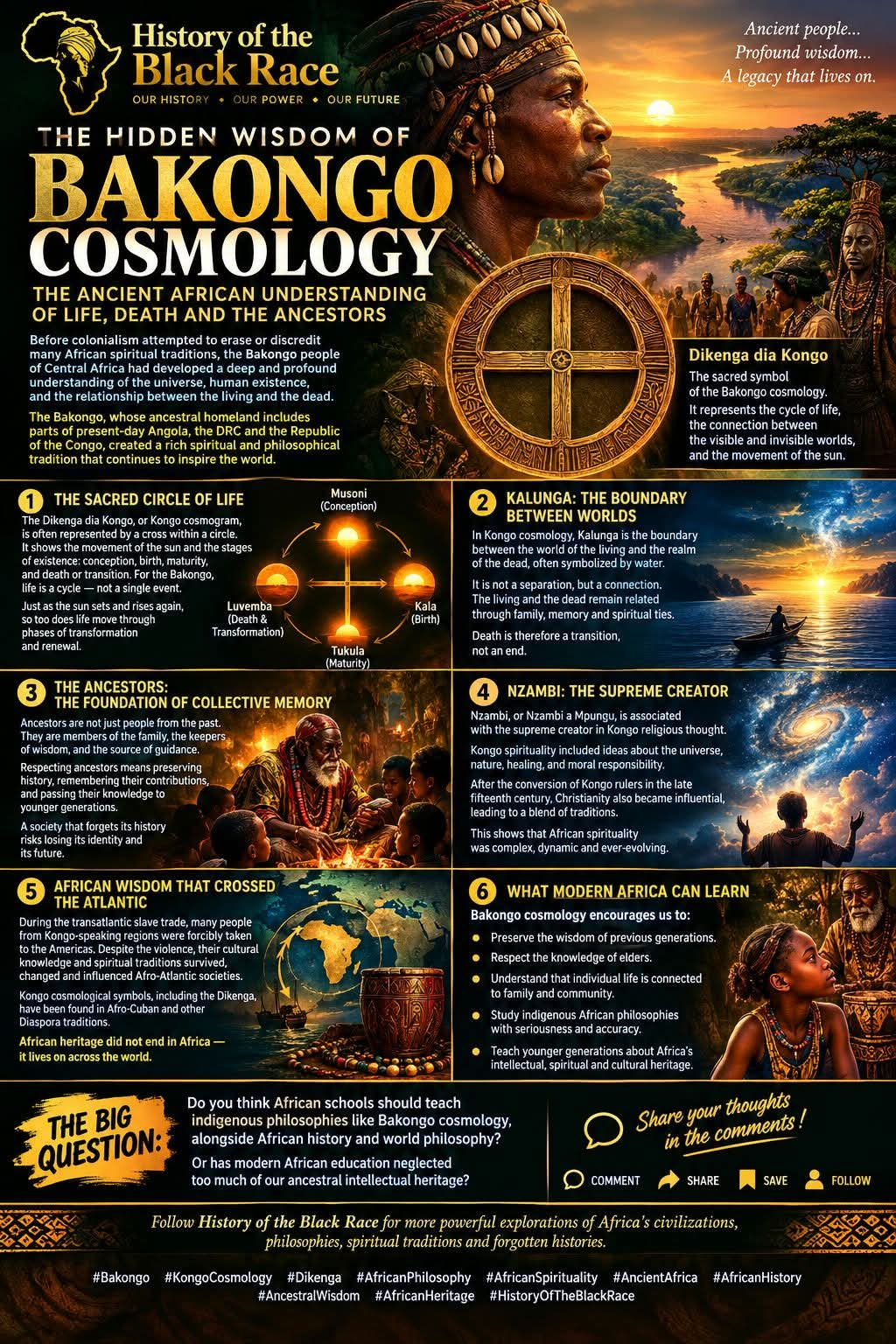
THE HIDDEN WISDOM OF BAKONGO COSMOLOGY: THE ANCIENT AFRICAN UNDERSTANDING OF LIFE, DEATH, AND THE ANCESTORS
Before colonialism attempted to erase or discredit many African spiritual traditions, African civilizations had developed profound ways of understanding the universe, human existence, and the relationship between the living and the dead.
One powerful example is the cosmology of the Bakongo people of Central Africa.
The Bakongo, whose ancestral homeland includes parts of present-day Angola, the Democratic Republic of the Congo, and the Republic of the Congo, developed a rich spiritual and philosophical tradition that explored the meaning of life, the power of ancestry, and the connection between the visible and invisible worlds.
🌍 THE SACRED CIRCLE OF LIFE
One of the most recognized symbols associated with Bakongo cosmology is the Dikenga dia Kongo, commonly known as the Kongo cosmogram.
Often represented by a cross within a circle, it illustrates the movement of the sun and offers a way to understand the different stages of existence.
These stages are commonly interpreted as conception, birth, maturity, and death or transition.
For the Bakongo, as understood through this cosmological tradition, human existence is not isolated from the wider universe. Life follows patterns of emergence, growth, transformation, and renewal.
The setting sun does not mean that the sun has ceased to exist. It disappears from view before rising again. This natural cycle provides a powerful image for contemplating the mysteries of human existence.
🌊 KALUNGA: THE BOUNDARY BETWEEN WORLDS
In influential interpretations of Kongo cosmology, Kalunga is associated with the boundary separating the world of the living from the realm of the dead, often symbolized by water.
This boundary represents a distinction between two realms, but it does not necessarily mean that the living and the dead are understood as entirely unrelated.
The spiritual significance of this idea lies in the relationship between physical existence, ancestral memory, and the continuation of family identity beyond an individual’s lifetime.
Death is therefore approached not merely as a biological event, but as a profound transition within a wider spiritual worldview.
👑 THE ANCESTORS: THE FOUNDATION OF COLLECTIVE MEMORY
In many Bakongo traditions, ancestors hold an important place in the spiritual and social life of the community.
They represent family history, inherited wisdom, and the legacy of those who came before.
Respecting ancestors also means preserving their knowledge, remembering their contributions, and passing important cultural teachings to younger generations.
This gives us a lesson that remains relevant today: a society that forgets its history risks losing valuable knowledge about its identity, struggles, achievements, and possibilities for the future.
Our ancestors may no longer walk beside us physically, but their inventions, sacrifices, ideas, and teachings can continue to shape our lives.
☀️ NZAMBI AND THE CREATIVE POWER OF THE UNIVERSE
Nzambi, also known in the expression Nzambi a Mpungu, is associated with the supreme creator in Kongo religious thought.
This tradition reflects African efforts to understand the origin of existence, the ordering of the universe, and humanity’s place within it.
Kongo religious thought also included understandings of spiritual power, healing, nature, and moral responsibility. These beliefs developed over time and interacted with Christianity following the conversion of Kongo rulers in the late fifteenth century.
This history reminds us that African spiritual traditions were complex, dynamic systems of thought rather than a single set of beliefs shared identically by every community.
🔥 AFRICAN WISDOM THAT CROSSED THE ATLANTIC
The history of Bakongo cosmology did not end in Central Africa.
During the transatlantic slave trade, many people from Kongo-speaking regions were forcibly transported to the Americas. Despite the violence of enslavement, aspects of their cultural knowledge and spiritual traditions survived, changed, and influenced Afro-Atlantic societies.
Kongo cosmological symbolism, including the Dikenga, has become an important subject in research on African cultural continuity in the Americas.
This is one reason African history must be studied beyond the boundaries of modern African nations. The intellectual and spiritual heritage of African peoples also forms part of the history of the wider world.
🌍 WHAT MODERN AFRICA CAN LEARN
Bakongo cosmology encourages us to reflect on several important principles:
- Preserve the wisdom of previous generations.
- Respect the knowledge and experiences of elders.
- Understand that individual life is connected to family and community.
- Study indigenous African philosophies with seriousness and historical accuracy.
- Teach younger generations about Africa’s intellectual, spiritual, and cultural heritage.
African history is not only the history of kingdoms, wars, and political leaders. It is also the history of how African people understood existence, developed philosophies, interpreted nature, and sought answers to life’s deepest questions.
The Bakongo tradition is one important part of that wider heritage.
THE BIG QUESTION FOR OUR COMMUNITY:
Do you believe African schools should teach indigenous philosophies such as Bakongo cosmology, alongside African political history and world philosophy?
Or do you think modern African education has neglected too much of our ancestral intellectual heritage?
Let’s discuss this respectfully in the comments. Your perspective matters.

